Community Member Urges Loudoun Board to Block Power Lines Near Schools
Updated
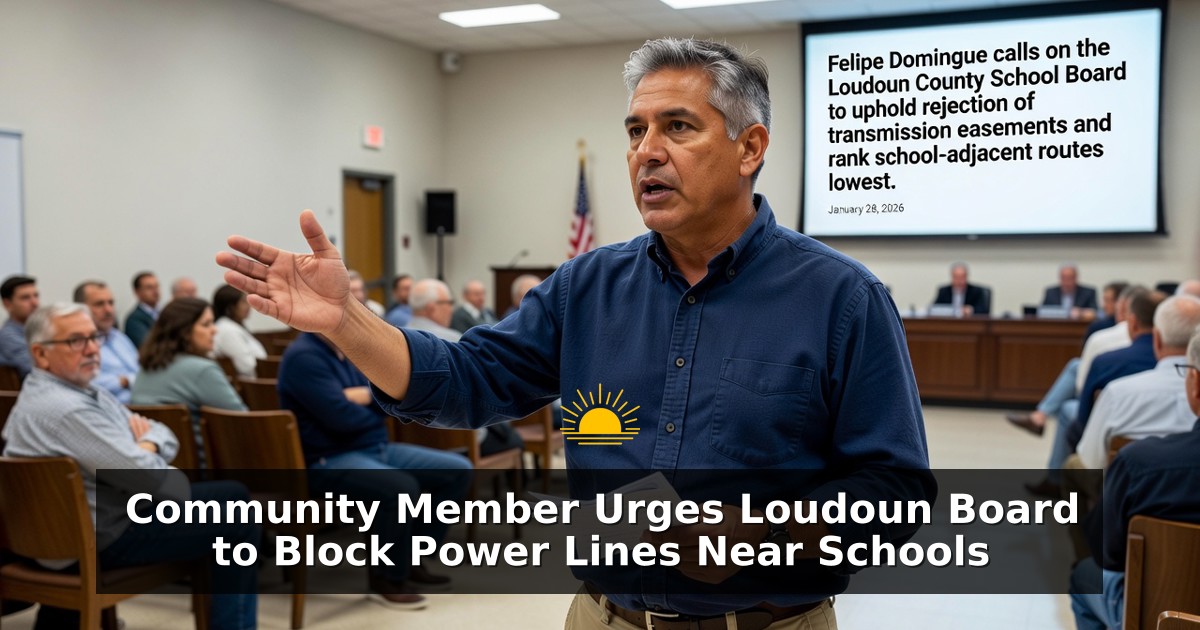
A community member spoke before the Loudoun County School Board on January 28, 2026, advocating for the rejection of overhead transmission line proposals that could affect local schools. Felipe Domingue delivered remarks during the board's second Tuesday meeting, which officials had rescheduled from January 27. He requested that the board uphold its prior decision to deny all easements for overhead lines crossing school board property. Domingue noted his family's direct connection to the issue through his wife's employment at an affected school. He also indicated that he spoke for other community members and businesses that would experience comparable impacts from the lines.
Domingue directed attention to the Golden to Mars case as the context for his comments. He encouraged the school board to utilize its forthcoming closing brief to express clear opposition to any route positioned adjacent to school property. Safety considerations for both staff and students formed a central theme in his address to the members. The speaker outlined how certain pathways might influence the educational setting along with walking zones and overall student wellbeing. These points underscored his broader appeal for careful evaluation of infrastructure placements near learning environments.
Specific Route Recommendations Presented
Routes 3A and the staff alternative route received particular scrutiny in the testimony. Domingue recommended that these be ranked near the bottom of the board's list due to their similar potential effects on schools. He acknowledged that the board could not reject the routes completely on its own authority. Nevertheless, he suggested the body could communicate effectively to the SEC that routes on or near school property remain unacceptable. This messaging strategy aimed to guide external decision-makers toward more suitable options.
In contrast, Domingue identified the newly proposed Route 1F as the optimal choice among available alignments. He described this route as providing the strongest balance of community needs in the ongoing process. Support for Route 1F aligned with efforts to minimize disruptions while addressing necessary energy transmission requirements. The proposal of this alternative reflected evolving options within the case under review. Board consideration of such preferences could shape the content of official submissions.
Loudoun County Context for Energy Infrastructure
Loudoun County continues to manage substantial growth that drives increased demand for electrical capacity. Data centers and residential expansion contribute to the need for upgraded transmission infrastructure across northern Virginia. Projects like the one referenced in the Golden to Mars case undergo detailed review to determine final paths. Public bodies including school boards offer perspectives on how routes interact with existing community assets. Input during meetings helps document local priorities for inclusion in regulatory filings.
The Loudoun County School Board oversees policies and facilities for a large student population in one of Virginia's fastest-developing localities. Members evaluate a range of issues that extend to external factors capable of affecting school grounds or operations. The current board is structured with representatives from the Algonkian, Ashburn, Blue Ridge, Broad Run, Catoctin, Dulles, Leesburg, and Sterling districts plus an at-large member who together deliberate on such matters. Domingue's appearance fits within the tradition of open comment periods that solicit resident views. His dual role as a family representative and community advocate illustrated the layered interests at stake.
Regulatory Framework and Public Input
Utility transmission projects in the commonwealth fall under the jurisdiction of state regulators who assess multiple criteria. These include cost, environmental effects, and community impacts during the approval sequence. School board positions, when formally submitted, become part of the materials examined in such cases. Domingue pressed for the closing brief to articulate firm resistance to proximity routes. He framed the original rejection of crossing easements as a decision worthy of continued support.
Concerns about high-voltage lines near educational institutions often involve discussions of physical space and operational continuity. Walking zones, which facilitate safe student access, featured in the list of potentially affected elements. Educational settings encompass classrooms, outdoor areas, and related activities that define the school experience. Student wellbeing covers a spectrum of factors that communities seek to safeguard amid surrounding development. The testimony connected these elements directly to the ranking of proposed paths.
Advocacy for Alternative Alignments
By elevating Route 1F, the speaker pointed toward a solution intended to reconcile competing demands. Energy reliability supports economic activity and residential quality of life throughout the region. At the same time, preserving the integrity of school properties ranks high among local values. Domingue's closing request asked board members to weigh staff and student safety prominently. His polite address to the honorable members set a respectful tone for the substantive points that followed.
Further examination of route options typically involves comparisons of length, terrain, and existing land uses. Alternatives that avoid concentrated populations or sensitive sites frequently receive favorable notice in public forums. The staff alternative and Route 3A, per the comments, shared drawbacks related to school adjacency. Placing them lower in preference order would signal priorities without overstepping jurisdictional bounds. Such nuanced engagement characterizes effective participation in multi-agency processes.
Implications for Local Stakeholders
Businesses operating near potential line corridors share in the impacts described by Domingue. Property considerations, visual changes, and access issues can arise from new easements or overhead structures. Community members living in the vicinity monitor these proposals for effects on daily life and long-term planning. The school board's role, while centered on education, intersects with these wider concerns when properties overlap or adjoin. Collective representation strengthens the articulation of shared positions.
As proceedings advance, the submission of briefs marks a key procedural stage for parties involved. The Loudoun County School Board's contribution holds potential to highlight educational perspectives within the larger debate. Domingue expressed hope that reinforced opposition would advance protections for the involved schools. His remarks concluded with an appeal for support of the preferred new route. The full meeting agenda encompassed this public comment alongside other board business.
Sustained community dialogue contributes to informed outcomes on infrastructure siting. Virginia's framework encourages participation from affected localities and individuals. In Loudoun County, the pace of change amplifies the relevance of each major project review. Testimonies like the one delivered on January 28 add specific, grounded insights to the record. Officials balance these against technical and statutory requirements in reaching determinations.
community community impact Education Felipe Domingue I'm Lines Loudoun County Member Near Parent parent testimony Power power lines Rejection Route 1F School Board school safety Schools student well-being Urges
