Parent Urges Loudoun School Board to Back Route 1F on Transmission Lines
Updated
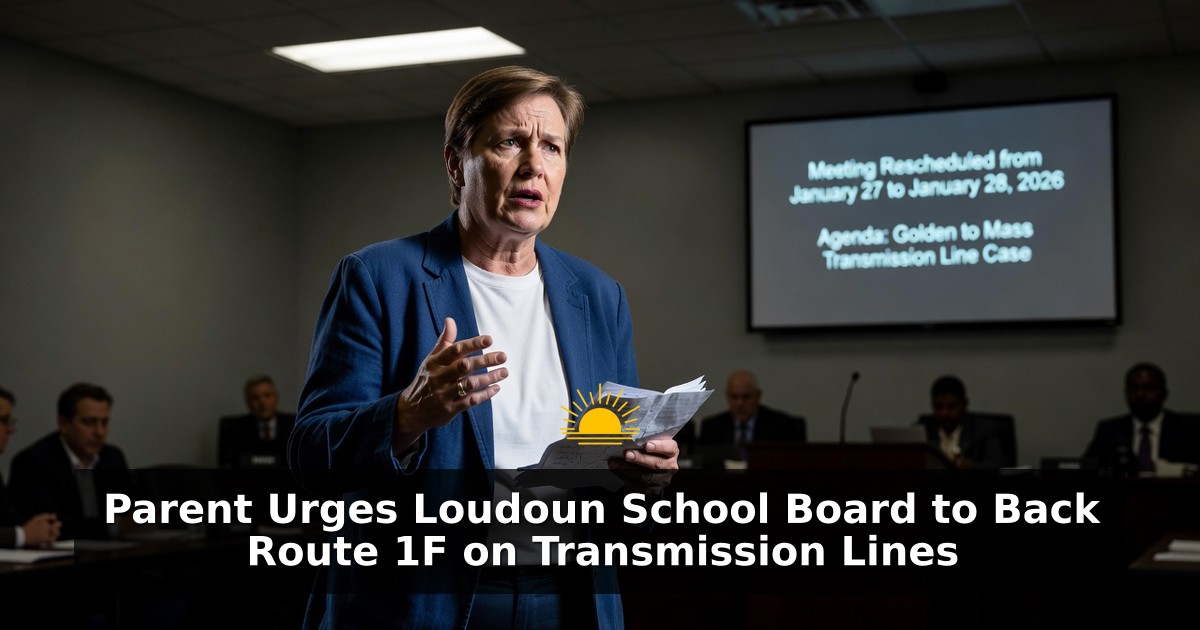
A parent addressed the Loudoun County School Board during its meeting on January 28, 2026, which had been rescheduled from January 27, to discuss the Golden to Mass transmission line case. The speaker, identifying as a parent of children who will progress through the county school system, asked the board to uphold its earlier decision rejecting all overhead transmission line easements on school board property. Specific routes named for continued rejection included routes 2, 3, 3B, and 4. The comments centered on protecting school sites and nearby areas from potential infrastructure impacts while seeking a balanced alternative.
Loudoun County School Board members currently serving are Melinda Mansfield, April Chandler, Deana Griffiths, Julie Chakroff, Tiffany Polifko, Kari LaBell, Lauren Shernoff, Erika Ogedegbe, Sumera Rashid, and Arben Istrefi. These representatives oversee policy, facilities, and community concerns for Loudoun County Public Schools, one of Virginia’s largest divisions. Public comment periods regularly allow residents to raise issues tied to land use and student environments. The January meeting provided one such opportunity for input on utility corridor proposals.
Transmission Project Background and Regulatory Context
Virginia’s State Corporation Commission reviews major electric transmission projects through formal proceedings that include evidentiary hearings. Utilities present multiple route options, and local governments, landowners, and school systems may offer positions or evidence. Hearings often occur in Richmond, where land-use strategies and county stances receive detailed examination. In this case, testimony referenced before the commission indicated the county would not oppose route 3 or its variations, raising questions about consistency with prior school board positions on property crossings.
Overhead transmission lines require easements that can limit future building, alter campus layouts, and affect surrounding open space. School board property serves educational programming, recreation, and potential expansion needs in a high-growth region. Loudoun County has experienced sustained population increases that place pressure on both power infrastructure and school capacity. Route decisions therefore carry long-term consequences for how schools function alongside necessary utility upgrades.
Parent Emphasis on Route 1F Advantages
The parent respectfully urged the board to support the newly proposed Route 1F. According to the statement, this option better balances community, educational, and environmental needs compared with the other paths under consideration. The speaker expressed deep concern over any approach that would place lines across school sites or diminish adjacent space used by students and families. Maintaining the original rejection of routes 2, 3, 3B, and 4 formed the core request alongside endorsement of the alternative.
Route 1F emerged in the proceedings as an option intended to reduce direct conflicts with school board holdings. Proponents of careful siting often cite the value of preserving campus integrity, minimizing visual and operational disruption, and limiting effects on local ecosystems. Environmental considerations can include habitat continuity, stormwater patterns, and tree cover that buffer school grounds. Educational needs encompass safe outdoor areas, future classroom or athletic additions, and uninterrupted daily operations during construction phases.
Broader Implications for Schools and Neighborhoods
Transmission corridor choices influence more than immediate property lines. Nearby residential neighborhoods may experience changes in viewsheds, property considerations, and construction traffic patterns. Schools function as community anchors, so easement decisions can shape how families perceive safety and long-term planning around those campuses. The parent’s remarks underscored that children currently entering the system will live with the outcomes of today’s route selections for many years.
County land-use strategies discussed at the Richmond hearing added another layer of complexity. Such strategies guide development density, open-space preservation, and infrastructure coordination across agencies. When school property falls within potential corridors, alignment between school board resolutions and broader county positions becomes especially relevant. The speaker noted the importance of clear, consistent advocacy to protect educational assets while still addressing regional power reliability requirements.
Public participation remains a standard feature of both school board meetings and State Corporation Commission cases. Residents frequently highlight localized knowledge about traffic, environmental features, and school usage that technical filings may not fully capture. In Loudoun County, rapid development has made these intersections between utilities and public facilities more common. The January 28 comments added a parental perspective focused on matriculation pathways and the daily environments students will encounter.
Ongoing Considerations for Local Decision-Makers
School boards do not site transmission lines, yet they hold authority over their own property and can formally convey positions to the commission and county officials. Upholding a prior rejection of certain easements signals continued priority on keeping overhead infrastructure off school grounds. Supporting an alternative such as Route 1F offers a constructive path that acknowledges the need for upgraded electric capacity. The balance sought involves reliable energy delivery without compromising the spaces where teaching and learning occur.
Community members following the Golden to Mass case continue to weigh how each route interacts with existing schools, planned facilities, and environmental resources. The parent’s request centered on leadership and careful consideration of these intersecting priorities. As the regulatory process advances, documentation of school board views can inform the broader record. Outcomes will ultimately affect not only current campuses but also the neighborhoods and families connected to them across Loudoun County.
Further public meetings and commission milestones will provide additional chances for input. Stakeholders on all sides monitor how educational, environmental, and community factors receive weight in final routing determinations. The statement delivered on January 28 framed Route 1F as the option most compatible with protecting school board property while meeting wider needs. Officials and residents alike retain roles in ensuring that infrastructure growth proceeds with full awareness of its effects on Virginia’s students and schools.
board community County Education environment land use strategy Loudoun County meeting Parent parent testimony Richmond hearing Route Route 1F Route 3 School School Board school property Support urge Urges
