Virginia FOIA Covers Personal Emails on Public Business
Updated
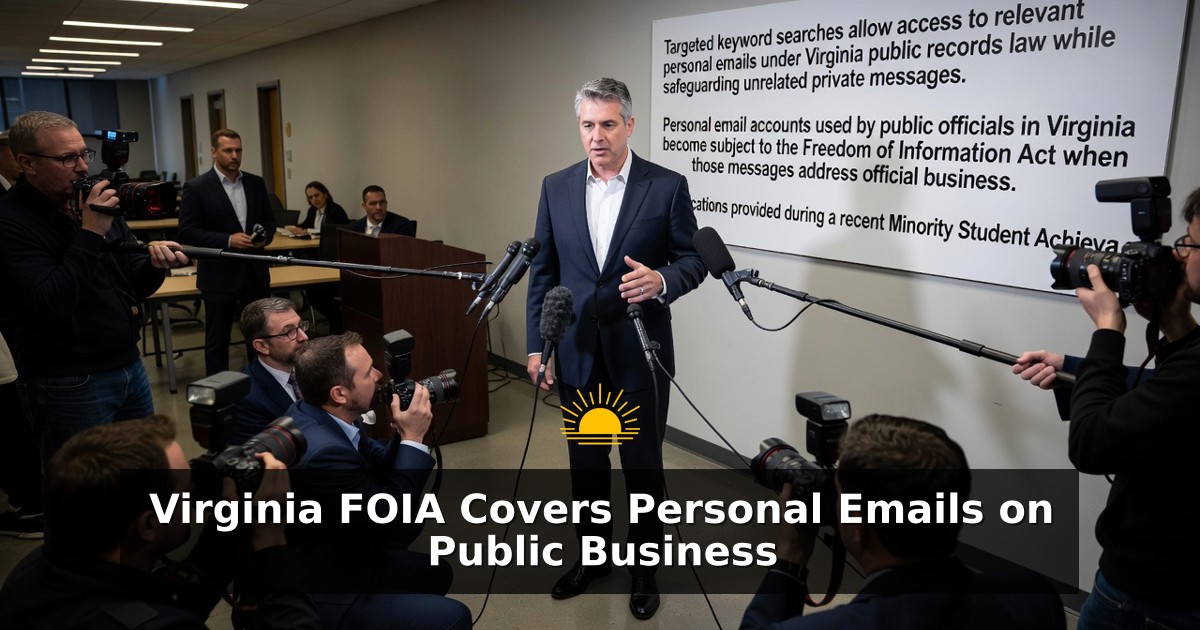
Personal email accounts used by public officials in Virginia become subject to the Freedom of Information Act when those messages address official business. Clarifications provided during a recent Minority Student Achievement Advisory Committee meeting underscored that any discussion of public matters on private platforms creates accessible records. Officials explained that two delegates exchanging views on policy through personal accounts would generate documents open to formal requests. This principle ensures accountability without requiring wholesale examination of private inboxes. The approach reflects longstanding interpretations of state transparency statutes that prioritize the content of communications over the medium employed.
Virginia’s Freedom of Information Act defines public records broadly to include any writing or recording prepared or owned by a public body or its officers in the transaction of public business. Courts and attorneys general have consistently held that the physical location of a message does not determine its status. When an official conducts government work from a personal address, the resulting correspondence meets the statutory definition. Requesters therefore possess a legal right to obtain those materials once a proper application is filed. Agencies must respond within established timelines while applying only the exemptions expressly listed in the code.
Targeted Search Procedures Protect Privacy
Agencies do not conduct unrestricted reviews of entire personal email accounts. Instead, custodians request that officials produce messages containing specific keywords tied to the subject of the inquiry. Examples cited include committee acronyms, policy numbers, or distinctive phrases associated with the matter under discussion. This method isolates relevant records and leaves purely private correspondence untouched. Officials emphasized that the process avoids any general invasion of personal privacy while still fulfilling transparency obligations.
The same targeted technique applies whether the account belongs to a school administrator, an elected delegate, or an advisory committee member. Search terms are crafted narrowly so that only messages bearing a clear nexus to public business are captured. Once identified, those emails undergo standard review for possible redactions under existing exemptions such as personnel information or attorney-client privilege. The remainder is released to the requester in accordance with statutory deadlines. This disciplined workflow has become standard practice across many Virginia localities.
Practical Implications for School Officials and Constituents
School principals and other administrators sometimes reply to parent emails with brief, formal language or shift the conversation to a telephone call. Awareness that written exchanges on public matters may later surface through records requests contributes to that caution. Officials seek to ensure that every retained message accurately reflects institutional positions and contains no extraneous personal detail. Telephone discussions, by contrast, ordinarily generate no automatically preserved record unless notes are later created. Understanding these dynamics helps citizens interpret the tone and format of responses they receive.
Advisory committees such as the Minority Student Achievement Advisory Committee routinely handle sensitive educational topics that generate substantial email traffic. Members who elect to use personal accounts for convenience must therefore remain prepared to search those accounts when a valid request arrives. Training materials increasingly stress the value of routing official correspondence through government-provided addresses whenever possible. Doing so simplifies retrieval, reduces privacy concerns, and demonstrates good-faith compliance with open-government norms. Nevertheless, the law continues to reach personal accounts whenever public business is conducted there.
Broader Legal Context Across the Commonwealth
Virginia Code provisions make clear that the definition of a public record turns on the nature of the business discussed rather than the ownership of the device or account. Multiple opinions issued by the Office of the Attorney General have reinforced this content-based standard over successive administrations. Local government attorneys regularly advise boards and committees that deleting relevant personal emails after a request is received can constitute a violation. Retention schedules still apply, and spoliation risks remain real. Consequently, many jurisdictions now include explicit guidance on personal-device use within their FOIA compliance manuals.
Citizens submitting requests are encouraged to supply precise search terms that mirror the language likely to appear in official discussions. Vague or overly broad demands may be narrowed by the custodian to manageable proportions, yet the underlying right of access remains intact. Fees for extensive searches are permitted under the statute, provided they reflect actual costs and are communicated in advance. These procedural safeguards balance the public’s right to know against the administrative burden placed on agencies and individual officials. Ongoing education efforts aim to keep both requesters and custodians informed of evolving best practices.
Looking ahead, Virginia continues to refine its approach to digital records in an era of ubiquitous personal devices. Legislative reviews periodically examine whether additional clarity is needed regarding ephemeral messaging applications or cloud-based platforms. For the present, the established rule remains straightforward: content that constitutes public business is subject to disclosure regardless of the email address employed. Targeted keyword searches supply the practical mechanism that reconciles transparency with legitimate privacy expectations. Officials and residents alike benefit from clear understanding of these boundaries as they engage in the daily work of self-government.
The principles articulated in the advisory committee setting apply with equal force to every public body operating under Virginia law. Consistent application fosters public confidence that government business conducted anywhere remains visible to those it serves. At the same time, the refusal to conduct indiscriminate sweeps of private accounts preserves a necessary zone of personal autonomy. This equilibrium stands as a core feature of the commonwealth’s commitment to open yet respectful administration. Continued dialogue among officials, attorneys, and citizens will help maintain that balance as communication technologies evolve.
accessed accountability committee communication disclosure emails FOIA government Know legal advice meeting MSAAC Need Personal personal emails privacy public business regulations transparency Virginia
