Virginia FOIA Council Clarifies Agenda Change Rules for Public Meetings
Updated
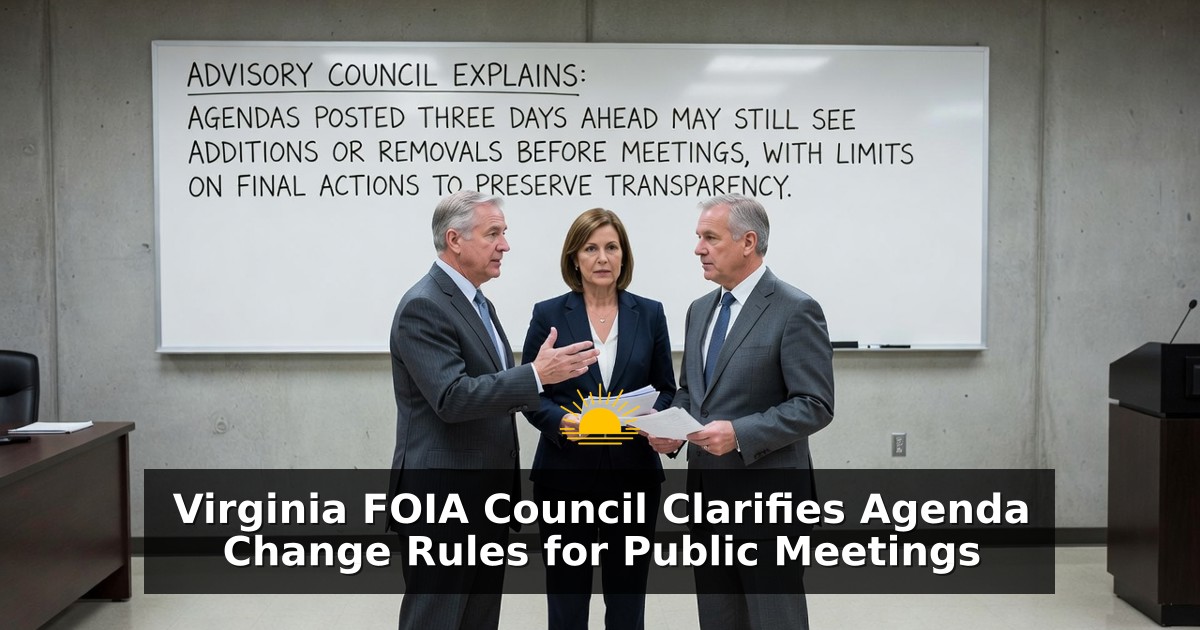
Virginia's Freedom of Information Advisory Council has issued an important clarification on how public bodies may handle changes to meeting agendas under the state's Freedom of Information Act. The guidance confirms that while agendas must be made available at least three days before a meeting, items can still be added or removed prior to the start of proceedings. Final action on newly added matters remains restricted except in specific circumstances such as time-sensitive issues or topics appropriate for closed sessions. This interpretation aims to support both open government principles and the practical needs of public agencies across the Commonwealth.
The clarification addresses questions that arose after recent legislative updates took effect earlier this year. Officials noted that the core three-day advance posting requirement continues unchanged to give citizens adequate notice of planned discussions. At the same time, the rules recognize that unexpected developments can require adjustments so that government operations do not grind to a halt. Public bodies retain the ability to revise agendas before meetings convene, provided they observe limits on when binding decisions may be reached. The council emphasized that these boundaries help maintain accountability without creating unnecessary procedural barriers.
Understanding the Three-Day Posting Requirement
Under Virginia's Freedom of Information Act, public bodies are obligated to post meeting agendas a minimum of three working days in advance. This longstanding provision exists so that residents, journalists, and interested parties can review topics scheduled for consideration and prepare to attend or comment. The advance notice supports informed public participation and reduces the chance of surprise decisions on significant matters. Agencies typically publish agendas on their websites and make physical copies available at official offices. Failure to meet the three-day standard can raise compliance concerns and undermine trust in governmental processes.
The recent discussion before the Freedom of Information Advisory Council reaffirmed that this posting timeline remains a firm expectation. Council members explained that the requirement applies broadly to local governing bodies, school boards, state agencies, and other entities covered by the statute. By keeping the three-day rule intact, the clarification preserves a predictable framework that Virginians have come to rely upon. It also aligns with the overall purpose of the Freedom of Information Act, which is to ensure that the business of government is conducted in the open whenever possible. Observers note that consistent application of notice rules strengthens democratic oversight throughout the state.
Flexibility for Agenda Adjustments Before Meetings
Despite the advance posting mandate, the council made clear that agendas are not locked in stone once published. Public bodies may add or remove items in the period leading up to the meeting itself. This flexibility acknowledges the dynamic nature of public administration, where emergencies, new information, or shifting priorities can emerge quickly. For example, a sudden infrastructure issue or a time-critical personnel matter might necessitate an agenda update. The guidance stresses that such changes should still be handled transparently so that attendees are not left completely uninformed when they arrive.
Council representatives pointed out that the ability to revise agendas supports efficient government without automatically violating open-meeting principles. They distinguished between merely discussing an added topic and taking final action on it. Discussion alone may be permissible in many cases, while decisive votes or formal approvals face tighter constraints. This distinction allows boards and commissions to respond to unfolding events while still protecting the public's right to meaningful notice. The approach reflects an effort to avoid overly rigid procedures that could hinder timely responses to community needs.
Limits on Final Action for Newly Added Items
A central element of the clarification concerns when final action may be taken on agenda items that were not included in the original three-day posting. According to the council, final action generally requires that the matter appeared on the advance agenda. Exceptions exist for genuinely time-sensitive subjects that cannot reasonably wait until a subsequent meeting and for topics that qualify for closed-session consideration under existing FOIA exemptions. These narrow carve-outs prevent the rules from becoming impractical while still discouraging last-minute decision-making on major policy questions.
The emphasis on prior listing for final votes helps ensure that citizens have a fair opportunity to learn about and respond to proposals that could affect them. Without such limits, the three-day notice requirement could be rendered meaningless through repeated last-minute additions. The council's explanation therefore seeks to close potential loopholes while leaving room for legitimate operational adjustments. Public bodies are encouraged to document the reasons for any late changes, particularly when invoking the time-sensitive or closed-meeting exceptions. Clear records of this kind further reinforce accountability and facilitate later review if questions arise.
Balancing Public Access With Governmental Efficiency
The discussion underscores a continuing tension familiar to open-government advocates and public administrators alike. On one side stands the public's interest in knowing what officials plan to decide so that participation and oversight remain possible. On the other side lies the reality that government must sometimes act swiftly when circumstances demand it. Virginia's FOIA framework has long attempted to strike a workable balance between these competing values. The latest clarification continues that tradition by preserving notice requirements while expressly authorizing limited pre-meeting flexibility.
Supporters of strong transparency rules often argue that any erosion of advance-notice standards risks reducing public confidence. They contend that citizens deserve reliable information about the issues their representatives will address. Conversely, local government managers and elected officials frequently highlight the difficulty of operating under absolute rigidity when unexpected issues surface. The council's guidance attempts to honor both perspectives by keeping the three-day rule as the default and defining narrow conditions under which deviations may occur. This measured approach may reduce confusion and litigation while still advancing the statute's core objectives.
Implications for Citizens and Public Bodies Across Virginia
For ordinary Virginians, the clarification means that checking an agenda three days before a meeting remains the best way to stay informed, yet they should also recognize that limited changes can still take place. Attending meetings or monitoring updates close to the start time can help residents catch any late additions. Civic organizations and news outlets may likewise adjust their monitoring practices to account for possible revisions. Overall, the rules continue to favor openness while acknowledging administrative realities that public servants confront daily.
Public bodies, meanwhile, receive clearer direction on how to manage agendas without inadvertently violating FOIA. Training for board members and staff can now incorporate the council's explanation so that practices remain consistent statewide. Agencies are likely to review their internal procedures for posting, amending, and documenting agendas in light of the guidance. When final action on a late-added item is contemplated, decision-makers will need to confirm that an exception properly applies. Such diligence protects both the legality of their actions and the public's trust in the process.
Looking ahead, the Freedom of Information Advisory Council's role in interpreting these provisions remains essential. As new questions surface about digital postings, remote participation, or emerging technologies, further guidance may be required. The present clarification on agenda changes illustrates how the council helps translate statutory language into practical advice. By addressing real-world uncertainties, the body contributes to more uniform compliance and a better-informed citizenry. The ongoing dialogue between transparency ideals and operational needs will continue to shape Virginia's open-government landscape for years to come.
In summary, the council has affirmed that the three-day agenda posting rule stands firm, that additions and removals before meetings are permissible, and that final action on new items is limited to defined exceptions. This framework seeks to keep Virginians informed about public business while allowing government to function effectively. The clarification provides welcome certainty for officials and residents alike as they navigate the requirements of the Freedom of Information Act. Continued attention to both the letter and the spirit of these rules will help sustain accountable governance throughout the Commonwealth.
agenda changes agenda posting civic participation FOIA general assembly government efficiency government transparency law interpretation meeting flexibility meeting protocol policy clarification proposed agenda public access public bodies public engagement Senator Bennett Parker subcommittee transparency Virginia Virginia's
