Loudoun Parent Backs Shared Chromebook Carts Over One-to-One Model
Updated
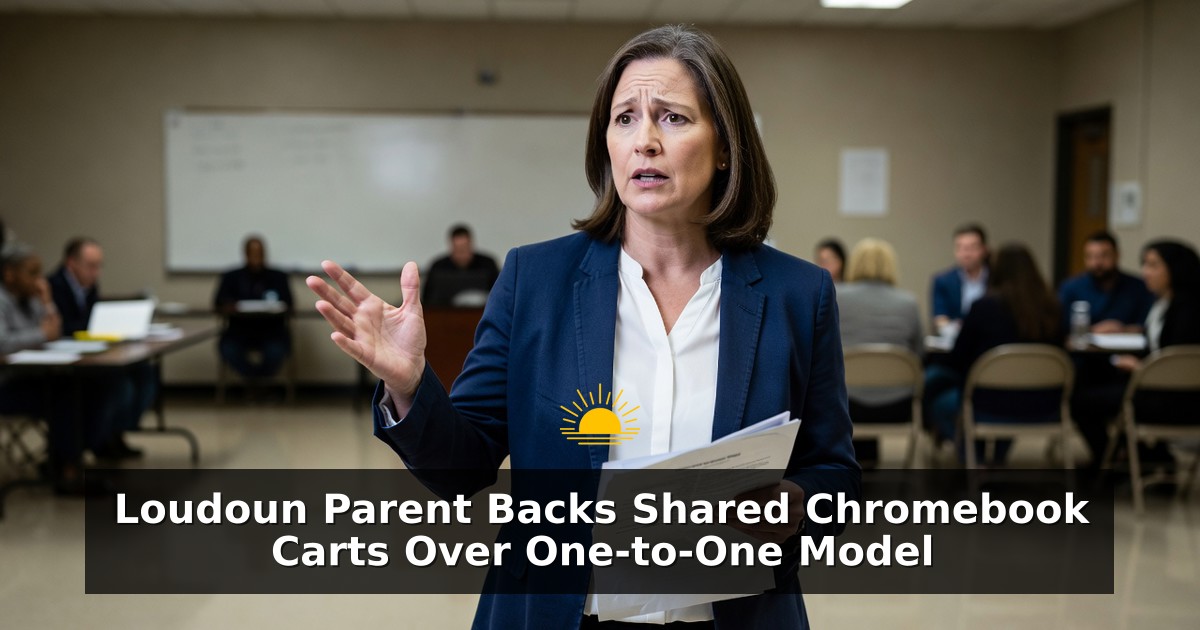
Loudoun County Public Schools continues to weigh technology spending as part of its annual budget process. At a recent budget work session and public hearing, parent Jacqueline Porter spoke in favor of moving from a one-to-one Chromebook program to a shared classroom cart system. Porter, whose child attends kindergarten at Ashburn Elementary School, backed a proposal linked to School Board member Lauren Shernoff. She described the current individual-device approach as fiscally unsustainable while pointing to research on reading comprehension, handwriting, and child development.
The Loudoun County School Board sets policy and approves budgets for the division that serves tens of thousands of students across the county. Current board members are Chairperson Melinda Berg, At-Large member Harris Mahedavi, Algonkian District representative April Chandler, Ashburn District representative Deana Griffiths, Blue Ridge District representative Kari LaBell, Broad Run District representative Joy Maloney, Catoctin District representative John Marshall, Dulles District representative Lauren Shernoff, Leesburg District representative Beth Barts, and Sterling District representative Brenda Sheridan. Board discussions regularly examine how technology investments affect both operating costs and classroom practice.
Porter told the board that the one-to-one model carries ongoing expenses well beyond the initial purchase price of the devices. High breakage rates among young students, especially five-year-olds in kindergarten, generate repeated replacement costs. Constant requests for information-technology troubleshooting further drain staff time and budget lines that could otherwise support physical classroom materials or specialized instruction. A cart-based inventory, she argued, would let the district maintain a smaller and more durable fleet of devices while still providing access when digital tools are needed.
Fiscal Pressures of One-to-One Device Programs
School divisions across Virginia and the nation adopted one-to-one device programs rapidly during and after the pandemic to support remote and hybrid learning. Chromebooks typically cost between two hundred and four hundred dollars each, depending on model and bulk purchasing agreements. When every student receives a device, a mid-sized elementary school can require several hundred units, and a full division inventory can reach tens of thousands of machines. Annual refresh cycles, protective cases, licensing, and insurance add further layers of expense that compound over a five-year replacement window.
Breakage and loss rates are especially pronounced in the early grades. Young children drop devices, spill liquids, or mishandle charging ports, leading to repair tickets that consume technician hours. Industry reports and district audits frequently cite elementary breakage rates that exceed those in middle and high schools by a wide margin. Information-technology departments must then divert personnel from network upgrades or instructional-software support to handle individual device repairs. Porter framed these patterns as an unsustainable draw on local tax dollars that produces diminishing returns for student outcomes.
Shared classroom carts reverse the ratio of devices to students. Instead of one machine per child, a cart of twenty to thirty durable units can serve an entire grade level on a scheduled or as-needed basis. Districts that have piloted cart models report lower per-pupil technology costs and fewer help-desk tickets. The savings can be redirected toward consumable classroom supplies, hands-on science kits, or additional reading specialists. Porter described the change as a shift from blanket technology distribution to more surgical use of digital tools.
Research on Reading and Writing Modalities
Porter also cited academic studies that compare digital and print learning environments. A body of research conducted at universities in Norway has found that students who read extended texts on paper consistently score higher on comprehension assessments than peers who read the same material on screens. Physical pages supply spatial landmarks that help readers form a mental map of the narrative or argument. Scrolling on a screen removes those anchors and can increase cognitive load, particularly for younger learners still developing fluency.
Additional work published in the journal Psychological Science examined how students encode new information. Researchers observed that the motor act of forming letters with pen and paper creates richer memory traces than typing on a keyboard. The slower pace of handwriting appears to give the brain more time to process meaning, leading to stronger retention on later tests. These findings have been replicated in multiple age groups and have prompted some education systems to reintroduce cursive or manuscript practice even as digital tools remain available.
Porter connected the research to everyday classroom realities. When every student sits behind an individual screen, opportunities for spontaneous discussion and collaborative problem-solving can shrink. Teachers must manage login issues, battery levels, and off-task browsing in addition to delivering content. A cart system, she said, keeps devices available for targeted research, assessment, or creation tasks while restoring time for face-to-face interaction and paper-based work.
Screen Time and Early Brain Development
The American Academy of Pediatrics has issued guidelines cautioning against excessive screen exposure in childhood. The organization notes that heavy device use can displace sleep, physical activity, and in-person social exchange. Porter referenced these recommendations when she described the psychological impact of a permanent one-to-one environment. She pointed to the Harvard Center on the Developing Child, which emphasizes “serve and return” interactions between children and caregivers as the building blocks of neural architecture. Those back-and-forth exchanges occur most readily when students and teachers share physical space without a screen mediating every moment.
In a cart-based classroom the default setting becomes human conversation, board work, and hands-on materials. Screens appear when they serve a clear instructional purpose and then return to the cart. Educators who have implemented similar models report that students regain practice in sustaining attention on paper tasks and in negotiating ideas verbally with peers. Porter presented the approach as both developmentally appropriate and aligned with responsible stewardship of public funds.
Budget Reallocation Possibilities
Any reduction in device inventory frees recurring dollars inside the technology and operations categories of the school budget. Those funds could purchase classroom libraries, manipulatives for mathematics, art supplies, or contracts for specialized reading and mathematics instructors. Some divisions have used comparable savings to lower class sizes in early grades or to expand career and technical education offerings. Porter urged the Loudoun County School Board to treat the proposed shift as an opportunity to maximize return on investment for student learning rather than simply cutting a line item.
Division leaders routinely examine multi-year cost projections when they refresh technology plans. Factors include warranty coverage, residual values of retired devices, and the price trajectory of newer models. Shared carts also simplify software licensing and content-filtering management because fewer unique endpoints require configuration. The cumulative effect can stabilize the technology budget against inflation and enrollment growth while preserving access to digital resources.
Public hearings on the budget give parents and residents a formal channel to influence these trade-offs. Porter’s remarks added a parent perspective that linked day-to-day classroom experience with larger fiscal and developmental questions. Board members will continue to receive staff analyses, cost estimates, and further community input before any final policy or budget vote. The discussion reflects a broader national conversation about how school systems balance the promise of educational technology with evidence on how children learn best and with the practical limits of local revenue.
Loudoun County’s size and rapid enrollment changes make efficient resource use especially consequential. Decisions made in the current budget cycle will shape classroom environments for years ahead. By examining both the financial ledger and the research on cognition and development, the board aims to align technology policy with measurable student needs. Porter’s testimony placed shared carts on the agenda as one concrete option for achieving that alignment.
board meeting Budget Cart Model Chromebooks Classroom Materials cost savings Education financial implications fiscal responsibility implications instruction Learning Methods Loudoun County Parents proposal School Board School System Students Sustainability Technology
