Delegate Griffin Opposes HB 1294 Over Prosecution and Discovery Concerns
Updated
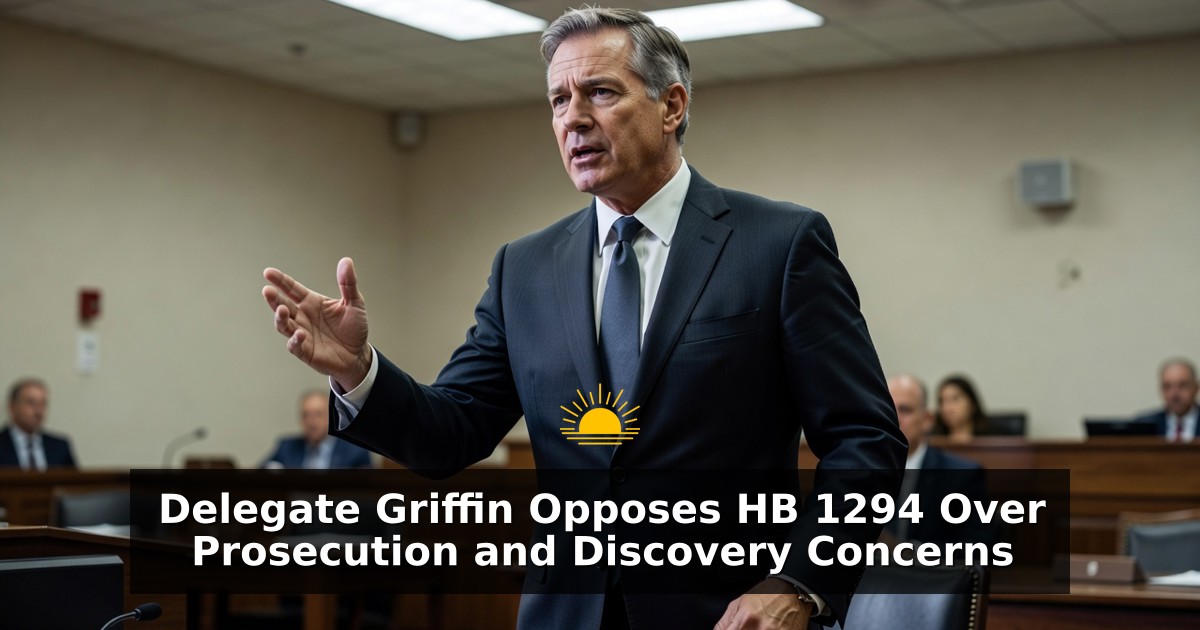
Delegate Griffin voiced clear opposition to House Bill 1294 during a recent Virginia General Assembly subcommittee discussion, emphasizing practical difficulties the proposal could create for criminal prosecutions across the commonwealth. Drawing directly from his ongoing work in the courtroom, Griffin stated that the legislation fails to address the central requirements of evidence disclosure under established Supreme Court standards. He described a pattern of measures that, in his view, increase obstacles for prosecutors seeking to enforce existing laws. The remarks centered on discovery obligations that already demand careful handling of materials showing guilt or innocence. Officials and observers following the session noted the comments as part of broader debates on balancing defendant rights with effective law enforcement tools in Virginia courts.
Griffin underscored his unique position as someone who regularly serves in both prosecutorial and defense roles, giving him repeated exposure to discovery disputes. He explained that he complies with discovery orders several days each week while working for the prosecution and then shifts to scrutinizing compliance when representing defendants. This dual perspective, he argued, reveals that the fundamental question remains whether evidence is inculpatory or exculpatory rather than the precise methods used to obtain it. Under long-standing Supreme Court precedent, prosecutors must turn over material that tends to prove guilt or that could exonerate the accused. Griffin maintained that existing frameworks already govern these disclosures without needing additional layers focused on acquisition details.
Dual Courtroom Experience Shapes Legislative View
The delegate highlighted how weekly involvement with discovery matters informs his assessment of proposed changes. When acting as a prosecutor, he follows court orders to share relevant information in a timely manner. On the defense side, he actively presses offices to meet those same obligations and challenges any shortfalls. This back-and-forth, according to his testimony, demonstrates that the system already prioritizes the character of the evidence itself. Griffin expressed concern that HB 1294 would introduce new complications around documenting how law enforcement gathered materials. Such requirements, he suggested, divert attention from the core legal duty to evaluate whether items help or hurt the defense case.
Legal practitioners in Virginia routinely navigate rules derived from landmark decisions that mandate disclosure of favorable evidence to the accused. These obligations exist to protect fair trial rights while allowing cases to proceed on reliable information. Griffin pointed out that he knows of few other routine mechanisms that compel detailed explanations of evidence collection methods beyond standard chain-of-custody and authenticity showings. Adding further procedural steps, in his estimation, would lengthen preparation timelines and create fresh grounds for pretrial litigation. The result could slow dockets already managing high volumes of criminal matters in circuit and general district courts throughout the state.
Emphasis on Inculpatory and Exculpatory Standards
Central to the opposition was the distinction between evidence that supports a finding of guilt and evidence that supports a finding of innocence. Griffin reiterated that Supreme Court law focuses on this binary rather than investigative techniques. Prosecutors must identify and provide exculpatory material to avoid violations that can lead to reversed convictions or disciplinary consequences. Inculpatory items form the backbone of the government’s case and are subject to separate disclosure timelines under Virginia practice. By shifting emphasis toward the origins of evidence, the bill risks generating disputes unrelated to relevance or reliability, he argued. This approach, Griffin contended, overlooks the practical realities faced by attorneys on both sides of the aisle every week.
Discovery disputes already consume significant courtroom time when parties disagree over the scope or timing of productions. Judges issue orders tailored to individual cases, and attorneys monitor compliance closely to protect their clients’ interests. Griffin’s description of jumping between roles illustrates how the same professional can experience the pressures of both production and demand. He maintained that the current system, while imperfect, correctly centers on the evidentiary value of materials. Introducing new hurdles without clarifying or streamlining the underlying discovery process would, in his words, simply make the prosecutor’s job harder. That outcome could reduce the efficiency of charging decisions and plea negotiations that resolve most criminal matters.
Concerns About Cumulative Legislative Trends
Griffin linked HB 1294 to what he described as a larger set of proposals that collectively raise barriers to successful prosecutions. He stated that such measures appear designed to complicate efforts to enforce the law and to secure convictions when evidence supports them. Putting criminals in jail becomes more difficult when procedural requirements multiply without corresponding improvements in evidence management, according to his assessment. Law enforcement agencies and commonwealth’s attorneys’ offices must already allocate resources to meet constitutional and statutory discovery mandates. Additional documentation demands could stretch those resources further, potentially affecting case preparation quality in jurisdictions with limited staffing.
Virginia’s criminal justice system relies on cooperation among police, prosecutors, defense counsel, and courts to move cases forward while safeguarding rights. Any legislation altering discovery practices therefore carries implications for trial schedules, witness availability, and public confidence in outcomes. Griffin’s opposition rests on the prediction that the bill would hinder rather than help these coordinated efforts. He concluded his remarks by affirming his stance against the measure for these practical reasons. The subcommittee heard the perspective as part of its review of communications-related and justice-system proposals during the session.
Implications for Court Operations and Case Management
If enacted, changes of the type Griffin outlined could alter how pretrial motions are litigated in Virginia courtrooms. Defense attorneys might file more frequent challenges seeking detailed acquisition histories, while prosecutors would need to prepare additional affidavits or testimony from investigators. Judges would then devote hearing time to resolving those secondary questions instead of focusing on admissibility or suppression issues grounded in constitutional standards. Over time, such shifts might contribute to longer average case durations from arrest to disposition. Court administrators already track metrics on backlog and continuance rates, and new procedural layers often register in those statistics.
Commonwealth’s attorneys in urban and rural localities alike manage caseloads that include violent felonies, property crimes, and traffic offenses requiring swift yet careful handling of evidence. Training staff on expanded disclosure protocols would demand time and funding that compete with other priorities such as victim services and diversion programs. Griffin’s experience on both sides of cases positions him to anticipate friction points that pure policy discussions might overlook. His testimony stressed that the key remains the substance of the evidence under Supreme Court guidance. Observers of the legislative process will continue monitoring how similar bills advance and whether amendments address the operational concerns raised.
The discussion around HB 1294 reflects ongoing tension between enhancing transparency in criminal proceedings and preserving workable tools for holding offenders accountable. Griffin’s comments add a practitioner’s voice to that conversation by grounding abstract rules in weekly courtroom realities. As the General Assembly considers the measure, the focus on inculpatory versus exculpatory material offers a clear benchmark drawn from controlling precedent. Lawmakers, attorneys, and the public will weigh whether the proposed hurdles serve justice or inadvertently impede it. Further committee actions and potential floor debates will determine the bill’s path and its ultimate effect on Virginia’s legal landscape.
Bills committee courtroom criminals defendant defense attorney disclosure discovery issues discovery orders enforcement evidence exculpatory floor guilty inculpatory Jail law Law Enforcement motion not guilty prosecution prosecutor supreme court voting
All Virginia News is published by ALL VIRGINIA NEWS, LLC. How we're funded · Corrections · Ethics
