Advocate Presses Virginia Disability Commission for Local Accessibility Guidelines
Updated
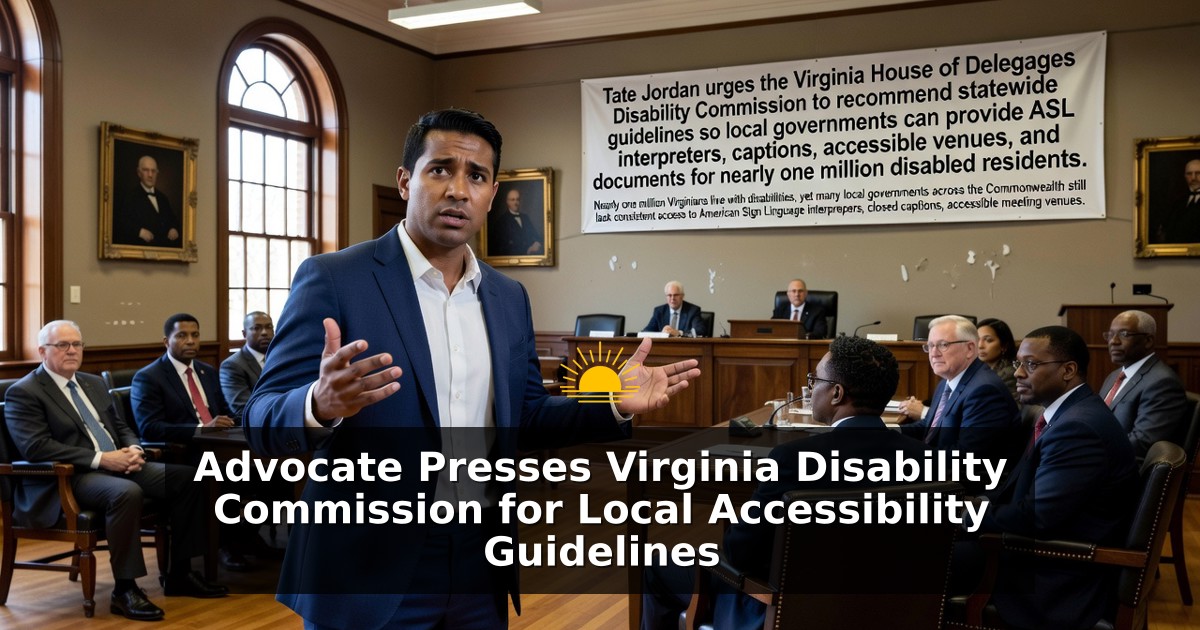
Nearly one million Virginians live with disabilities, yet many local governments across the Commonwealth still lack consistent access to American Sign Language interpreters, closed captions, accessible meeting venues, and documents that residents with disabilities can use. That gap was the focus of remarks delivered to the Virginia House of Delegates Disability Commission by Tate Jordan, executive director of Virginia for Civic Engagement. Jordan told the commission that the absence of these basic tools leaves a large share of the population unable to follow or participate fully in local government proceedings.
Jordan described the core mission of the organization as advocacy for greater civic accessibility in government throughout Virginia. The presentation emphasized that disability is not a marginal issue in the state. With a population of disabled residents approaching one million, the lack of interpreters, captions, and accessible materials at the local level creates practical barriers to information and public participation. Jordan noted that these shortcomings appear even though the affected population is substantial and the need for equal access is widely recognized.
Local officials have expressed willingness to improve services, according to the testimony. Jordan reported speaking with multiple local governments that said they support the idea of ASL interpretation and closed captioning. The recurring obstacle, Jordan explained, is that many jurisdictions simply do not know how to arrange those services or how to make venues and documents usable for people with mobility or sensory disabilities. That knowledge gap, rather than outright opposition, was presented as a primary reason standardized guidance is needed.
Jordan urged the Disability Commission to adopt policies or to expand its working documents with clear recommendations that local governments can follow. Suggested topics included practical steps for securing ASL interpreters, methods for confirming that meeting spaces accommodate people with mobility disabilities, and requirements that agendas, minutes, and other official communications be produced in accessible formats. The request framed these measures as tools that would help localities move from good intentions to consistent practice.
Barriers Facing Disabled Residents in Local Government
Public meetings, agendas, and minutes form the basic record of local decision-making. When those materials and the meetings themselves are not accessible, residents who are deaf, hard of hearing, or who have mobility or other disabilities can be excluded from the process. Jordan underscored that closed captions and ASL interpretation are still missing from many local proceedings. Accessible digital and print documents are likewise unevenly available, limiting the ability of disabled citizens to review what their governments are doing and to prepare comments or questions.
Venue accessibility remains another practical concern. Buildings and rooms used for public meetings must allow entry and participation by people who use wheelchairs or other mobility aids. Jordan asked the commission to include guidance that would help localities evaluate and improve physical access. Without such standards, even well-intentioned governments may continue to hold meetings in spaces that effectively shut out part of the community they serve.
The scale of the population involved makes the issue one of broad civic importance. Nearly a million residents means that accessibility shortfalls affect families, workers, and voters in communities of every size. Jordan argued that local government, as the level of government closest to daily life, has a particular responsibility to ensure that disability does not become a barrier to information or participation. The testimony linked that responsibility to the foundational idea that government exists by and for the people and therefore should remain open to all residents regardless of disability.
Calls for Practical Statewide Guidance
Rather than leaving each locality to invent its own approach, Jordan proposed that the Disability Commission supply shared guidelines. Those guidelines would explain how governments can locate and contract for ASL interpreters, how they can add reliable closed captioning to meetings and video records, and how they can produce agendas, minutes, and related documents in formats usable by people with disabilities. The request was framed as an addition to existing commission work rather than a wholesale replacement of current efforts.
Jordan pointed to the practice of providing ASL interpreters at high-profile federal press conferences during the Biden administration as an example of visible, routine accessibility. The suggestion was that similar visibility and consistency at the local level across Virginia would demonstrate that accessibility is a normal part of public business. Local governments that already express support for these services would gain a clearer path to implementation if the commission issued concrete recommendations.
The testimony closed by thanking the commission for its time and for its ongoing dedication to supporting people with disabilities. Jordan reiterated that standardized guidance would help translate that support into everyday operations at city halls, county offices, and other local bodies. The emphasis remained on practical steps that localities can take once they have reliable information about interpreters, captions, venue standards, and document accessibility.
Broader Context for Civic Inclusion in Virginia
Accessibility in government communications and meetings is closely tied to equal participation in civic life. When residents cannot follow proceedings or review official records, their ability to vote in an informed way, to comment on proposed actions, or to hold officials accountable is reduced. Jordan’s presentation treated these barriers as solvable through clearer statewide expectations and shared technical knowledge rather than through isolated local experiments.
Virginia’s Disability Commission sits in a position to influence how localities approach these questions. By adding guidelines on ASL services, captioning, physical access, and accessible documents to its working materials, the commission could give county and municipal governments a common reference point. Jordan’s remarks indicated that many local officials are already receptive; what they lack is a straightforward roadmap. Commission action on that front would address the knowledge gap directly.
The nearly one million disabled Virginians cited in the testimony represent a cross-section of the Commonwealth’s communities. Ensuring that government meetings and materials are usable by this population supports the principle that public institutions should remain open to every resident. Jordan’s request to the commission centered on turning that principle into routine practice through clear, usable recommendations that local governments can adopt and implement.
Observers of state disability policy note that consistent guidance often reduces duplication of effort and helps smaller localities that may lack specialized staff. Recommendations covering interpreter procurement, captioning technology, venue checklists, and document standards would give officials concrete starting points. Jordan’s appearance before the commission placed those practical needs on the record and linked them to the larger goal of inclusive civic engagement across Virginia.
The discussion highlighted that accessibility is not solely a matter of technology or budget line items. It also depends on clear expectations and shared methods that any locality can follow. By asking the Disability Commission to supply those methods, Jordan framed the next step as one of coordination and clarity. The outcome sought was straightforward: local governments equipped to provide ASL interpretation, closed captions, accessible meeting spaces, and usable documents so that disabled residents can take part in the public business that affects their lives.
accessibility accessible documents ASL interpreters Biden administration civic accessibility civic engagement closed captions Commonwealth of Virginia disability rights disabled residents equal participation government meetings guidelines inclusivity local governments local policies press conferences Tate Jordan Virginia Virginia for Civic Engagement
