40 Feet, 100 Feet, 300 Feet: Virginia's Distance Rules Around Polling Places
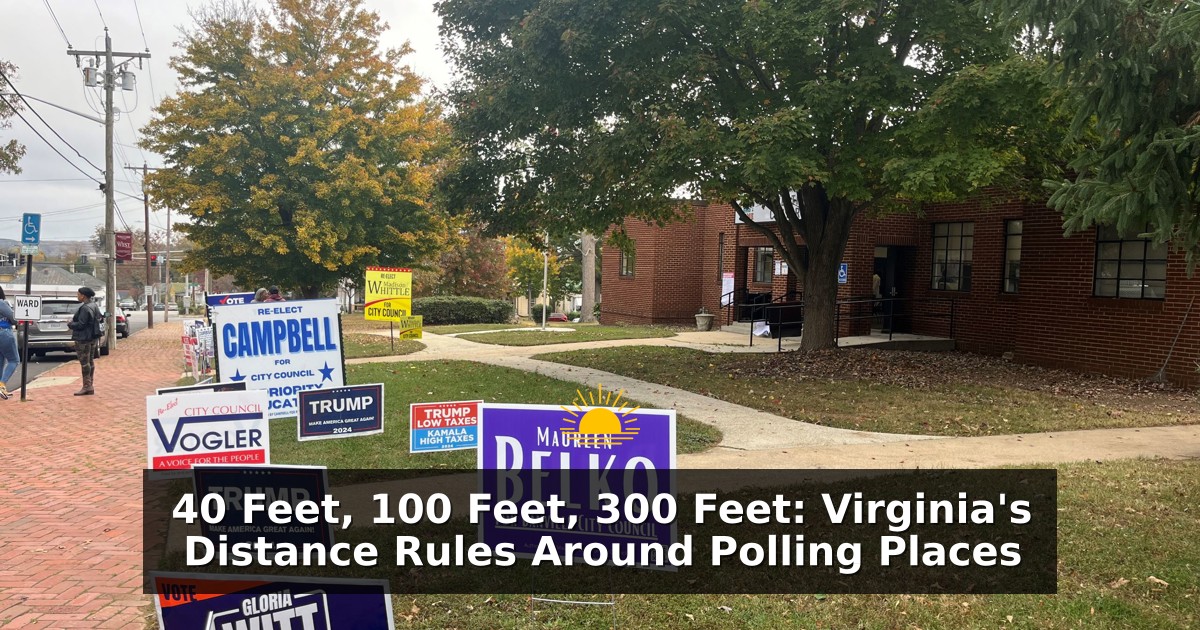
Virginia polling places come with an invisible set of boundaries. A joint bulletin from the Virginia Department of Elections (ELECT) and the Office of the Attorney General (OAG), dated Oct. 15, describes three of them, each tied to a different distance: 40 feet, 100 feet and 300 feet. Knowing them helps voters understand what they will and won't see on Nov. 3, and what is not allowed.
The bulletin is informational and is not legal advice, as it says itself. It was addressed to general registrars, local electoral boards, local government attorneys and circuit court clerks.
40 feet: no loitering or congregating
The shortest distance is the best known. According to the bulletin, it is unlawful to "loiter or congregate" within 40 feet of any entrance of a polling location. The bulletin cites Va. Code § 24.2-604(A) and also describes that law as barring anyone from loitering within 40 feet of the entrance.
The same provision makes it unlawful to "hinder or delay a qualified voter" entering or leaving a polling location. In other words, the 40-foot zone is meant to keep a clear path for voters.
The 40-foot line also plays a role in how local officials handle people who are not supposed to be inside. The bulletin says that when someone asks to enter without authorization, they must wait outside the 40-foot prohibited area while the general registrar and electoral board consider the request. It also says officers of election may, by majority vote, require an authorized observer who is breaking the rules to stay outside the 40-foot perimeter.
100 feet: firearms
The second distance concerns firearms. The bulletin states that it is unlawful to knowingly carry a firearm within 100 feet of a building used as a polling location, citing Va. Code § 24.2-604(F).
There are exceptions, according to a footnote in the bulletin. They cover law enforcement officers, qualified retired law enforcement officers, persons on their own private property within 100 feet, and properly licensed armed security officers.
Note the wording: the rule applies to the building used as a polling location, not only to its door. A voter who lives within 100 feet of a polling place is not stripped of the right to be on their own property, and the bulletin lists that as an exception for people on their own private property.
If an armed person tries to enter a polling location, the bulletin's advice for local officials is direct. Officials should call local law enforcement immediately.
300 feet: loudspeakers
The third distance is the longest. The bulletin says it is unlawful to use loudspeakers within 300 feet of a polling location, citing Va. Code § 24.2-605.
Loudspeakers are not the only noise-related offense mentioned. The bulletin also lists "noisy or riotous conduct in or around a polling location that disturbs an election" as unlawful, citing Va. Code § 24.2-607(B). That provision is not tied to a stated distance in the bulletin. It covers conduct in or around the polling location.
What the distances do not do
The distances are not the whole story. The bulletin makes a point of saying that Virginia's protections for voters against intimidation are not limited to the 40-foot boundary. They also cover voters engaged in curbside voting outside polling locations and those using ballot drop boxes. In other words, a person cannot intimidate a voter simply by standing 41 feet away.
The bulletin quotes Va. Code § 24.2-607(A), which makes it unlawful for any person to "hinder, intimidate, or interfere with any qualified voter so as to prevent the voter from casting a secret ballot." It also points to § 24.2-1005, which prohibits intimidating, threatening or coercing any other person to vote in a particular way, or to not vote.
What about campaigning outside?
The bulletin does not give a full guide to campaigning outside polling places, and AVN is not reporting beyond what it says. What it does state is that inside a polling location a person cannot give campaign or referendum material to anyone or attempt to influence a person's vote (Va. Code § 24.2-604(C)). Voters with questions about how those rules apply to signs, literature or volunteers outside the building should check with their locality's general registrar.
Penalties
The bulletin does not list penalties for the 40-foot, 100-foot or 300-foot rules, so AVN is not describing them here. The one criminal classification the bulletin gives is a Class 5 felony for attempting to steal or tamper with ballot containers, voting equipment or documents, which is a separate matter from the distance rules. Voters who want to know how a specific violation is charged should consult the Virginia Code sections cited above.
Quick reference
- 40 feet: No loitering or congregating near any entrance; no hindering or delaying a voter (Va. Code § 24.2-604(A)).
- 100 feet: No knowingly carrying a firearm within 100 feet of a building used as a polling location, with listed exceptions (Va. Code § 24.2-604(F)).
- 300 feet: No loudspeakers (Va. Code § 24.2-605).
- In or around: No noisy or riotous conduct that disturbs an election (Va. Code § 24.2-607(B)).
Who to call
If you see a violation, tell a poll worker or the chief officer of election first. If an armed person tries to enter, call local law enforcement. For state-level issues, the bulletin lists ELECT at (804) 864-8901 and the Attorney General's election officials line at (804) 200-4226, although those numbers are given for local officials. Election Day is Nov. 3.
attorney general circuit court Department Election Day enforcement government Law Enforcement local government referendum Virginia Virginia code