Testimony Highlights Florida Dental Licensing Path as Warning on Access Gaps
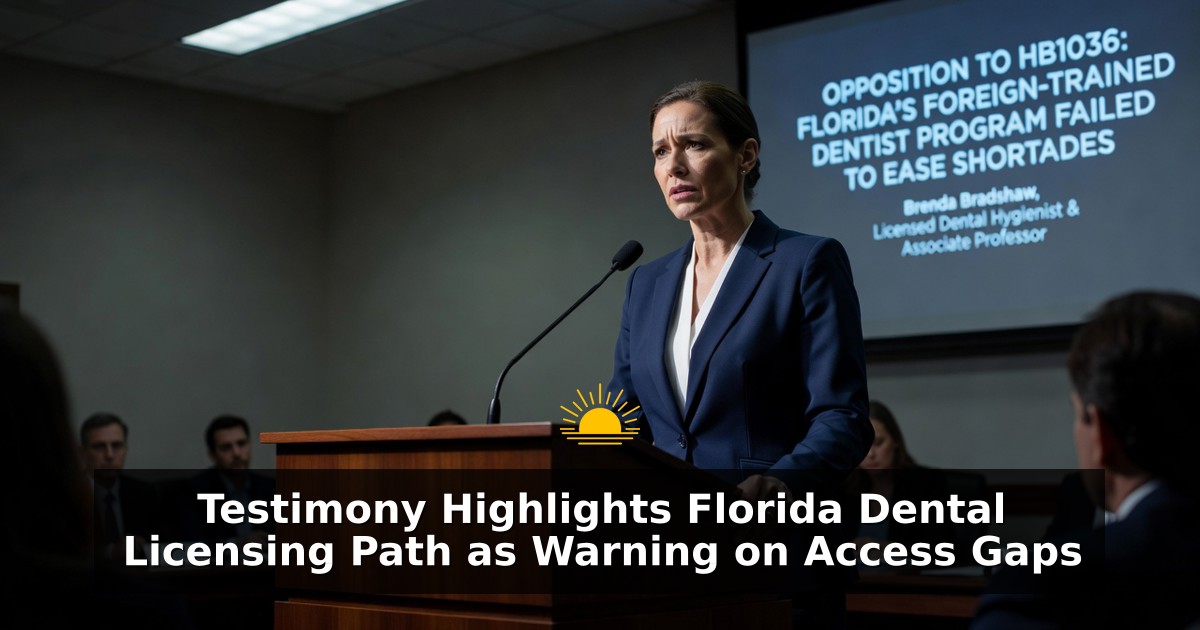
Brenda Bradshaw, a licensed dental hygienist and associate professor in dental hygiene, appeared before the Health Professions Subcommittee to voice strong opposition to House Bill 1036. She centered her remarks on Florida’s long-running experience with alternative pathways into the dental hygiene workforce. Bradshaw described the Sunshine State’s approach as a clear cautionary example for lawmakers weighing similar changes. Her testimony underscored that workforce substitution measures alone have not closed persistent gaps in oral health care access.
Bradshaw explained that Florida began permitting internationally trained dentists to qualify for dental hygienist licenses in the 1990s. Candidates could meet requirements through examinations and credential reviews rather than completing an accredited dental hygiene program. This policy created an accelerated route into practice for foreign-educated dentists seeking to work in the state. Over time the pathway attracted growing numbers of applicants and generated public debate about standards and patient safety.
Between 2010 and 2012 Florida recorded a sharp rise in applications from foreign-trained dentists under the alternative licensing route. The surge drew widespread public attention and sparked controversy among residents, professional groups, and policymakers. Critics questioned whether the abbreviated process adequately prepared practitioners for the distinct scope of dental hygiene. Supporters had hoped the influx would expand the available workforce in underserved communities.
Despite the policy adjustments and subsequent increases in licensed personnel, Florida continues to face severe limitations in dental care availability. Bradshaw noted that the state currently ranks last in the nation for overall dental access. Residents and advocates still raise concerns about the practical results of the earlier reforms. The experience illustrates that simply expanding eligibility categories does not automatically translate into better geographic coverage or higher utilization rates.
Florida also reports the lowest rate of children receiving dental visits when compared with other states. This metric points to ongoing barriers that affect preventive care and early intervention for younger populations. Families in many communities encounter long waits, limited provider options, or financial obstacles that keep children from routine checkups. Such patterns persist even after decades of workforce-focused legislative efforts.
Compounding the access challenges, 65 of Florida’s 67 counties remain federally designated dental health professional shortage areas. These designations, issued through federal health resources criteria, identify regions lacking sufficient dental professionals relative to population needs. Rural and lower-income counties are especially affected, leaving large segments of the population without reliable local services. The near-statewide shortage status has endured despite the licensing flexibility introduced years earlier.
Broader Context of Dental Workforce Policies
Health policy analysts have long examined whether substituting one category of oral health professional for another can meaningfully improve access. Florida’s record supplies a detailed case study because the state moved early to recognize foreign dental credentials for hygiene licensure. Data collected over subsequent decades show that shortage designations and low visit rates have remained stubbornly high. Observers note that factors such as distribution of providers, reimbursement levels, and practice location preferences often outweigh simple headcount increases.
Federal shortage area maps reinforce the picture Bradshaw presented. Designations take into account population-to-provider ratios, travel times to care, and socioeconomic indicators. When nearly every county in a large state qualifies, the underlying problems clearly extend beyond the number of individuals holding a particular license. Transportation barriers, insurance coverage gaps, and the concentration of practices in urban centers continue to limit reach into remote or economically distressed zones.
Children’s dental visit rates serve as another sensitive indicator of system performance. National surveys consistently link early oral health care to long-term outcomes, including reduced emergency visits and better overall health. Florida’s position at the bottom of state rankings suggests that workforce pathway changes have not produced the expected gains in pediatric utilization. Public health departments and school-based programs still struggle to fill the void left by insufficient private-practice capacity in many areas.
Implications for Legislative Consideration
Lawmakers reviewing bills that alter professional entry requirements frequently look to other states for evidence of real-world effects. Bradshaw’s testimony placed Florida’s outcomes squarely in that comparative frame. She argued that the combination of last-place access rankings, minimal pediatric visit rates, and near-universal shortage designations demonstrates the limits of substitution strategies. The subcommittee heard that even aggressive policy shifts failed to resolve the core distribution and availability problems.
Professional education standards for dental hygiene traditionally emphasize specific clinical competencies, preventive focus, and patient-management skills distinct from those of dentists. When internationally trained dentists enter hygiene practice through credential review and examination alone, questions arise about alignment with those competencies. Florida’s experience shows that public controversy can accompany rapid growth in such applications, particularly when residents perceive potential differences in preparation.
Access-to-care shortages remain a nationwide concern, yet state-level experiments produce varied results. Florida’s sustained ranking at the bottom on multiple metrics offers a data point that other jurisdictions can weigh carefully. Policymakers must balance the desire to enlarge the workforce against the need for demonstrated improvements in actual service delivery. Bradshaw concluded her remarks by urging the subcommittee to consider these documented outcomes before advancing similar measures.
Ongoing monitoring of shortage designations and utilization statistics will continue to inform the debate. Federal and state agencies regularly update health professional shortage area lists, providing transparent benchmarks. Children’s dental visit data drawn from national health surveys likewise allow longitudinal tracking. Together these sources supply an empirical foundation for evaluating whether licensing innovations achieve their stated goals of expanding care.
In summary, the testimony presented Florida as a jurisdiction that pursued workforce flexibility yet still confronts extensive dental access deficits. The 1990s policy change, the application spike a decade later, and the current last-place rankings form a coherent narrative of limited impact. Subcommittee members received a detailed account grounded in licensing history, public reaction, and measurable health-system indicators. The record leaves open the question of which complementary strategies might be required to produce lasting gains in oral health availability.
access to care applications associate professor Brenda Bradshaw children receiving dental visits committee controversy credential review dental access dental health professional shortage areas dental hygiene dental hygiene program dental hygienist examinations Florida foreign trained dentists HB1036 internationally trained dentists Licensure Requirements Madam Chair policy changes public attention subcommittee workforce substitution