Abigail Spanberger Signs Executive Order 22 on Data Center Accountability and AI Task Force
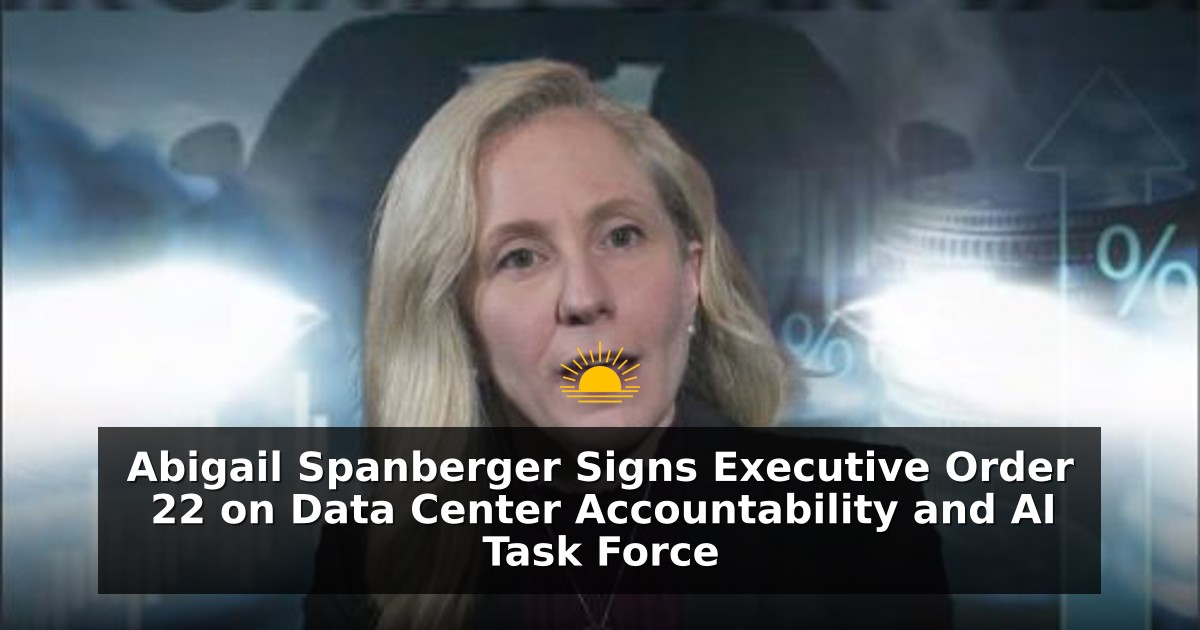
Gov. Abigail Spanberger used a Richmond press conference to unveil what her office called the country’s most aggressive data-center accountability framework, pairing Executive Order 22 with a slate of legislative priorities aimed at the 2027 General Assembly session.
The package stops short of a statewide moratorium on new projects and does not immediately end sales-tax exemptions that have become a flashpoint in budget fights. Instead it blends immediate executive actions with proposals that would need lawmakers’ votes, a structure that drew praise as a first step and criticism as too little from opposite ends of the spectrum.
What Executive Order 22 does now
According to administration materials and contemporaneous reporting, the order bars nondisclosure agreements among executive-branch agencies and employees on data-center projects, directs faster work on noise rules, orders a review of diesel and other backup generation options, and pushes agencies to develop community-engagement tools for localities. It also kicks off an artificial intelligence task force focused on privacy, cybersecurity, and workforce displacement risks tied to rapid AI expansion.
Separate accounts of the order say large new projects with peak demand of at least 25 megawatts would be steered away from certain state economic-development and expedited-review assistance programs. That carve-out is designed to cool the perception that Richmond is still greasing every hyperscale deal even as localities argue about traffic, power lines, water, and night-time generator noise.
Spanberger cast the moment as a response to residents who see energy bills climb while project details stay locked behind NDAs. “Day by day, community members are demanding action,” she said, arguing the state must show leadership even when individual counties and cities experiment with their own pauses.
Legislative asks for 2027
Beyond the order, Spanberger sketched bills that would limit by-right approval for facilities above the 25-megawatt threshold, require clearer local votes, shift more generation and transmission costs onto large users, and harden environmental standards. A longer-term VA-LEAD style ranking system for resource use, jobs, and community benefits is also in the mix, though detailed criteria are not due until later.
Those ideas land in a midterm-year climate where data centers are both a tax-base engine and a political liability. Loudoun County supervisors recently advanced a proposal to pause new applications for up to a year while rewriting local rules. Fairfax already hosts by-right industrial projects near Alexandria’s western edge that would exceed the governor’s proposed threshold many times over, a reminder that zoning on the books can outrun statewide messaging.
Mixed reviews from allies and industry
Senate President Pro Tempore Louise Lucas, D-Portsmouth, said the governor still ignored roughly $2 billion in sales-tax exemptions and called the proposal inadequate. Environmental groups including the Piedmont Environmental Council argued the plan largely governs future projects while leaving the existing pipeline untouched. Clean Virginia called the framework a meaningful step but still urged a pause while details are written.
House Minority Leader Terry Kilgore, R-Scott County, labeled the package internally contradictory for encouraging campuses to bring their own power while restricting on-site gas and backup generation. The Data Center Coalition said it shares goals of responsible development but wants workable details before taking a final position.
For ratepayers, the through-line is cost allocation. Virginia markets itself as a digital infrastructure capital, and the grid investments required to keep that title are enormous. Spanberger’s order does not rewrite utility rates overnight, but it tries to change the political default: less secrecy at the state level, more explicit local approval for the biggest loads, and a January agenda that forces legislators to pick sides on who pays for the next wave of megawatts.
Whether that is enough will be tested in committee rooms, not press conferences. Local boards are already writing their own pauses. The SCC is already reviewing a utility merger that would reshape how power is financed. Spanberger’s framework inserts the governor’s office into both conversations with a message that accountability, not only recruitment, is now a Richmond brand.
Email the Virginia Senate At:
Lashrecse Aird - senatoraird@senate.virginia.gov,
Lamont Bagby - senatorbagby@senate.virginia.gov,
Elizabeth Bennett-Parker - senatorbennett-parker@senate.virginia.gov,
Jennifer Boysko - senatorboysko@senate.virginia.gov,
Jennifer Carroll Foy - senatorcarrollfoy@senate.virginia.gov,
Luther Cifers - senatorcifers@senate.virginia.gov,
Christie Craig - senatorcraig@senate.virginia.gov,
Creigh Deeds - senatordeeds@senate.virginia.gov,
Bill DeSteph - senatordesteph@senate.virginia.gov,
Danny Diggs - senatordiggs@senate.virginia.gov,
Tara Durant - senatordurant@senate.virginia.gov,
Barbara Favola - senatorfavola@senate.virginia.gov,
Timmy French - senatorfrench@senate.virginia.gov,
Travis Hackworth - senatorhackworth@senate.virginia.gov,
Christopher Head - senatorhead@senate.virginia.gov,
Michael Jones - senatorjones@senate.virginia.gov,
Emily Jordan - senatorjordan@senate.virginia.gov,
Mamie Locke - senatorlocke@senate.virginia.gov,
Louise Lucas - senatorlucas@senate.virginia.gov,
David Marsden - senatormarsden@senate.virginia.gov,
Ryan McDougle - senatormcdougle@senate.virginia.gov,
Jeremy McPike - senatormcpike@senate.virginia.gov,
Tammy Mulchi - senatormulchi@senate.virginia.gov,
Mark Obenshain - senatorobenshain@senate.virginia.gov,
Mark Peake - senatorpeake@senate.virginia.gov,
Stella Pekarsky - senatorpekarsky@senate.virginia.gov,
Russet Perry - senatorperry@senate.virginia.gov,
Todd Pillion - senatorpillion@senate.virginia.gov,
Bryce Reeves - senatorreeves@senate.virginia.gov,
Danica Roem - senatorroem@senate.virginia.gov,
Aaron Rouse - senatorrouse@senate.virginia.gov,
Saddam Salim - senatorsalim@senate.virginia.gov,
Kannan Srinivasan - senatorsrinivasan@senate.virginia.gov,
William Stanley - senatorstanley@senate.virginia.gov,
Richard Stuart - senatorstuart@senate.virginia.gov,
Glen Sturtevant - senatorsturtevant@senate.virginia.gov,
David Suetterlein - senatorsuetterlein@senate.virginia.gov,
Scott Surovell - senatorsurovell@senate.virginia.gov,
Schuyler VanValkenburg - senatorvanvalkenburg@senate.virginia.gov,
Angelia Williams Graves - senatorwilliamsgraves@senate.virginia.gov,
Email the Alexandria City Council:
Alyia Gaskins, alyia.gaskins@alexandriava.gov,
Sarah Bagley, sarah.bagley@alexandriava.gov,
Canek Aguirre, canek.aguirre@alexandriava.gov,
John Chapman, john.taylor.chapman@alexandriava.gov,
Abdel-Rahman Elnoubi, abdel.elnoubi@alexandriava.gov,
Jacinta Greene, jacinta.greene@alexandriava.gov,
Sandy Marks,
Email the Loudoun County School Board:
April Chandler, april.chandler@lcps.org,
Anne Donohue, anne.donohue@lcps.org,
Deana Griffiths, deana.griffiths@lcps.org,
Ross Svenson, ross.stevenson@lcps.org,
Kari LaBell, kari.labell@lcps.org,
Jon Pepper, jonathon.pepper@lcps.org,
Lauren Shernoff, lauren.shernoff@lcps.org,
Sumera Rashid, sumera.rashid@lcps.org,
Amy Riccardi, amy.riccardi@lcps.org,
Email the Board of Supervisors at:
Phyllis J. Randall (Chair, At-Large) – Phyllis.Randall@loudoun.gov,
Michael R. Turner (Vice Chair, Ashburn District) – Mike.Turner@loudoun.gov,
Juli E. Briskman (Algonkian District) – Juli.Briskman@loudoun.gov,
Sylvia R. Glass (Broad Run District) – Sylvia.Glass@loudoun.gov,
Caleb Kershner (Catoctin District) – caleb.kershner@loudoun.gov,
Matthew F. Letourneau (Dulles District) – Matt.Letourneau@loudoun.gov,
Kristen C. Umstattd (Leesburg District) – Kristen.Umstattd@loudoun.gov,
Laura A. TeKrony (Little River District) – Laura.TeKrony@loudoun.gov,
Koran Saines (Sterling District) – Koran.Saines@loudoun.gov
Alexandria City Loudoun County Aaron Rouse Abdel Elnoubi Abdel-Rahman Elnoubi Abigail Spanberger Adam Ebbin Alexandria City Council Ali Faruk Alyia Gaskins Amy Riccardi Andrew Breton Angelia Williams Graves Anne Donohue Anne Holton April Chandler Artificial Intelligence Barbara Favola Bars Bill DeSteph Bills Bryce Reeves Budget Caleb Kershner Canek Aguirre Cheryl Burke Christie Craig Christopher Head Creigh Deeds Cynthia Newbille Danica Roem Danny Diggs Data Data Center Data Centers David Marsden David Suetterlein Deana Griffiths Ellen Robertson Emily Jordan Emmett Jafari Energy Executive Order Fairfax Glen Sturtevant Governor Grid Jacinta E. Greene Jacinta Greene Jennifer Boysko Jennifer Carroll Foy Jeremy McPike Jobs John Chapman John Taylor Chapman Jon Pepper Juli Briskman Kannan Srinivasan Kari LaBell Katherine Jordan Kathryn Ricard Kenya Gibson Koran Saines Kristen Umstattd Lamont Bagby Land Lashrecse Aird Laura TeKrony Lauren Shernoff Lawmakers Loudoun County Loudoun County Board of Supervisors Loudoun County School Board Louise Lucas Luther Cifers Mamie Locke Mark Obenshain Mark Peake Matt Letourneau Matthew Percival Michael Jones Mike Turner Nicole Jones Phyllis Randall Power power lines President Reva Trammell Richard Stuart Richmond Richmond City Council Richmond School Board Ross Svenson Russet Perry Ryan McDougle Saddam Salim Sandy Marks Sarah Abubaker Sarah Bagley SCC Schuyler VanValkenburg Scott Scott Surovell Senate Shavonda Fernandez Stella Pekarsky Stephanie Lynch Stephanie Rizzi Sumera Rashid Sylvia Glass Tammy Mulchi Tara Durant Terry Kilgore Timmy French Todd Pillion Traffic Travis Hackworth Virginia Virginia House of Delegates Virginia Senate Water Wesley Hedgepeth William Stanley