ACLU of Virginia Endorses Prison Language Access Measure
Updated
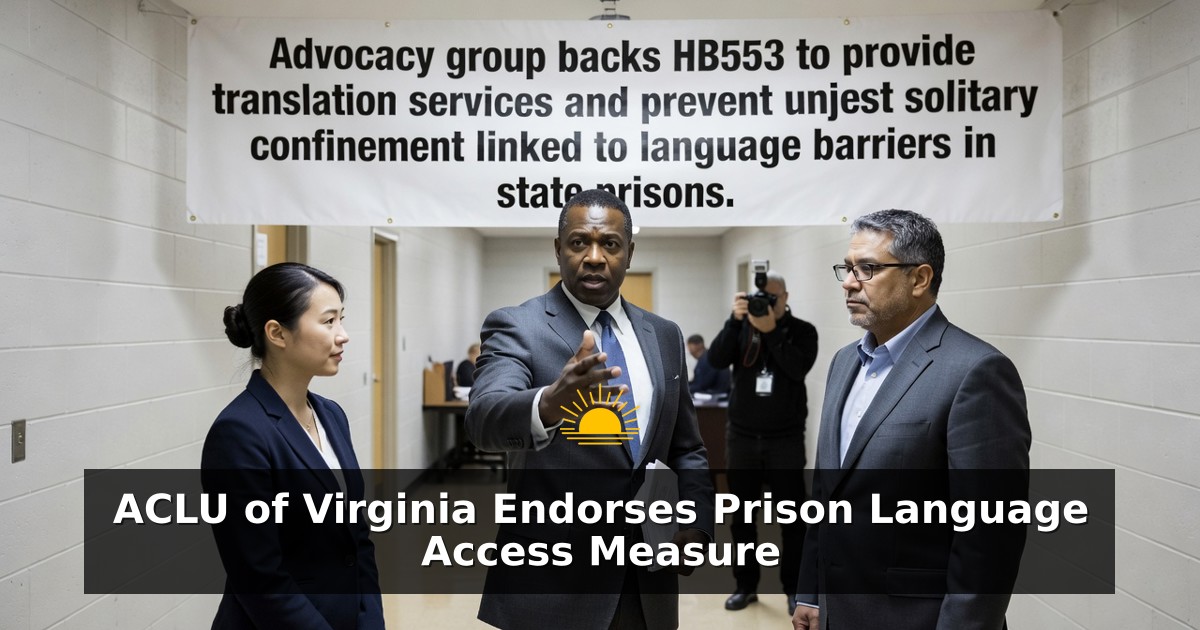
The ACLU of Virginia has formally expressed support for House Bill 553, legislation designed to expand language access services within the Virginia Department of Corrections. Gregory Brown of the ACLU of Virginia appeared before a public safety subcommittee to urge passage of the measure. He described the bill as essential for protecting the rights of inmates who lack proficiency in English. Brown referenced a specific past case to illustrate the human cost of inadequate translation support in correctional settings.
In that case, an inmate remained in solitary confinement for 12 years because he could not complete required elements of the Virginia Department of Corrections step-down program. The barrier stemmed directly from his limited ability to read or write English at a proficient level. Without adequate language assistance, the individual was unable to progress through the structured phases intended to return him to general population. Brown stressed that such outcomes undermine basic fairness and constitutional protections inside prisons.
HB553 seeks to address these gaps by ensuring that qualified translators and interpreters are available to inmates. The proposal aims to prevent misunderstandings that can escalate into disciplinary actions or prolonged isolation. Supporters argue that clear communication is fundamental to any system that claims to uphold due process. Brown thanked the bill’s patron for introducing the legislation and called it a necessary safeguard against future injustices rooted in language differences.
Language Barriers and Correctional Programs
Step-down programs in restrictive housing units typically require inmates to demonstrate behavioral compliance, complete educational modules, and participate in counseling or group sessions. When materials and instructions are provided only in English, non-proficient speakers face structural disadvantages. These disadvantages can freeze an individual in solitary confinement far longer than intended by policy. Research on correctional practices nationwide has shown that limited English proficiency correlates with higher rates of extended isolation and reduced access to rehabilitative opportunities.
The Virginia Department of Corrections oversees thousands of incarcerated people, a portion of whom speak languages other than English as their primary means of communication. Without systematic interpreter services, daily interactions with officers, medical staff, and program facilitators become fraught with potential error. Misinterpreted directives can lead to infractions that further delay release from restrictive housing. HB553 would establish clearer obligations for the department to furnish language assistance at critical decision points.
Advocates note that language access also affects medical care, mental health treatment, and grievance procedures. An inmate unable to describe symptoms accurately may receive delayed or incorrect treatment. Similarly, the inability to file a coherent written grievance can leave legitimate complaints unaddressed. These cumulative effects compound the isolation already inherent in solitary confinement and raise questions about equal protection under the law.
Constitutional Dimensions of Language Access
Federal courts have long recognized that meaningful access to prison programs and proceedings forms part of an inmate’s due process rights. Title VI of the Civil Rights Act further requires recipients of federal funds, including state correctional systems, to take reasonable steps to ensure limited-English-proficient individuals can participate fully. HB553 aligns Virginia statute more closely with these existing obligations by creating explicit expectations for translation services. Brown framed the bill as a practical tool for preventing constitutional violations before they occur.
Solitary confinement itself has drawn sustained scrutiny from legal scholars, medical associations, and human rights organizations because of its documented psychological harms. When language barriers unnecessarily prolong such confinement, the harms multiply. The 12-year case cited by the ACLU of Virginia demonstrates how an administrative requirement, applied without linguistic accommodation, can produce extreme results. Ensuring interpreters are present during program assessments and disciplinary hearings would reduce the likelihood of similar outcomes.
Broader Implications for Prison Administration
Correctional administrators face legitimate operational challenges in delivering language services across multiple facilities and numerous languages. Yet the cost of failing to provide those services appears in extended housing expenses, litigation risk, and diminished program effectiveness. HB553 offers a legislative framework intended to balance those practical concerns with the imperative of fair treatment. By codifying access to translators, the bill would give both staff and inmates clearer guidance on expectations.
Public safety subcommittees routinely examine measures that affect the internal operations of the Department of Corrections. Testimony such as Brown’s supplies lawmakers with concrete examples rather than abstract principles. The account of a dozen years spent in isolation solely because of language limitations crystallizes the stakes. Lawmakers must weigh whether current departmental practices already meet constitutional minima or whether statutory reinforcement is required.
The ACLU of Virginia’s endorsement adds an established civil liberties voice to the discussion surrounding HB553. The organization has monitored conditions of confinement in the Commonwealth for decades and frequently appears in legislative hearings on criminal justice matters. Brown’s remarks focused narrowly on the language-access provisions and their capacity to avert unjust punishment. He did not expand into unrelated reform topics, keeping the testimony centered on the bill’s core purpose.
Implementation and Oversight Considerations
If enacted, HB553 would likely require the Virginia Department of Corrections to develop protocols for identifying language needs at intake and at subsequent classification reviews. Training for staff on the use of interpreter services would form another necessary component. Oversight mechanisms, whether through internal audits or external reporting, would help ensure that the promised access materializes in daily practice. These administrative details remain subject to further refinement as the bill moves through the legislative process.
Language access ultimately serves the twin goals of institutional order and individual justice. Inmates who understand rules and program requirements are better positioned to comply with them. Staff who can communicate clearly face fewer preventable conflicts. The case of prolonged solitary confinement underscores what happens when that communication channel is absent for years on end. HB553 represents an effort to close that channel gap through deliberate statutory language.
As the public safety subcommittee continues its review, the testimony offered by Gregory Brown stands as a documented call for preventive reform. The ACLU of Virginia maintains that no person should remain in restrictive housing merely because English literacy eluded them. By supporting dedicated translation resources, the bill seeks to align Virginia’s prison practices with fundamental notions of fairness. The measure now awaits further consideration by legislators charged with balancing security, fiscal responsibility, and constitutional duty.
ACLU of Virginia advocacy bill committee constitutional rights Gregory Brown HB553 injustice Inmates justice language access Legislation non-English speakers prisons rights solitary confinement Support testimony translation services Virginia