ACLU of Virginia Endorses House Bill 286 for National Guard Oversight
Updated
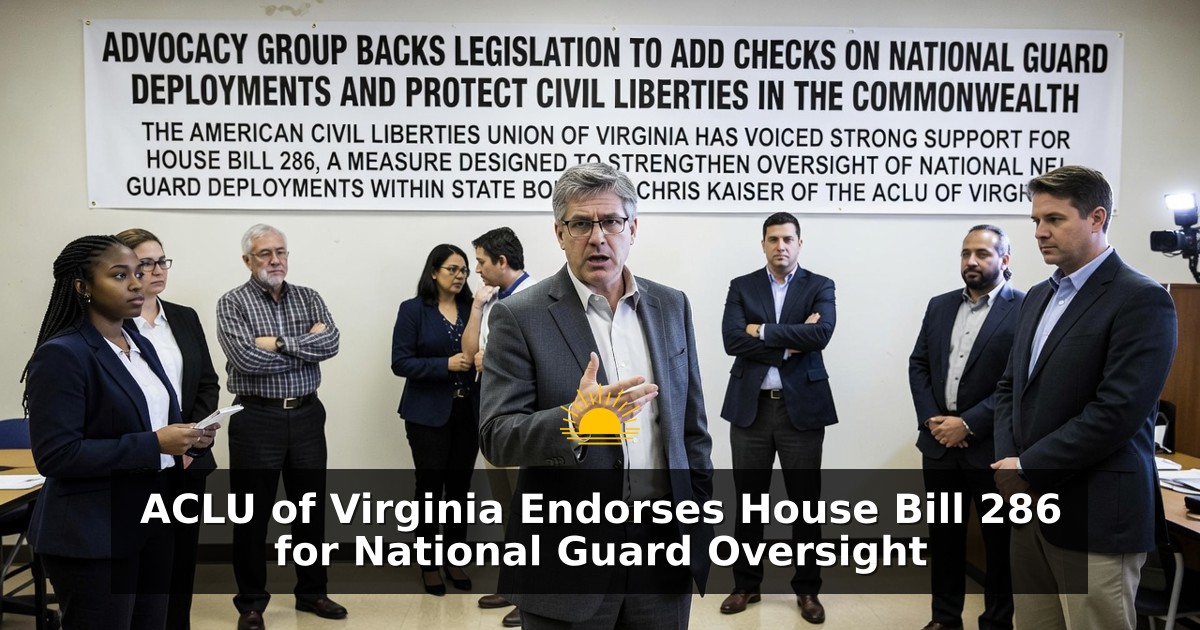
The American Civil Liberties Union of Virginia has voiced strong support for House Bill 286, a measure designed to strengthen oversight of National Guard deployments within state borders. Chris Kaiser of the ACLU of Virginia testified in favor of the legislation, emphasizing its role in safeguarding First Amendment rights and preventing the normalization of military presence in civilian areas. The bill seeks to introduce additional checks and balances so that any use of the Guard responds thoughtfully to public safety needs without chilling free expression. Officials and advocates describe the proposal as a necessary assertion of state authority amid broader national debates over domestic military roles.
Kaiser explained that recent National Guard deployments in multiple jurisdictions across the country have produced unintended consequences for everyday citizens. Those actions, he noted, created an atmosphere that discouraged members of the public from exercising core constitutional protections. The presence of armed personnel in civilian settings raised alarms about the gradual acceptance of a standing military-style force on city streets. Such developments, according to the ACLU representative, should concern residents regardless of political affiliation because they touch fundamental questions of liberty and governance.
House Bill 286 aims to address these issues by clarifying the limits of executive power and requiring coordinated input from the legislative branch. Proponents argue that while the state cannot fully dictate outcomes when federal authorities assume control of Guard units, Virginia can still maximize its sovereign rights inside its own borders. The legislation would establish procedural safeguards intended to ensure deployments occur only after careful deliberation by both the governor’s office and lawmakers. This dual-branch approach is presented as a practical way to balance rapid response capabilities with democratic accountability.
Delegate Helmer, identified in testimony as a key supporter of the measure, has underscored that the bill should not have been required under ordinary circumstances. Yet the pattern of recent deployments made the reforms clearly necessary in the eyes of civil liberties advocates. Kaiser echoed that sentiment, stating the organization wished the legislation were unnecessary but recognized the urgency created by current events. The ACLU’s position rests on the principle that military assets belong primarily to external defense and should appear on domestic streets only under tightly controlled conditions.
State sovereignty forms a central pillar of the argument advanced by supporters. Virginia retains significant authority over its National Guard forces when they remain under state activation status, allowing local leaders to set priorities that reflect community values. By codifying extra layers of review, House Bill 286 would reinforce that traditional arrangement and reduce the risk of unilateral decisions. Advocates maintain that thoughtful inter-branch consultation produces better outcomes than hasty executive orders alone. The result, they contend, is a framework more consistent with constitutional design and public expectations of limited government power.
Civil liberties organizations have long monitored the intersection of military deployments and free speech. Historical episodes in various states demonstrated how visible troop presence can alter the character of public assemblies, marches, and protests. Even when units operate under lawful orders, the optics of armed soldiers near civilian gatherings may deter participation by law-abiding residents. House Bill 286 seeks to minimize that chilling effect by ensuring deployments receive deliberate scrutiny rather than automatic approval. Kaiser stressed that protecting the right to peaceful expression remains a non-negotiable priority for the ACLU of Virginia.
Normalization of military personnel in everyday policing roles represents another core worry articulated during the hearing. Once communities grow accustomed to seeing Guard members performing functions traditionally reserved for local law enforcement, the distinction between civilian and military authority can blur. That shift carries long-term implications for democratic culture and public trust. The proposed legislation attempts to draw clearer boundaries so that any domestic use of the Guard stays exceptional rather than routine. Supporters believe such clarity benefits both service members and the civilians they may be asked to assist.
Legal scholars note that the National Guard occupies a unique dual-status position under American law. Units can serve state governors during emergencies or be federalized for national missions, creating complex chains of command. House Bill 286 focuses on the state-controlled scenarios where Virginia officials retain the greatest latitude. By embedding checks and balances into statute, the measure would guide future governors and General Assembly members toward measured responses. The ACLU views this statutory guidance as an essential tool for preserving civil space free from unnecessary militarization.
Public discussion surrounding the bill has also touched on the practical limits of state power. Kaiser acknowledged that federal decisions can override certain state preferences once troops are called into national service. Nevertheless, he insisted Virginia should exhaust every available avenue to assert its interests and protect residents. The legislation therefore concentrates on maximizing influence within the sphere still controlled by Richmond. This pragmatic stance seeks to avoid empty gestures while still delivering concrete procedural improvements.
As the General Assembly considers House Bill 286, the testimony from the ACLU of Virginia adds a prominent civil-liberties perspective to the record. Lawmakers must weigh operational flexibility against the documented risks of intimidation and mission creep. The organization’s endorsement frames the bill as a modest yet meaningful step toward responsible stewardship of military resources. Continued debate is expected to explore implementation details, reporting requirements, and coordination mechanisms between the executive and legislative branches.
Observers of Virginia politics recognize that questions of Guard deployment touch deep traditions of local control and individual rights. The commonwealth’s history includes both proud service by its Guard units and careful attention to the proper bounds of force. House Bill 286 fits within that tradition by insisting on deliberate process before troops appear on city streets. Whether the measure advances, its introduction has already elevated public awareness of the stakes involved. Residents, elected officials, and advocacy groups will watch closely as the proposal moves through committee and floor consideration.
In the end, the ACLU’s support rests on a straightforward proposition: military power deployed inside the state must remain accountable to civilian institutions and respectful of constitutional freedoms. Chris Kaiser’s remarks distilled years of organizational experience monitoring free-speech issues into a concise call for reform. House Bill 286 offers one concrete vehicle for translating those concerns into statutory language. The coming weeks will determine whether the General Assembly shares the view that additional safeguards have become essential for the protection of Virginians’ civil liberties.
ACLU backs bill Checks and Balances Chris Civil Liberties Civilian Streets Guard House Bill 286 Legislative Response Military Deployment Military Presence National National Guard oversight Public Expression State Sovereignty supports Virginia Virginia's