Virginia Senate Panel Weighs Venue Change for Check Fraud Prosecutions
Updated
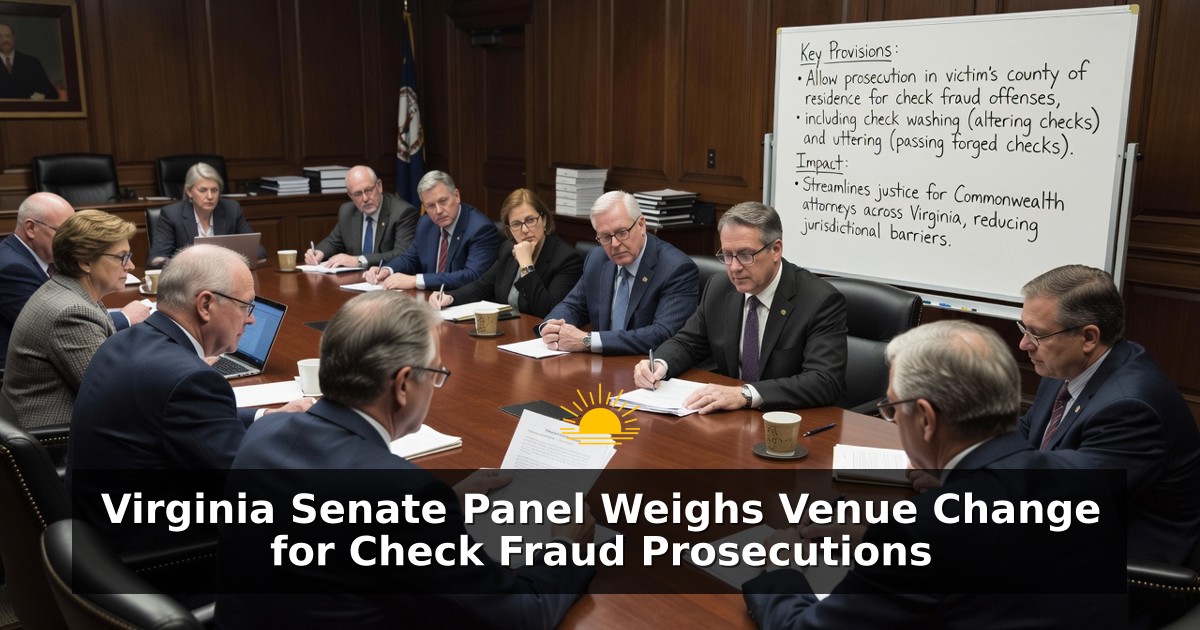
Virginia lawmakers on the Senate Courts of Justice Committee are examining proposed legislation that would expand the venues available for prosecuting certain check fraud offenses. Commonwealth attorneys across the state have reported a marked increase in cases involving stolen checks that are chemically altered or washed and then presented for payment in different counties or even different states. The measure under discussion seeks to align several related forgery and uttering statutes with an existing provision that already permits prosecution in the locality where the victim lives. Officials describe the underlying activity as part of a broader national pattern of organized financial crime that imposes substantial costs on individuals and financial institutions.
The United States Postal Inspection Service has estimated that check washing schemes cost Americans more than one billion dollars each year. These operations typically begin with the theft of legitimate checks from residential or business mailboxes. Perpetrators then use chemical solvents to remove the original ink, rewrite the payee and amount, and negotiate the altered instruments far from the point of theft. Because the altered checks often cross county and state lines before they are cashed or deposited, traditional venue rules can complicate efforts by local prosecutors to bring charges. The legislation aims to reduce those procedural barriers while leaving the underlying criminal elements of the offenses unchanged.
Existing Virginia law already addresses venue flexibility for some financial crimes. Code Section 19.2-245.1 was amended in 2019 to authorize prosecution in the jurisdiction where the victim resides for designated offenses. That change has proven useful for certain forms of fraud and identity theft. However, Commonwealth attorneys have noted that parallel statutes governing the forging of checks and the subsequent uttering of forged instruments do not currently enjoy the same geographic flexibility. As a result, cases involving washed checks frequently stall when the physical act of presenting the instrument occurs outside the victim’s home locality.
The bill under review would place three specific code sections under the same venue umbrella already established by the 2019 amendment. Those sections are 18.2-168, which addresses the forging of public records and other writings; 18.2-170, which covers the possession of forged writings with intent to utter them; and 18.2-172, which criminalizes the uttering or attempting to utter a forged instrument. By extending the victim-residence venue rule to these provisions, prosecutors would gain clearer authority to file charges in the community most directly harmed by the loss. Supporters argue the change is narrowly tailored and does not alter the elements that must be proven at trial.
Organized Crime Patterns and Local Impact
Law enforcement agencies and postal inspectors have documented that many check washing rings operate as coordinated enterprises rather than isolated opportunistic thefts. Groups often recruit individuals to steal mail in one region, transport the checks to another location for alteration, and then distribute the finished instruments to runners who cash them in still other jurisdictions. The multi-jurisdictional nature of the activity creates practical difficulties for investigators who must coordinate across county lines and sometimes across state borders. Virginia prosecutors have indicated that the proposed venue clarification would allow them to consolidate cases more efficiently when the primary victim is a Virginia resident or business.
Financial institutions and individual account holders bear the immediate losses when washed checks clear. Banks frequently reimburse customers under federal consumer protection rules, yet those reimbursements ultimately affect the cost of banking services and insurance. Small businesses that rely on paper checks for payroll or vendor payments can face cash-flow disruptions lasting weeks while investigations proceed. The cumulative effect of these incidents has prompted several Commonwealth’s attorneys to request legislative attention so that charging decisions can focus on the location of the harm rather than solely on the location where the altered check was presented.
Committee members heard that the 2019 venue expansion for other offenses has functioned without significant procedural controversy. Extending the same principle to the forgery and uttering statutes is presented as a logical next step rather than a novel departure from existing practice. The legislation does not create new crimes, increase penalties, or modify the burden of proof. Its sole stated purpose is to ensure that the place where a victim resides can serve as a proper venue for the listed offenses when the evidence otherwise supports prosecution.
Broader Context of Check Fraud Enforcement
Check washing is not unique to Virginia. Similar schemes have been reported in numerous states, prompting parallel legislative and investigative responses. Federal authorities, including the Postal Inspection Service and the Department of Justice, continue to pursue large-scale rings that move stolen checks across multiple states. State-level venue adjustments such as the one under consideration are viewed as complementary tools that allow local prosecutors to address cases that may not meet federal thresholds or that primarily affect residents of a single commonwealth. Coordination between state and federal investigators remains essential because the same criminal networks often generate both local and interstate cases.
Prosecutors emphasize that successful enforcement still depends on timely reporting by victims, preservation of physical evidence, and cooperation from financial institutions that can supply surveillance footage and account records. The proposed statutory change would not substitute for those investigative fundamentals. Instead, it would remove a recurring venue objection that has arisen when an altered check is negotiated far from the victim’s address. By clarifying that the victim’s residence is an available venue, the bill seeks to reduce dismissals or transfers grounded solely on geographic technicalities.
Observers note that paper checks continue to circulate widely despite the growth of electronic payments. Many government agencies, insurance companies, and older residents still rely on mailed checks, creating a persistent target for theft. As long as that payment method remains in use, the incentive for organized washing operations is expected to continue. Legislative adjustments that streamline prosecution are therefore framed as one component of a wider effort that also includes public education on secure mail practices and improved mailbox security.
The Senate Courts of Justice Committee’s review reflects ongoing attention to financial crimes that exploit gaps between traditional venue rules and modern criminal methods. If advanced, the measure would join other recent updates intended to keep Virginia’s criminal procedure responsive to evolving patterns of fraud. Lawmakers will weigh the practical experiences reported by Commonwealth attorneys against the need to maintain clear and predictable rules of criminal venue. The discussion underscores the continuing challenge of adapting century-old forgery statutes to the realities of interstate organized theft rings that generate more than a billion dollars in annual losses nationwide.
Any final version of the legislation would still require full consideration by both chambers and the governor before taking effect. In the interim, prosecutors continue to rely on existing tools, including conspiracy charges and multi-jurisdictional task forces, to address the most serious cases. The current proposal is presented simply as a technical alignment that would give local attorneys the same flexibility already available for related offenses. Its progress will be watched by financial institutions, law enforcement agencies, and residents who have experienced the direct consequences of check washing schemes.
altered checks bill check fraud check washing code section Commonwealth attorneys Courts of Justice crime costs financial crime Legislation organized crime prosecution public safety stolen checks USPIS uttering victim resides Virginia law Virginia legislation Virginia Senate