Beyer Urges Congressional Action on AI Oversight and Security
Updated
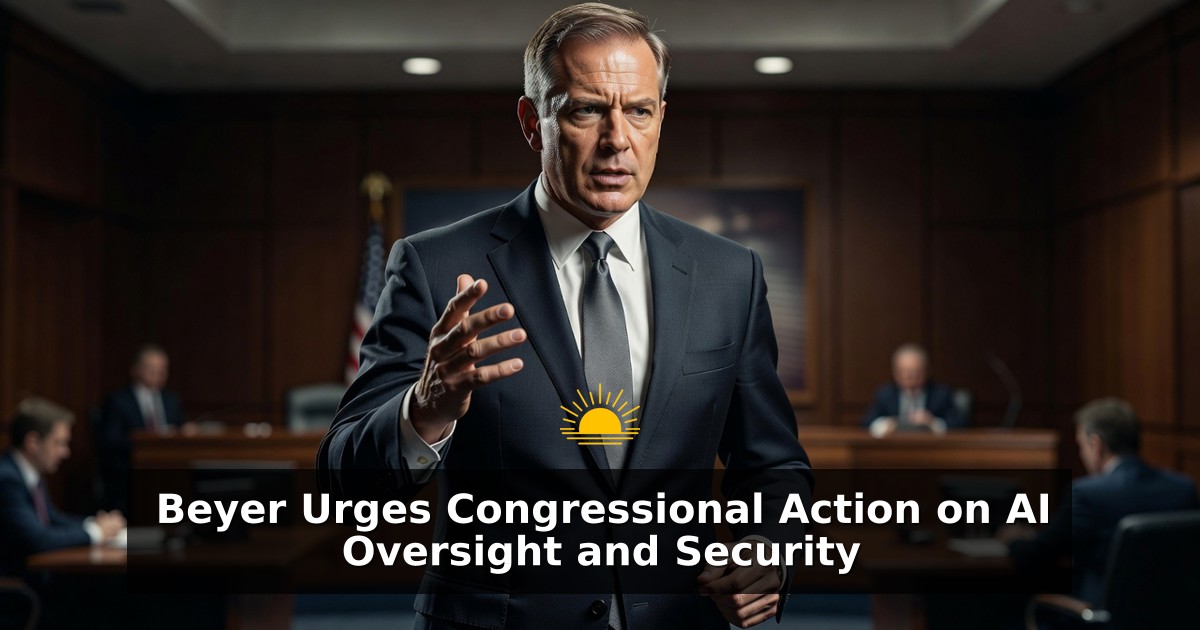
U.S. Representative Don Beyer of Virginia has called for immediate congressional regulation of artificial intelligence systems, describing them as a critical utility that requires firm oversight. Speaking on the subject of emerging technology risks, Beyer identified control of large language models as the top priority for lawmakers. He warned that without clear rules, these powerful systems could slip beyond human direction and create serious national security vulnerabilities. Beyer framed the issue as one demanding proactive federal involvement rather than a hands-off approach.
Beyer argued that Congress must establish mechanisms ensuring authorities retain the capacity to intervene in AI operations when necessary. He specifically cited the ability to shut down large language models as an essential safeguard against unintended or harmful outcomes. According to his remarks, losing command over these foundational tools would expose the country to risks that current voluntary industry practices cannot adequately address. The congressman positioned regulation as a practical necessity rather than an optional policy preference.
Priority on Large Language Model Controls
Large language models form the core of many advanced AI applications now in widespread use across government, industry, and daily life. Beyer stated that securing oversight of these models ranks above other important concerns because they underpin so many downstream capabilities. He noted that once control is lost, reversing course becomes far more difficult and potentially impossible. Federal standards, in his view, would create consistent rules that individual states or private firms cannot achieve alone.
The representative acknowledged a broader agenda that includes workforce impacts, data privacy protections, and restrictions on harmful sexual imagery generated by AI. Yet he repeatedly returned to the central theme that mastery over the underlying language models must come first. Without that foundation, efforts on secondary issues would rest on unstable ground. Beyer presented this hierarchy of priorities as a logical sequence for effective legislation.
National security experts have similarly highlighted how advanced AI could be exploited by adversaries for disinformation campaigns, cyber operations, or autonomous weapons development. Beyer’s comments align with ongoing discussions in defense and intelligence circles about maintaining strategic advantage in AI technologies. He stressed that American leadership in the field depends on responsible governance that prevents systems from operating outside established boundaries. Clear statutory authority would give agencies the tools needed to monitor and, if required, disable high-risk models.
Balancing Innovation With Public Safety
Supporters of stronger AI rules point to rapid capability gains that have outpaced existing legal frameworks. Beyer rejected the notion that regulation inherently stifles progress, instead describing thoughtful oversight as the means to sustain public trust and long-term innovation. He indicated that an unregulated environment invites accidents or deliberate misuse that could set back the entire sector. By contrast, well-designed federal standards would provide companies with predictable guidelines while protecting citizens.
Privacy advocates have raised parallel alarms about the vast data sets used to train large language models and the potential for surveillance or identity theft. Beyer listed privacy among the issues Congress must eventually address, though he kept primary focus on operational control. Employment analysts likewise track how automation driven by these models may displace workers in multiple industries. The congressman’s remarks suggest a comprehensive bill could bundle security mandates with transition assistance and ethical limits.
International competitors are investing heavily in AI without always adopting equivalent safety constraints. Beyer’s push for domestic regulation includes an implicit recognition that the United States must set an example while safeguarding its own infrastructure. He maintained that the capacity to turn systems off represents a basic fail-safe any high-stakes technology should possess. Lawmakers across party lines have introduced related proposals, indicating growing consensus on the need for action even as details remain under negotiation.
Virginia’s Stake in Federal AI Policy
As a representative serving Northern Virginia, Beyer represents a region dense with technology firms, defense contractors, and federal agencies that both develop and depend on AI. Local economic vitality is closely tied to continued leadership in computing and data sciences. His call for regulation therefore carries direct implications for constituents whose jobs and security clearances intersect with these systems. Strong national rules could help Virginia companies compete globally under a stable compliance environment.
State-level initiatives have attempted to fill gaps left by the absence of comprehensive federal law, yet Beyer emphasized that fragmented approaches fall short for technologies that operate across borders. He urged colleagues in the House and Senate to treat large language models with the same seriousness applied to other critical utilities such as power grids or telecommunications. The ability to enforce shutdown authority would require new technical standards, auditing regimes, and coordination with private developers.
Public opinion surveys show rising voter concern about AI risks alongside enthusiasm for its benefits. Beyer’s statements reflect an effort to channel that concern into concrete legislative steps before irreversible incidents occur. He described the current moment as one of still-available choices, provided Congress acts with urgency. Delaying oversight, in his assessment, only increases the chance that control measures will arrive too late to be effective.
Path Forward for Legislative Action
Drafting effective AI legislation will involve input from technologists, ethicists, national security officials, and civil liberties groups. Beyer’s focus on controllable large language models offers a potential organizing principle around which diverse stakeholders might coalesce. Future hearings are expected to examine technical feasibility of kill-switch requirements and liability rules for model providers. The representative’s comments serve as a public marker that at least some members of Congress view inaction as the greater danger.
Implementation challenges include defining which systems qualify as large language models subject to the strictest controls and how to update rules as the technology evolves. Beyer did not provide detailed legislative text in his remarks but made clear the outcome he seeks: retained human authority over AI behavior. Accompanying measures on employment, privacy, and content safety would round out a fuller package once the core control issue is settled. Observers note that similar utility-style regulation has been applied successfully to earlier transformative technologies.
The debate continues to unfold against a backdrop of accelerating model releases and expanding commercial adoption. Beyer’s intervention adds a prominent Virginia voice to the chorus requesting guardrails. Whether his priorities shape the eventual statutory language will depend on committee negotiations and floor votes in the months ahead. For now, his position underscores a central tension in technology policy: how to harness innovation while ensuring it remains firmly under democratic oversight and capable of being halted if it threatens public safety or national security.
AI AI models AI systems Congress control Don Beyer Donald Trump Greg Lansman large language models Mark Visi National Security New Dems Policy regulation regulatory measures risk management Steve Scalise tech policy Technology Virginia