Virginia Lawmakers Weigh AI Fraud Alert System Modeled on Amber Alerts
Updated
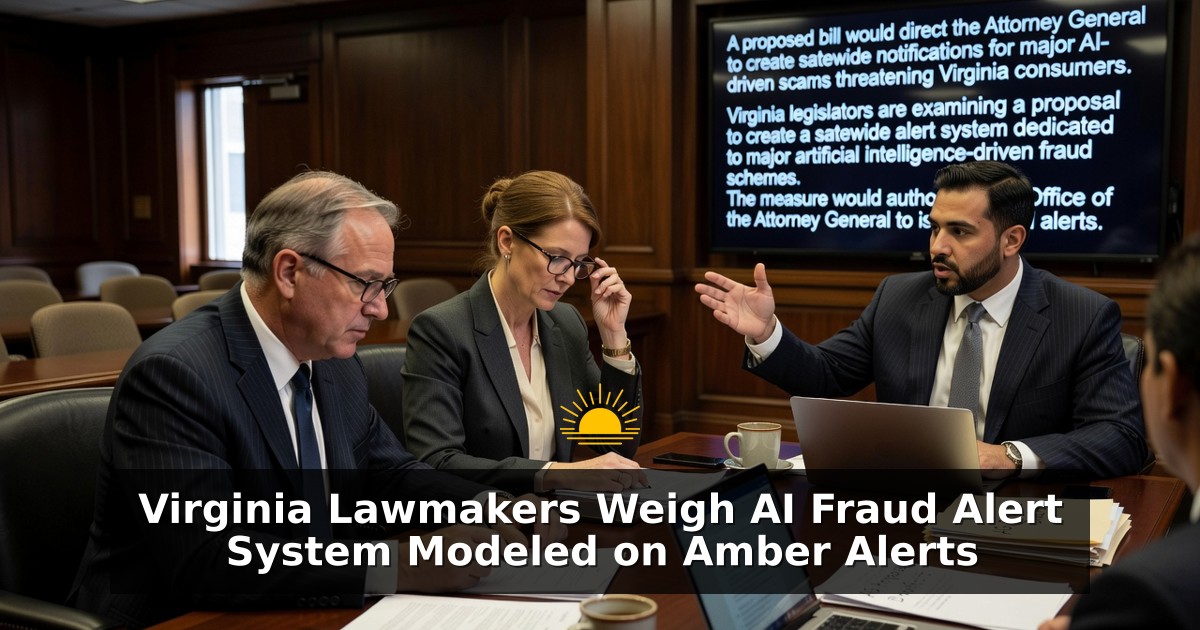
Virginia legislators are examining a proposal to create a statewide alert system dedicated to major artificial intelligence-driven fraud schemes. The measure would authorize the Office of the Attorney General to issue rapid public notifications when significant scams reach a threshold determined by consumer protection officials. Supporters describe the concept as an expansion of familiar emergency messaging already used for missing children and severe weather. The discussion occurred during a meeting of the Professions-Occupations and Administrative Process Subcommittee.
Delegate Glass presented the legislation for the second consecutive year, emphasizing the speed at which AI-enabled scams can proliferate. According to the remarks, these schemes succeed largely because they spread widely before the public becomes aware of the threat. The proposed system would function in a manner comparable to Amber Alerts or local weather warnings that residents in places such as Norfolk already receive regularly. Once activated, the alerts would inform Virginians about fraud activity identified by the Attorney General’s consumer counsel staff.
Rising Threat of AI-Enabled Scams
Artificial intelligence tools have lowered barriers for criminals seeking to impersonate trusted institutions, relatives, or government agencies. Voice cloning, deepfake video, and automated phishing campaigns can now be generated at scale and distributed across multiple platforms within hours. Consumer protection agencies across the United States have documented sharp increases in reported losses tied to these techniques. Virginia officials note that traditional complaint-driven responses often lag behind the pace of the schemes themselves.
The bill under consideration seeks to close that timing gap by establishing a dedicated notification channel. Under the framework described, the Attorney General’s Office would evaluate emerging scams and decide when a fraud has risen to a level warranting statewide or regional alerts. Residents could then receive the information through the same infrastructure already used for emergency broadcasts. Proponents argue that early awareness can reduce the number of individuals who fall victim before law enforcement or financial institutions can intervene.
How the Alert Mechanism Would Operate
Existing public warning systems provide a ready template. Amber Alerts rely on coordination among law enforcement, broadcasters, and wireless carriers to disseminate critical information quickly. Weather alerts similarly reach mobile devices, radio, and television with minimal delay. The AI fraud proposal would adapt those pathways so that verified scam warnings travel through identical channels. Officials would retain discretion to determine which incidents meet the criteria for public notification, preventing alert fatigue while still addressing high-impact threats.
Delegate Glass underscored that the system is intended as a consumer-protection tool rather than a law-enforcement broadcast. The focus remains on informing the public so individuals can recognize and avoid fraudulent solicitations. By routing determinations through the Attorney General’s consumer counsel, the process would draw on existing expertise in identifying deceptive trade practices. The second-year reintroduction of the bill signals continued interest in modernizing the state’s response to digital threats.
Broader Context of Consumer Protection Efforts
State attorneys general nationwide have expanded resources devoted to technology-facilitated fraud. Many offices now maintain specialized units that track cryptocurrency schemes, romance scams enhanced by AI, and impersonation of government benefits programs. Public education campaigns traditionally rely on press releases, social media posts, and partnership with local media. An automated alert system would add a more immediate layer to those efforts, potentially reaching residents who do not actively follow consumer-protection news.
Virginia’s proposal arrives amid growing recognition that AI capabilities evolve faster than conventional regulatory cycles. Lawmakers in other jurisdictions have explored similar notification concepts, though few have enacted fully operational statewide systems. If adopted, the Virginia model could supply practical data on effectiveness, opt-out rates, and coordination challenges with wireless providers and broadcasters. Observers note that success would depend on clear thresholds for activation and consistent messaging that avoids unnecessary alarm.
Legislative Path and Implementation Considerations
The subcommittee hearing provided an early venue for examining the bill’s scope and administrative requirements. Establishing the alert system would require the Attorney General’s Office to develop internal protocols for scam verification, geographic targeting, and message content. Coordination with the Virginia State Police and emergency management agencies already managing Amber and weather alerts would likely prove essential. Funding for system integration, public outreach, and ongoing evaluation remains a practical question for later stages of the legislative process.
Supporters frame the initiative as a straightforward modernization of tools Virginians already trust. Critics of rapid-alert expansion in other policy areas sometimes raise concerns about over-notification or privacy. The current proposal appears designed to limit alerts to frauds of significant scale, thereby preserving the credibility of the channel. Continued hearings will allow additional stakeholders, including consumer advocates, technology firms, and local governments, to offer technical and operational input.
Potential Implications for Residents and Other States
If enacted, the AI fraud alert system would give Virginia residents an additional layer of timely information when sophisticated scams begin circulating. Families could receive warnings about voice-clone grandparent schemes or fake government payment demands before large numbers of people are contacted. Financial institutions and local law enforcement might also benefit from synchronized public messaging that reduces the volume of successful fraud attempts. The approach reflects a broader shift toward proactive rather than purely reactive consumer protection.
Other states confronting similar rises in AI-driven fraud may watch Virginia’s experience closely. Shared technical standards for emergency alerts already exist at the federal level, potentially easing replication elsewhere. Whether the model proves effective will hinge on measurable outcomes such as reduced complaint volumes, faster scam disruption, and sustained public trust in the alert mechanism. For now, the legislation remains under review as lawmakers weigh the balance between innovation and careful implementation.
The discussion highlights the challenge of adapting long-standing public safety infrastructure to emerging digital risks. By linking fraud notifications to systems already familiar to residents, sponsors aim to deliver practical protection without requiring citizens to adopt new applications or monitoring habits. Further legislative action will determine whether the concept advances beyond the subcommittee stage and into statutory form.
AI fraud alert system AI scams Alert Attorney General's Office considers consumer protection Delegate Glass digital threats establishing Fraud fraud prevention growing Proposed public safety System threat Virginia Virginia legislation Virginia subcommittee