Virginia Panel Weighs Amendment on Foreign-Trained Chiropractors
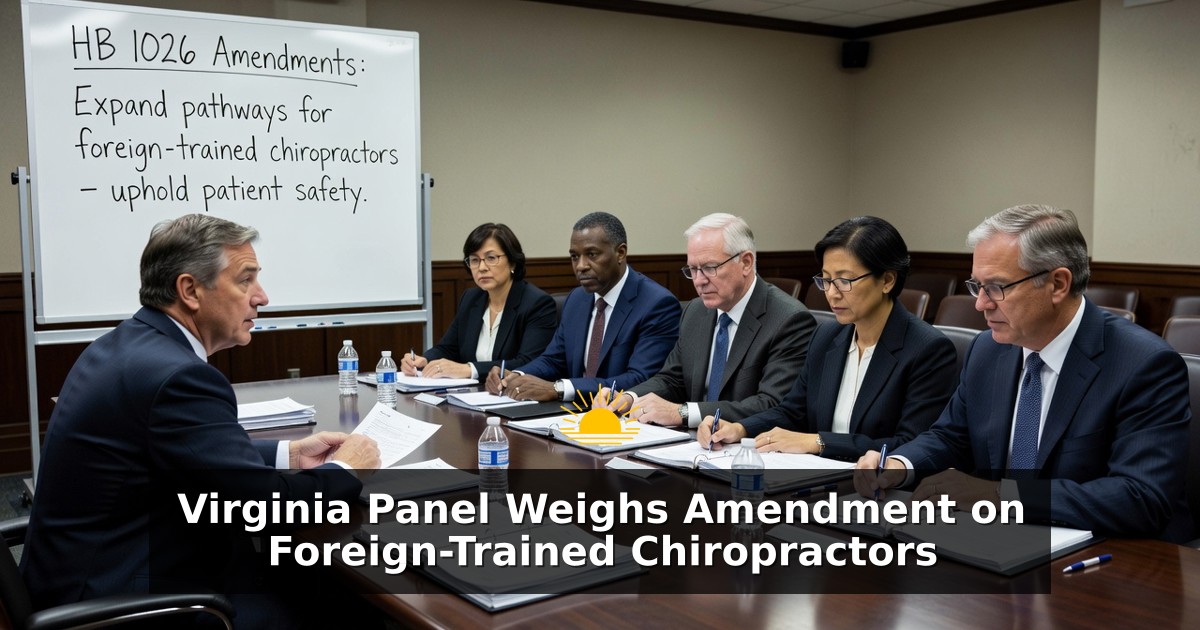
A Virginia health professions subcommittee on Thursday examined proposed amendments to House Bill 1026 that would expand pathways for certain foreign-trained chiropractors to seek licensure in the commonwealth. The discussion centered on allowing individuals who previously held licenses in their home countries to apply, provided they meet established educational and safety criteria. Delegate Tran offered the change as a friendly amendment intended to open opportunities for qualified immigrants and refugees without compromising professional standards. Committee members indicated general support for refining the language to maintain clear boundaries around eligibility.
The core of the amendment addresses practitioners who graduated from recognized institutions abroad, obtained licensure there, and later relocated to the United States. Under the suggested language, these individuals could demonstrate prior approval in their countries of origin even if they do not currently hold an active license. Additional requirements would include a period of residency in the United States, currently referenced as five years, along with fulfillment of supplemental measures designed to protect patients. Proponents framed the pathway as a means to integrate experienced professionals into Virginia’s health workforce while preserving rigorous oversight.
Subcommittee members stressed that any expansion must explicitly exclude applicants whose prior licenses had been revoked for cause. Refinements to the bill text were discussed to ensure that disciplinary history remains a disqualifying factor. The conversation underscored a dual objective of inclusion and accountability, with participants noting that patient safety remains the paramount consideration in licensing decisions. Officials indicated that further drafting would clarify documentation standards for verifying foreign credentials and residency timelines.
Background on Chiropractic Licensing Requirements
Virginia currently requires chiropractors to graduate from accredited programs, pass national board examinations, and satisfy state-specific jurisprudence and clinical criteria before receiving a license. Foreign-trained applicants traditionally face additional hurdles in credential evaluation and often must hold an active license elsewhere at the time of application. The proposed amendment to HB 1026 would modify that active-license prerequisite for a defined subset of candidates who can prove earlier licensure and subsequent compliance with safety-related conditions. Supporters argued that the change recognizes the reality of interrupted careers among immigrants and refugees who may have left practice for extended periods after arriving in the United States.
National trends show growing attention to workforce shortages in musculoskeletal care and the potential contributions of internationally educated practitioners. Several states have explored limited reciprocity or alternative pathways that emphasize competency verification over continuous licensure. In Virginia, the Board of Medicine and related health regulatory boards already maintain processes for evaluating foreign transcripts and clinical experience. The amendment under review would build on those existing mechanisms rather than create an entirely separate track, according to the discussion. Lawmakers noted that maintaining alignment with national examination standards would help ensure consistency across jurisdictions.
Patient Safety and Oversight Provisions
Central to the subcommittee’s deliberations was the insistence that expanded eligibility must not dilute clinical competence expectations. The five-year residency element, combined with additional training or supervised practice requirements, was presented as a safeguard. Members discussed the need for clear statutory language that would allow the relevant licensing board to request primary-source verification of foreign licenses and educational records. Any history of revocation or serious disciplinary action would bar participation in the new pathway, a point repeatedly affirmed during the exchange.
Observers of the hearing noted that the friendly nature of the amendment facilitated constructive dialogue rather than partisan division. Delegate Tran’s proposal was described as an effort to include more qualified professionals, particularly those from immigrant and refugee communities, while keeping standards intact. Committee participants explored wording options that would distinguish between lapsed licenses due to relocation and licenses terminated for misconduct. The resulting consensus appeared to favor precise drafting that leaves little ambiguity for regulators charged with implementation.
Broader Workforce and Demographic Context
Virginia’s population continues to diversify, and health-care employers have reported challenges in recruiting practitioners who reflect the communities they serve. Chiropractic services form part of the continuum of care for back pain, sports injuries, and related conditions that affect large segments of the workforce. By creating a structured route for previously licensed foreign graduates who have established long-term residence, the amendment seeks to enlarge the pool of available clinicians. At the same time, the emphasis on documented prior licensure and ongoing safety requirements aims to reassure the public that quality controls remain robust.
Legislative analysts following health professions bills observed that similar measures in other states have required careful coordination with accrediting bodies and testing organizations. In the Virginia context, successful implementation would likely involve updated guidance from the Department of Health Professions and possible regulatory amendments. The subcommittee’s focus on refining exclusionary language for revoked licenses reflects an awareness of past cases in which inadequate screening led to public-protection concerns. Continued attention to verification protocols is expected as the bill advances.
Next Steps for HB 1026
Following the friendly amendment discussion, the subcommittee indicated that staff would prepare revised text incorporating the suggested inclusion criteria and the revocation safeguard. Further review by the full committee and potential floor consideration would determine the final form of the legislation. Stakeholders from professional associations, immigrant-service organizations, and patient-advocacy groups are anticipated to submit comments during subsequent stages. The measure’s progress will depend on maintaining the balance between expanded access and uncompromised standards that characterized the initial exchange.
The dialogue surrounding HB 1026 illustrates the ongoing effort within Virginia’s General Assembly to adapt licensing frameworks to contemporary demographic and workforce realities. By addressing the specific circumstances of foreign-trained chiropractors who once held licenses abroad, lawmakers are testing a model that could inform future policy in other licensed professions. Clear statutory language, rigorous verification, and explicit patient-safety mandates remain the guiding principles as the amendment moves forward. The outcome will shape how the commonwealth evaluates international credentials while upholding the integrity of its health-care regulatory system.
additional requirements Amendment approval chair currently holds friendly amendment graduated held home countries institutions license lived here Madam Chair pathway patient safety practice prove requirements United States