Arlington County Adopts $1.7 Billion Budget Amid Calls for Improved Fiscal Timelines
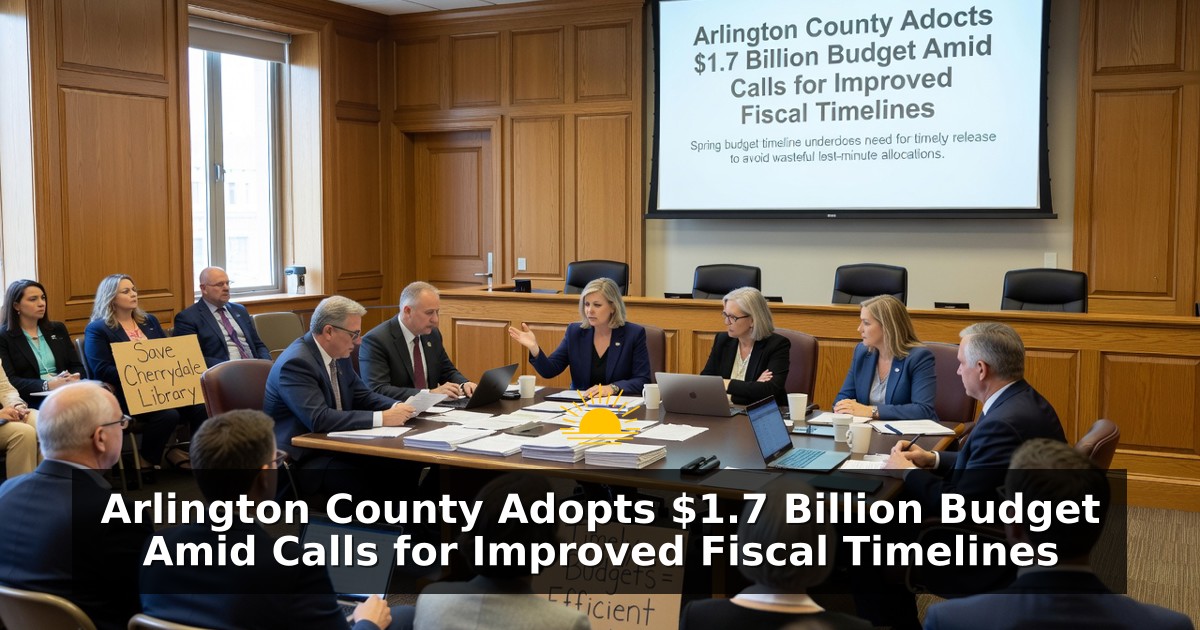
The Arlington County Board officially adopted a $1.7 billion budget for fiscal year 2027 on April 22, 2026, marking a modest 0.7 percent increase over the previous year. This spring budget timeline underscores the persistent need for timely fiscal releases to avoid rushed, last-minute funding allocations that can lead to systemic inefficiencies. The newly approved financial plan navigates a challenging economic landscape by shifting the tax burden toward homeowners amid ongoing declines in commercial property values. The current Arlington County Board consists of Libby Garvey, Matt de Ferranti, Takis Karantonis, Maureen Coffey, and Susan Cunningham. These local leaders faced the difficult task of balancing essential public services with the realities of stagnant commercial revenue streams. Consequently, the fiscal year 2027 budget represents a rare cycle without a significant overall spending increase. This fiscal reality forced the board to make complex trade-offs throughout the spring planning months. To cover critical funding gaps, the adopted budget includes a two-cent real estate tax rate increase for local property owners. This adjustment changes the county tax rate from $1.033 to $1.053 per $100 of assessed property value. While the overall budget grew by less than one percent, the shifting tax burden reflects a broader regional trend. Local residential taxpayers are absorbing the costs of declining commercial real estate assessments following long-term market shifts.
Last-Minute Adjustments and Allocations
The final days of the budget process highlighted the risks associated with delayed fiscal decisions and last-minute monetary allocations. Board members executed a late adjustment that reduced car-tax subsidies for expensive vehicles, a move that suddenly freed up $3.8 million in local funds. While this capital reallocation ultimately balanced the books, financial watchdogs frequently note that rushed adjustments can bypass comprehensive public scrutiny. Ensuring a timelier release of budget drafts could mitigate the need for these eleventh-hour financial maneuvers. Another late modification involved the Barcroft gymnastics program, which originally faced a steep 44 percent fee increase to remain operational. During the final budget sessions, officials scaled this proposed hike down to a 25 percent increase to ease the financial burden on participating families. Such last-minute fee recalibrations demonstrate the volatility of the spring budget timeline when initial proposals are not finalized early. A more structured timeline would provide departments with the necessary buffer periods to implement fee changes predictably.
Prioritizing Core Community Services
Despite the constrained revenue environment, the final budget successfully prioritized funding for essential public safety and criminal justice initiatives. Local food security programs, affordable housing developments, and safety net nonprofits also received protected funding status within the $1.7 billion framework. These targeted investments aim to support the most vulnerable populations in the county while maintaining core municipal operations. The board emphasized that protecting these foundational services remained a non-negotiable aspect of the fiscal planning process. Community advocacy played a significant role in preserving specific neighborhood services that were initially considered for potential cuts. Matt de Ferranti addressed the challenging fiscal environment, noting the difficulty of the recent financial decisions. He stated, “The budget we adopted last night is not an easy one: it prioritizes public safety and serving our most vulnerable.” He further explained that the board wanted to preserve community programs and services, like the Cherrydale Library and the gymnastics program at Barcroft, that help make Arlington a great place to live. The preservation of the Cherrydale Library stands as a testament to the community demand for accessible educational and recreational resources. Earlier draft versions of the budget left the facility’s long-term funding ambiguous, sparking concern among local civic associations and frequent patrons. By securing its operational budget in the final document, the county ensured that neighborhood-level library services remain uninterrupted for the upcoming fiscal year. Residents rallied heavily during the public comment periods to ensure this specific branch avoided the budgetary chopping block.
Navigating Commercial Property Declines
The underlying driver of this year’s stringent budget constraints is the continued depreciation of commercial property values across the county. Office building vacancies and shifting corporate footprints have significantly reduced the commercial tax revenues that traditionally subsidize local government operations. As a direct result, residential property owners are now shouldering a larger percentage of the overall tax burden to maintain the same level of municipal services. This dynamic marks a noticeable departure from previous decades when robust commercial growth comfortably funded county expansions. Financial analysts suggest that this structural shift in the local tax base may require Arlington to fundamentally rethink its future revenue models. Relying heavily on residential property taxes could become politically and economically unsustainable if commercial assessments do not eventually recover. Consequently, early and transparent budget timelines will become increasingly critical to allow residents ample opportunity to understand proposed tax rate changes. Clear communication regarding these macroeconomic shifts is necessary to maintain public trust during the annual budgeting cycle.
Improving the Fiscal Timeline
The late adjustments observed in the fiscal year 2027 budget cycle underscore the necessity of a more streamlined and timely fiscal planning process. When municipal leaders are forced to scramble for millions of dollars in the final hours, the risk of implementing inefficient or reactive policy measures rises significantly. Reforming the spring budget timeline to ensure earlier consensus could prevent the need to abruptly alter subsidy structures or drastically adjust program fees at the last minute. By locking in major allocations sooner, the county could avoid the appearance of wasteful or disorganized financial management. Moving forward, the Arlington County Board faces the dual challenge of managing stagnant revenues while improving the transparency of its allocation procedures. By establishing firmer deadlines for draft proposals, the county can foster a more predictable environment for both taxpayers and local agencies. Ultimately, a disciplined budgeting schedule will help safeguard public funds and ensure that every taxpayer dollar is allocated with maximum efficiency and foresight. Reforming the internal timeline remains a crucial step toward achieving long-term fiscal stability in a changing economic landscape.
Email the Arlington County School Board:
Miranda Turner, miranda.turner@apsva.us,
Kathleen Clark, kathleen.clark2@apsva.us,
Monique Bryant, monique.bryant@apsva.us,
Zuraya Tapia-Hadley, zuraya.tapiahadley@apsva.us,
Bethany Zecher Sutton, bethany.zechersutton@apsva.us,
Email the Arlington County Board:
Matt de Ferranti, mdeferranti@arlingtonva.us,
Maureen Coffey, mcoffey@arlingtonva.us,
Susan Cunningham, scunningham@arlingtonva.us,
Julius “JD” Spain, Sr., jdspainsr@arlingtonva.us,
Takis Karantonis, tkarantonis@arlingtonva.us,
Email the Arlington County School Board:
Miranda Turner, miranda.turner@apsva.us,
Kathleen Clark, kathleen.clark2@apsva.us,
Monique Bryant, monique.bryant@apsva.us,
Zuraya Tapia-Hadley, zuraya.tapiahadley@apsva.us,
Bethany Zecher Sutton, bethany.zechersutton@apsva.us,
Arlington County 2026 affordable allocated allocation allow Arlington Arlington County Arlington County Board Arlington County School Board Balancing Bethany Zecher Sutton board board members Budget budget process burden calls Capital challenge changing community complex concern consensus costs County criminal critical direct driver Ensuring establishing Explained facility Families Fee fees Financial fiscal fiscal year fiscal year 2027 Food funding funds government homeowners Housing Increase initiatives investments J.D. Spain Julius D. “JD” Spain, Sr. Kathleen Clark Landscape last minute local food local government market Matt de Ferranti Maureen Coffey measures Million Miranda Turner Monique Bryant move necessity officials ongoing opportunity owners planning Policy preservation procedures Process program programs property property owners property value Proposed protecting public comment public funds public safety public services rate regarding remains residents resources revenue Role safety School School Board services spending status Susan Cunningham Takis Karantonis Takis P. Karantonis tax Taxes taxpayer timeline transparency Trust value Zuraya Tapia-Hadley