Ashburn backup diesel generators ran up to 10 hours under federal emergency order
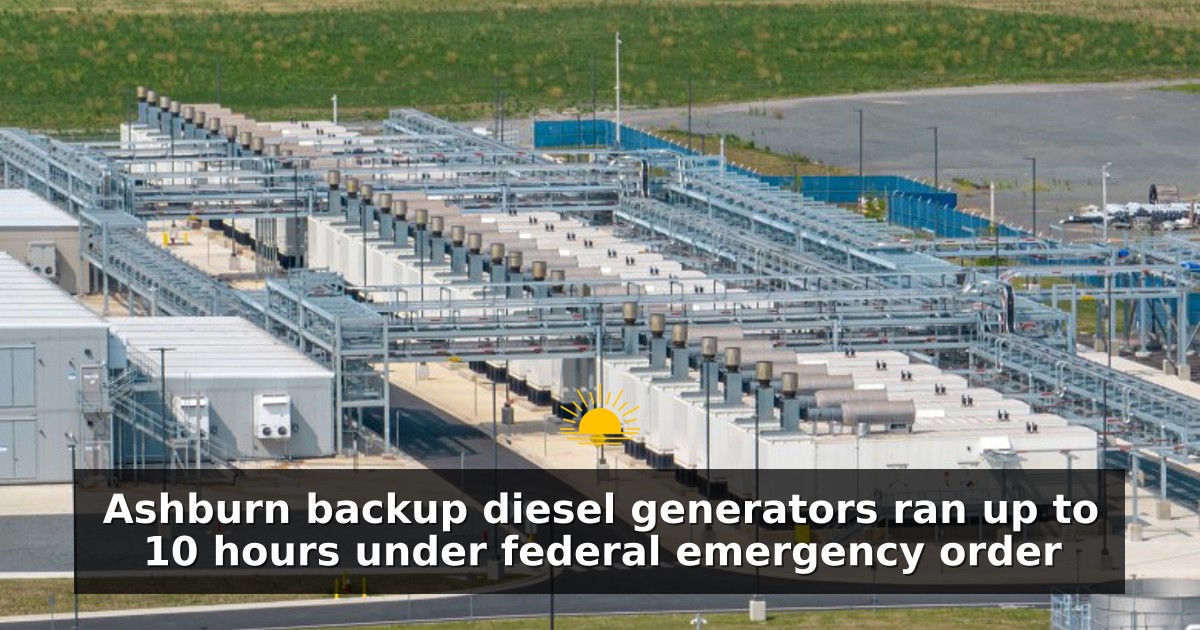
RICHMOND, Va. - Six emergency diesel generators in Ashburn ran for 8 to 10 hours on Sept. 17 under a federal emergency order that allowed the region's grid operator to call on backup power at large electricity users, according to a compliance report PJM Interconnection filed with the U.S. Department of Energy.
The report, dated Sept. 18, covers the first day of DOE Order No. 202-26-45. It lists units labeled VA1, VA2 and VA3 at 8 hours each, VA5 at 10 hours, and VA6 and VA10 at 9 hours each.
PJM's Exhibit A, the list of resources covered by the order, places all six in Ashburn, ZIP code 20147, and describes each as a diesel unit. Their listed nameplate ratings are 7, 11, 13, 28, 21 and 18 megawatts, about 98 megawatts combined. For each, the constraint relaxed by the order is listed as "Limitation on emergency engine operation."
Ownership not disclosed
Neither the order nor PJM's filings name the owners or operators of the Ashburn units, and they do not describe the facilities they serve. Ashburn is home to one of the largest concentrations of data centers in the world, and PJM said in a Sept. 17 operations update that the order authorized it "to direct data centers and other large load customers to switch to backup generation resources, if necessary." But the documents do not identify the Ashburn units as belonging to any particular data center or company.
A seventh Virginia backup unit, labeled CH1, is listed in Gainesville, ZIP code 20155, in Prince William County, rated at 30 megawatts, with a constraint of "Limitation on emergency engine operation, including fuel burn limitations." CH1 does not appear on the Sept. 17 compliance report.
The same report lists other backup sites outside Virginia that ran under the order, including a state prison in Pennsylvania, an Ohio school district, Gottlieb Inc. and the University of Akron.
What the order allowed
Paragraph B of the order authorized PJM, starting Sept. 17, to direct backup generation, "whether auxiliary, standby, directly-connected, battery storage, or other," to operate "as a last resort before declaring an EEA 3 (i.e., before firm load interruption) or during an EEA 3." An Energy Emergency Alert Level 3 is the stage at which grid operators may cut power to customers.
PJM asked that the order allow "use of backup generation by large loads notwithstanding any applicable environmental limitations under federal, state, or local law or regulation." PJM wrote that having large loads rely on their own generators "could help the RTO avoid residential load shed at EEA level 3."
The order follows a Jan. 22, 2026, letter from Wright to grid operators about using backup generation during emergencies. PJM cited several earlier 2026 orders that allowed similar dispatch.
The order exempts backup generators serving critical needs, including those at hospitals, 911 call centers, water and wastewater plants, defense and first-responder facilities, air traffic control and natural gas pipeline facilities. It also says backup units used under the order "shall not be considered a capacity resource," meaning they do not count toward the capacity PJM procures for reliability.
What the report does not show
The compliance report lists run hours only. It does not give the electricity produced or emissions released by the Ashburn generators, and it does not say whether the units would have exceeded their normal operating limits without the order. Hours run under the order do not count toward rolling-average limits, though the units must still meet monitoring and recordkeeping requirements where practicable and resume normal compliance after the order expires.
PJM's application said it would identify the location of dispatched units by posting Exhibit A. The Virginia Department of Environmental Quality issues air permits for stationary engines in the state. No Sept. 18 compliance report could be found on PJM's or DOE's websites.
Why it happened
PJM forecast demand near 133,285 megawatts on Sept. 17 and said it expected to be about 700 megawatts below its reserve margin. The grid operator said strain was most acute in the BGE, Pepco and Dominion zones, and that north-to-south power flows were limited by loading on the Conastone-Peach Bottom 500-kilovolt line. That afternoon, PJM called emergency demand response in those three zones.
The order was in effect through Sept. 18.
Documents
The order, PJM's application, its supplemental letter and Exhibit A are posted on the Department of Energy's 202(c) page for Order No. 202-26-45 at energy.gov. PJM's daily compliance report for Sept. 17 is posted at pjm.com.
Email the Board of Supervisors at:
Phyllis J. Randall (Chair, At-Large) – Phyllis.Randall@loudoun.gov,
Michael R. Turner (Vice Chair, Ashburn District) – Mike.Turner@loudoun.gov,
Juli E. Briskman (Algonkian District) – Juli.Briskman@loudoun.gov,
Sylvia R. Glass (Broad Run District) – Sylvia.Glass@loudoun.gov,
Caleb Kershner (Catoctin District) – caleb.kershner@loudoun.gov,
Matthew F. Letourneau (Dulles District) – Matt.Letourneau@loudoun.gov,
Kristen C. Umstattd (Leesburg District) – Kristen.Umstattd@loudoun.gov,
Laura A. TeKrony (Little River District) – Laura.TeKrony@loudoun.gov,
Koran Saines (Sterling District) – Koran.Saines@loudoun.gov
Loudoun County Ashburn backup generation Caleb Kershner diesel generators DOE Order 202-26-45 Juli Briskman Koran Saines Kristen Umstattd large loads Laura TeKrony Loudoun Loudoun County Board of Supervisors Matt Letourneau Mike Turner Phyllis Randall PJM Press Release Sylvia Glass Virginia