Attorney General Jones Says DHS May Have Violated Virginia Election Law
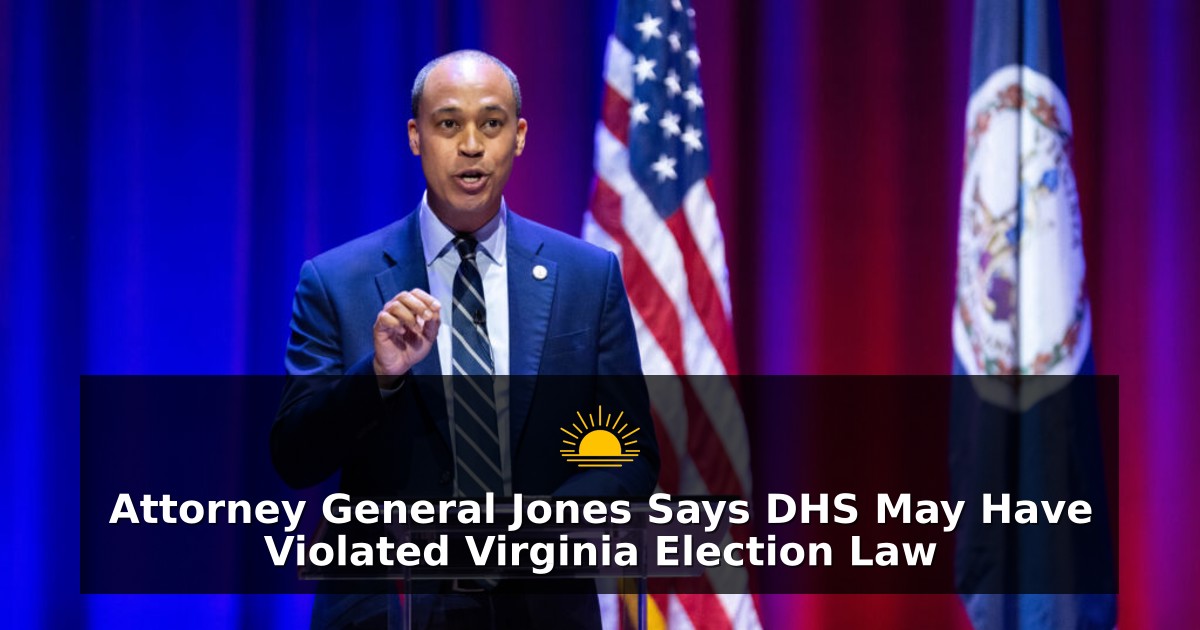
Virginia Attorney General Jay Jones said Thursday that the U.S. Department of Homeland Security may have violated several state election laws after a whistleblower accused federal employees of misrepresenting themselves on Virginia voter lookup tools while hunting for noncitizen voters.
In a letter obtained by The Associated Press and reported by The Washington Times, Jones demanded that Homeland Security Secretary Markwayne Mullin confirm in writing whether the department directed anyone to access Virginia voters’ information without first obtaining permission from those voters. “Virginia Election Code does not permit disclosure of this protected information to the federal government without a court order,” Jones wrote.
Virginia’s voter lookup systems are designed for individuals who attest under penalty of law that they are reviewing their own records. Jones argued that the state’s Election Code draws a hard line against handing protected voter data to federal agencies absent a court order, and he asked Mullin to preserve related records — including access logs, correspondence and training materials referenced in the whistleblower account.
The anonymous whistleblower report, published Monday by Democratic Senate leaders, describes a late-August DHS training for U.S. Citizenship and Immigration Services staff. According to the account, employees were pulled from other work, given less than two hours of training, and told to run DHS-provided lists through state voter registration systems to identify so-called unlawful voters.
The report contends agents were expected to review about 40 individuals per day — roughly 12 minutes apiece — to decide whether each person is a legal voter and to create federal records of anyone deemed not to be. Jones framed those practices as colliding with Virginia’s statutory limits on who may query voter tools and for what purpose.
The letter arrives amid a broader national fight over voter-roll access. President Donald Trump’s administration has alleged that noncitizen voting could be a significant source of fraud in the November midterms, even as academic and election-administration research has repeatedly found voting by noncitizens to be extremely rare. The Justice Department has sued seeking detailed voter data in dozens of states and the District of Columbia, though it has not yet prevailed in those cases.
For Virginia election officials and local registrars, the dispute is not abstract. County and city general registrars rely on the statewide voter registration system and related lookup tools to help residents confirm registration status, polling places and ballot options. If federal personnel are using those tools under false pretenses, Jones argued, it undermines both privacy protections written into state code and public confidence that voter data is used only for lawful purposes.
Jones’s request for written confirmation and records preservation also sets up a potential enforcement path. Attorneys general can pursue civil remedies when state privacy or election statutes are breached, and documentary trails — training decks, access logs, tasking emails — often become central exhibits. By putting Mullin on notice immediately, Jones is trying to freeze evidence before it disappears into routine federal retention cycles.
Political reaction in Richmond is likely to split along familiar lines. Democrats who back Jones will cast the letter as a defense of Virginia’s sovereign election administration against federal overreach. Republicans who prioritize aggressive noncitizen-voting investigations may argue that federal immigration agencies should be able to cross-check state rolls when they have leads. Local clerks and electoral boards, meanwhile, tend to care most about clear rules: who may query the system, under what attestation, and with what audit trail.
Virginia lawmakers have spent years tightening identity verification around absentee and same-day registration processes while also modernizing online voter services. Those reforms assumed that the people querying voter lookup portals would be the voters themselves or authorized election workers — not out-of-state federal teams working from DHS lists. Jones’s letter effectively asks whether that assumption still holds.
Election administrators across the commonwealth are already preparing for a high-turnout midterm cycle with contested House seats and intense ballot-security messaging. Adding a federal-state data fight on top of ordinary poll-worker recruitment, equipment testing and provisional-ballot procedures raises practical risks: confused voters, contested public-records requests, and rushed legislative proposals in the next General Assembly session.
Jones asked DHS not only to answer whether it directed the lookups but also to preserve materials named in the whistleblower report. That dual ask — confirm and preserve — is a classic litigation posture. It signals that Virginia’s attorney general is preparing for more than a press release: he wants a factual record that can support follow-up demands, civil suits or referrals if the department’s answer is unsatisfactory.
Whether DHS responds promptly will shape the next phase. If the department denies directing improper access, Jones may still press for audits of any Virginia-facing queries logged during the late-August window. If it acknowledges the program, expect fights over remedies: cessation, destruction of improperly obtained lists, notice to affected voters, or statutory changes clarifying that federal agencies need a court order before using Virginia’s voter tools.
For now, the immediate takeaway for Virginians is straightforward. The state’s top lawyer says federal personnel may have used Virginia voter lookup systems in ways state law does not allow, and he has demanded answers and evidence preservation from the Homeland Security secretary. Local election offices will keep running ordinary voter services while watching whether Richmond and Washington turn this dispute into a formal enforcement case before November.
Email Jay Jones at:
Jay Jones: RPickett@oag.state.va.us,
Ali Faruk Andrew Breton Anne Holton Cheryl Burke Cynthia Newbille Data Democrats Donald Trump election law Ellen Robertson Emmett Jafari Federal Government Fraud Immigration Jay Jones Katherine Jordan Kathryn Ricard Kenya Gibson Lawmakers Matthew Percival Nicole Jones President Republicans Reva Trammell Richmond Richmond City Council Richmond School Board Sarah Abubaker Senate Shavonda Fernandez Stephanie Lynch Stephanie Rizzi Trump Virginia voting Wesley Hedgepeth