Fairfax County Weighs Childcare Access Against Neighborhood Noise Concerns
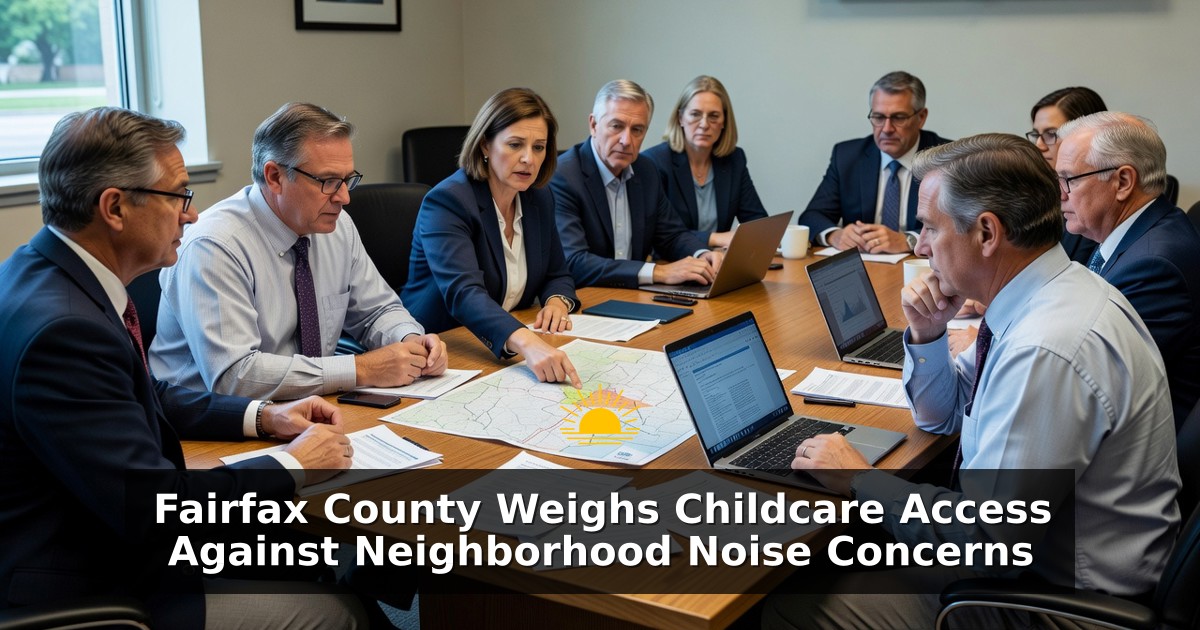
Fairfax County continues to confront the challenge of expanding reliable childcare options for working families while responding to neighborhood concerns about noise and regulatory processes. Local discussions have centered on home-based childcare settings located in residential areas, where the everyday sounds of children playing outdoors have become a frequent point of public comment. Officials and residents alike recognize that adequate early childhood care remains essential for economic stability and family well-being across the county. At the same time, maintaining the character and quiet of established neighborhoods ranks high among community priorities. The resulting tension has prompted careful review of existing standards and procedures.
Committee conversations in Fairfax County have highlighted differing views on whether the sounds of children at play should be treated as regulated noise. One perspective emphasized that outdoor play forms a normal and healthy part of childhood and should take precedence in residential zones. Proponents of this view argue that families living in these areas deserve primary consideration, even when nearby residents work from home and seek quieter conditions. They contend that applying formal noise metrics to children’s activities could unnecessarily restrict childcare providers. This stance reflects a broader belief that supporting the next generation outweighs certain lifestyle preferences of adult neighbors.
Community members who raise objections often focus on the cumulative effect of multiple children playing outside during daytime hours. Testimonies before local bodies frequently cite disruptions to remote work, rest, or the overall peace of residential streets. Some speakers have called for clearer guidelines or enforcement tools to address what they describe as excessive sound levels. County representatives have acknowledged that noise remains the most common complaint brought forward during public comment periods. Yet many of those same representatives have indicated that such concerns are routinely set aside when weighed against the documented need for childcare slots.
Procedural burdens placed on home childcare operators have also drawn scrutiny during these deliberations. Providers must navigate zoning rules, permitting steps, inspections, and ongoing compliance requirements that can prove time-consuming and costly. Advocates for simplified processes note that overly complex rules may discourage qualified caregivers from opening or expanding programs precisely when demand is high. Fairfax County has long sought to balance safety and quality standards with the practical realities faced by small-scale operators. Streamlining paperwork while preserving essential protections continues to surface as a shared goal among participants in the discussion.
Fairfax County is governed by its Board of Supervisors, whose current members are Chairman Jeff McKay, Walter Alcorn, John Foust, Penelope Gross, Patrick Herrity, Rodney Lusk, Dalia Palchik, Kathy Smith, Daniel Storck, and James Walkinshaw. These elected officials oversee land-use policies, public health regulations, and community development initiatives that directly shape childcare availability. Their decisions influence how residential properties may be used for family day homes and what conditions accompany those uses. Public hearings and committee work sessions provide the formal venues where competing interests are aired and recorded. The board’s ultimate policy choices will determine how the county reconciles family support with neighborhood expectations.
Demand for childcare in Fairfax County remains elevated as more parents return to workplaces or maintain hybrid schedules. State and local data have consistently shown gaps between the number of available slots and the number of children needing care, particularly for infants and toddlers. Home-based programs fill an important portion of that gap because they often offer flexible hours and familiar neighborhood settings. Restricting these programs through stringent noise rules or heavy administrative loads could shrink supply further. County leaders therefore face pressure to protect existing capacity while exploring measured adjustments that respond to legitimate resident feedback.
Existing Fairfax County noise ordinances already set general limits on sound levels in residential districts, yet they contain limited specific language addressing children’s play. Legal and planning staff have examined whether additional clarity would help both providers and neighbors understand expectations. Any revision would need to avoid creating standards so rigid that outdoor activity becomes impractical. Child development specialists routinely stress that fresh air and active play contribute significantly to physical and social growth. Policy language that acknowledges this developmental need while still offering neighbors avenues for relief has emerged as a central drafting challenge.
Public participation in the process has revealed a spectrum of experiences rather than a single unified neighborhood position. Some residents living near family day homes report positive relationships and minimal disturbance, describing the presence of children as an asset to community vitality. Others document repeated interruptions that affect concentration, sleep schedules, or property enjoyment. County facilitators have attempted to capture both sets of accounts without dismissing either. The record of testimony shows that emotional intensity often accompanies these statements, underscoring how deeply the issue touches daily life.
Economic considerations add another layer to the policy debate. Reliable childcare enables parents to remain in the workforce, supporting household incomes and the broader Fairfax County tax base. When providers close because of regulatory friction or neighbor conflicts, the ripple effects reach employers and local businesses. Conversely, unchecked noise can reduce quality of life and, in extreme cases, influence housing decisions. Officials therefore evaluate proposals through both social and fiscal lenses, seeking outcomes that sustain family services without eroding residential stability.
Looking ahead, Fairfax County appears poised to refine guidance rather than impose wholesale bans or deregulation. Incremental steps under discussion include clearer communication materials for providers, optional mediation pathways for neighbor disputes, and targeted reviews of permitting timelines. Any formal changes would move through public notice, additional comment opportunities, and eventual board action. The process itself illustrates the county’s effort to honor both the developmental needs of children and the legitimate interests of residents who share the same streets. Continued attention to evidence, fairness, and practical implementation will shape the next phase of this ongoing local conversation.
Balancing burdens challenge Childcare childcare needs Children committee community community concerns Concerns grapples needs noise ongoing particularly procedural procedural burdens regarding remains