Virginia Bill Mandates No-Copay Coverage for Over-the-Counter Contraceptives
Updated
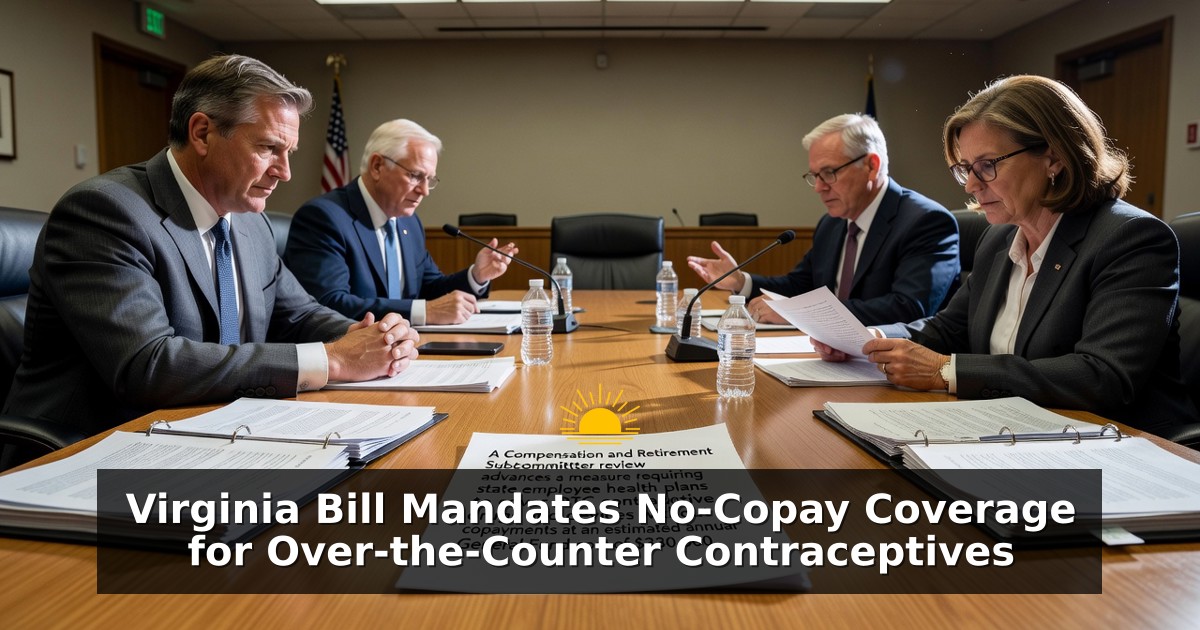
The Compensation and Retirement Subcommittee reviewed legislation that would require health insurance coverage for contraceptive drugs and devices available over the counter while prohibiting any associated copayments. The proposal extends existing rules that already bar copays for prescription contraceptive services under the State Employee Health Plan. Lawmakers considered the measure as part of ongoing efforts to align benefits with current pharmaceutical access standards. Officials noted that the change would apply uniformly across covered plans serving state workers.
Supporters of expanded access have long pointed to the practical barriers that cost-sharing can create for employees seeking routine preventive care. Over-the-counter options include a range of products that do not always require a clinician visit, potentially simplifying obtainment for many individuals. The subcommittee discussion centered on how the State Employee Health Plan would absorb the new mandate. Fiscal staff presented projections showing measurable but contained budget effects.
Legislative Clarifications and Committee Actions
The Labor and Commerce Committee previously adopted a line amendment clarifying that the required coverage applies whether or not a prescription is needed. That technical change ensures the bill language captures both traditional prescription products and those sold directly on pharmacy shelves. Committee members sought to eliminate ambiguity that might otherwise leave certain devices or medications outside the no-copay protection. The amendment was described as a straightforward drafting adjustment rather than a substantive policy shift.
Current Virginia rules already eliminate copayments for prescription contraceptive services offered through the state plan. Extending the same treatment to over-the-counter items creates consistency across the full spectrum of available methods. Health plan administrators would need to update claims processing systems and member communications to reflect the broader no-cost standard. Implementation timelines would likely follow the normal cycle for benefit-year adjustments once the measure advances.
Fiscal Impact on the State Employee Health Plan
Analysts estimated the total annual cost at $788,000 in combined funds for the State Employee Health Plan. Of that amount, $330,000 would come from the General Fund each year. The remaining share would be covered through other plan funding sources tied to employee and employer contributions. These figures represent a relatively modest increment within the overall scale of the state health benefits budget.
Budget officials emphasized that the projection accounts for expected utilization patterns based on existing prescription contraceptive claims data. Higher uptake of newly covered over-the-counter products could occur, yet the estimate already incorporates reasonable growth assumptions. The General Fund portion would appear as a recurring expenditure in future budget documents if the bill becomes law. Lawmakers weighing the proposal must balance the added cost against the preventive-care value of broader contraceptive access.
Importance of Contraceptive Access in Employee Benefits
Access to contraceptive drugs and devices remains a core component of comprehensive health coverage for working adults. When cost barriers are removed, employees can select methods that best fit their medical needs and life circumstances without financial hesitation. Public employers across many states have moved toward zero-copay models for both prescription and non-prescription options in recent years. Virginia’s State Employee Health Plan already follows the no-copay approach for prescribed services, making the over-the-counter extension a logical next step.
Research consistently shows that uninterrupted contraceptive use correlates with lower rates of unintended pregnancy and associated medical costs. State employees and their covered dependents would gain the ability to obtain eligible products at pharmacies without out-of-pocket charges. Plan design changes of this type often produce downstream savings through avoided higher-cost services, although such offsets were not quantified in the immediate fiscal note. The subcommittee examined these dynamics while reviewing the bill’s narrow focus on coverage mandates and cost-sharing prohibitions.
Next Steps in the Legislative Process
After subcommittee consideration, the measure would proceed through additional review stages typical of the Virginia General Assembly calendar. Further amendments could refine eligibility details, reporting requirements, or coordination with federal coverage standards. Stakeholders including employee representatives, health plan contractors, and fiscal agencies are expected to supply additional input as the bill advances. The $330,000 General Fund estimate will remain a central reference point during budget negotiations.
Observers noted that similar coverage expansions in other jurisdictions have been implemented with limited administrative disruption. Virginia’s existing infrastructure for processing contraceptive claims positions the State Employee Health Plan to absorb the change efficiently. Clear member notices and updated formularies would help ensure employees understand the new benefits. The legislation’s emphasis on both drugs and devices underscores an intent to cover the full range of over-the-counter contraceptive products currently marketed.
Broader Policy Context Within Virginia
Virginia has maintained a structured approach to state employee benefits that prioritizes preventive services while monitoring fiscal sustainability. The current proposal fits within that framework by building directly on rules already in force for prescription contraceptives. Lawmakers have repeatedly examined ways to reduce unnecessary friction in obtaining basic reproductive health products. The subcommittee’s review provided a focused venue for assessing both the coverage mandate and its precise cost to taxpayers.
Any final version of the bill would apply specifically to the State Employee Health Plan rather than the broader commercial insurance market. That limited scope keeps the fiscal impact contained and allows for careful evaluation of real-world utilization. Should experience demonstrate higher or lower costs than projected, future General Assemblies could adjust the benefit design accordingly. For now, the legislation stands as a targeted effort to equalize cost-sharing rules across prescription and over-the-counter contraceptive options.
The discussion highlighted the practical reality that many effective contraceptive methods no longer require a prescription yet still carry retail prices that can deter consistent use. Removing copayments addresses that barrier for the thousands of Virginians covered by the state plan. Continued legislative scrutiny will determine whether the measure moves forward with the clarified language adopted by the Labor and Commerce Committee. The estimated annual outlay of $330,000 from the General Fund remains the clearest quantifiable consequence identified during the subcommittee examination.
bill committee hearing Compensation and Retirement Subcommittee contraceptive coverage contraceptive devices contraceptive drugs co-pays cost estimate coverage clarification drug coverage General Fund health insurance insurance mandate Labor and Commerce Committee line amendment over the counter contraceptives prescription contraceptives reproductive health state employee benefits State Employee Health Plan