Virginia Lawmakers Consider Shift to Civil Penalties for Noise Ordinance Violations
Updated
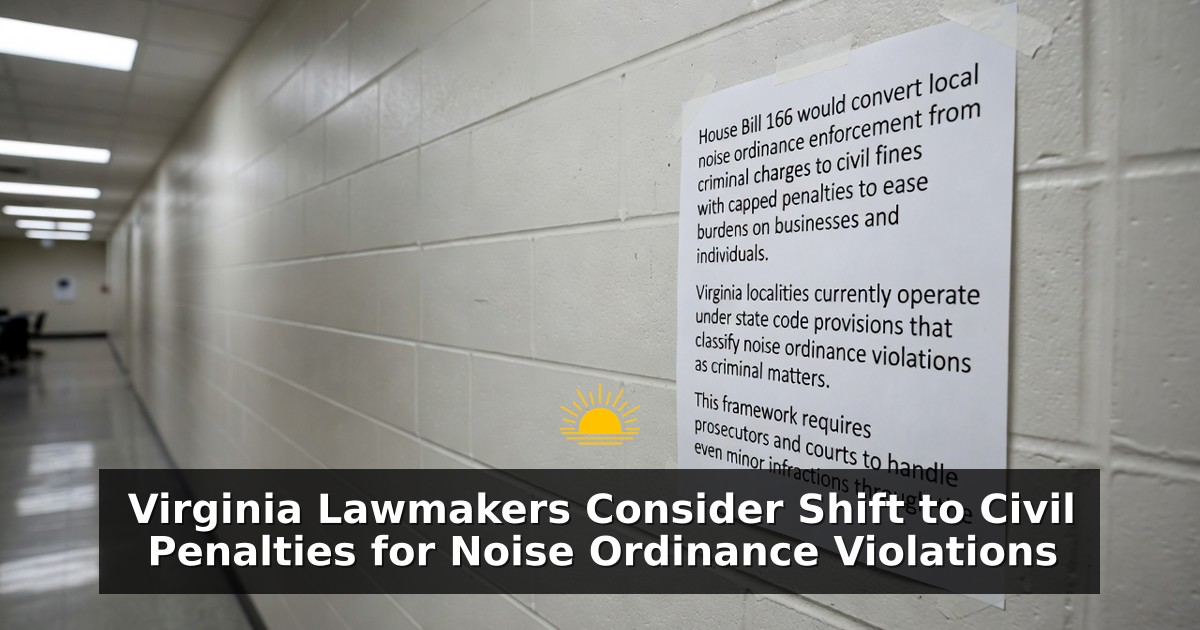
Virginia localities currently operate under state code provisions that classify noise ordinance violations as criminal matters. This framework requires prosecutors and courts to handle even minor infractions through the criminal justice system. Lawmakers are now examining House Bill 166, a measure designed to authorize civil enforcement options instead. The proposal seeks to address longstanding practical difficulties that arise when officials attempt to apply criminal processes to everyday noise complaints.
Enforcement challenges have proven especially pronounced for commercial and industrial operations. Practicing attorneys familiar with local government law note that bringing corporations into criminal court for noise issues is cumbersome and inefficient. Criminal proceedings demand higher burdens of proof, formal charging documents, and potential court appearances that consume significant public resources. These procedural hurdles often leave localities with limited realistic tools for addressing repeated or disruptive noise from businesses.
House Bill 166 proposes to remove an existing exemption that has prevented industrial properties from falling under civil penalty authority. By eliminating that exemption, the legislation would allow local governments to create civil actions specifically for noise ordinance violations. The change would apply across property types while preserving local flexibility to craft ordinances suited to community needs. Supporters of the approach argue that civil processes align better with the regulatory nature of most noise complaints.
Clear financial guardrails form a central feature of the bill. A first violation would carry a maximum civil fine of 250 dollars. Any subsequent violations would be limited to 500 dollars each. These caps aim to keep penalties proportionate to the typically non-violent character of noise infractions. The structure also provides predictability for property owners and business operators who must budget for potential compliance costs.
Shifting enforcement from criminal to civil status carries direct implications for individual records. Under the current criminal model, even a minor noise citation can appear on a permanent criminal history. Such entries may affect employment screening, professional licensing, housing applications, and other background checks for years afterward. Civil fines, by contrast, generally do not generate the same lasting criminal record consequences.
Business operators stand to gain operational clarity from the proposed reforms. Many commercial establishments, particularly those in hospitality, entertainment, construction, and light industry, generate sound as a routine byproduct of legitimate activity. The threat of criminal prosecution can create uncertainty that discourages investment or expansion. Civil fines offer a more straightforward compliance pathway that still deters excessive noise without elevating every dispute to criminal court.
Local governments would retain authority to adopt and enforce noise standards under the bill. The legislation does not mandate uniform statewide decibel limits or quiet hours. Instead, it equips counties and cities with an additional enforcement mechanism once they choose to enact civil penalty ordinances. This local-control emphasis reflects Virginia’s traditional approach to land-use and quality-of-life regulations.
Legal observers point out that civil enforcement already exists for numerous other local code violations across the Commonwealth. Zoning infractions, certain building-code matters, and various public-nuisance issues frequently proceed through civil channels. Extending similar treatment to noise ordinances would bring consistency to the broader regulatory toolkit available to local officials. The change could also free limited prosecutorial resources for more serious criminal matters.
Community residents who experience disruptive noise would continue to have avenues for relief. Civil processes typically allow for administrative hearings or general-district-court review rather than full criminal trials. Fines collected under the new authority could support local enforcement programs or general revenue, depending on how each locality structures its ordinance. The capped amounts are intended to remain meaningful without becoming punitive beyond the scale of the offense.
Industrial and commercial stakeholders have long cited the difficulty of defending corporate entities against criminal noise charges. Corporate criminal liability involves complex questions of knowledge, intent, and responsible agents that rarely fit simple noise disputes. Civil liability focuses more directly on the fact of the violation and the appropriate monetary sanction. This distinction is expected to streamline both investigation and resolution.
The bill’s sponsors have framed the measure as a practical modernization rather than a weakening of standards. Noise remains a legitimate quality-of-life concern in residential neighborhoods adjacent to commercial corridors or industrial zones. By making enforcement more workable, the legislation could actually increase the frequency of appropriate citations while reducing the collateral consequences attached to each case. Balanced implementation will depend on how carefully localities draft their implementing ordinances.
Public discussion around House Bill 166 has highlighted the tension between economic activity and residential tranquility. Virginia’s growing population and expanding commercial base have increased the number of potential friction points. Civil penalties offer one calibrated response that acknowledges both the right of residents to reasonable quiet and the need for businesses to operate without constant fear of criminal exposure. The capped fine schedule provides a transparent starting point for that balance.
If enacted, the measure would require localities interested in civil enforcement to update their local codes accordingly. Training for code-enforcement officers, adjustments to ticketing systems, and public education about the new process would follow. Courts would see a shift of certain dockets from criminal to civil divisions, potentially improving overall case-flow efficiency. Monitoring of fine collection rates and compliance outcomes would help evaluate the reform’s effectiveness over time.
House Bill 166 represents a targeted adjustment to an existing statutory framework rather than a wholesale rewrite of noise policy. Its core innovation lies in converting the default enforcement posture from criminal to civil while imposing modest, escalating monetary limits. The removal of the industrial-property exemption ensures the new tool applies evenly. Together these elements aim to reduce unnecessary criminal records, ease administrative burdens, and maintain meaningful deterrence against excessive noise.
Observers of the Virginia General Assembly will watch the bill’s progress through committee and floor consideration. Stakeholder input from local governments, business associations, and neighborhood groups is expected to shape any refinements. The underlying policy question remains how best to regulate an everyday quality-of-life issue without over-relying on the criminal justice system. House Bill 166 offers one concrete legislative answer grounded in civil process and limited fines.
250 500 attorney Business chair civil action corporations court criminal criminal violations delegate enforcement exemption first violation guardrails House Bill 166 industrial properties localities noise ordinances noise violation state code subsequent violations Tom