Birding and Myth-busting at a State Forest
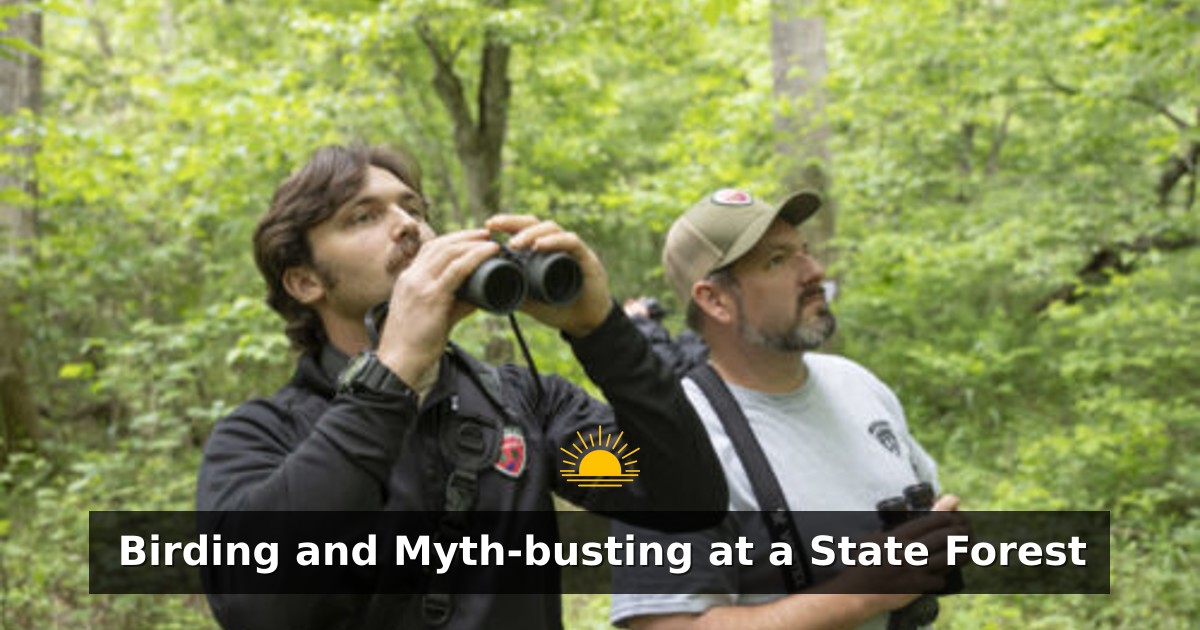
In May, DOF fielded a team of six to compete in the annual Virginia Birding Classic. The challenge was to spot as many birds as possible on public lands in one day. We chose the Appomattox-Buckingham State Forest as our venue. Avid birders all, our mission wasn’t winning a prize (though that would have been nice). Instead, we were out to document the value of a “working” forest to birds and do a little myth-busting about forest management and wildlife habitat. Our data collection resulted in 67 species of birds seen in 5 hours!
Myth – Managed forests are too neat and unnatural to support wildlife.
Truth – Management goals help foresters and landowners decide which activities happen on a working forest like the Appomattox-Buckingham. Any human-caused disturbance, such as a timber harvest, a thinning, or a prescribed burn, is short-lived. Vigorous plant growth soon erases most evidence of human intervention, and the forest is left on its own most of the time. With all the shade-tolerant understory trees, saplings, shrubs, forest-floor plants, fallen trees and branches, it’s usually hard to tell you are in a managed forest.
Hardwood forests in particular tend to be managed on a very long time scale, often 80 years or more. This gives the forest time to develop true late-successional characteristics that benefit forest interior birds, such as wood thrush, ovenbird, and many wood warblers.
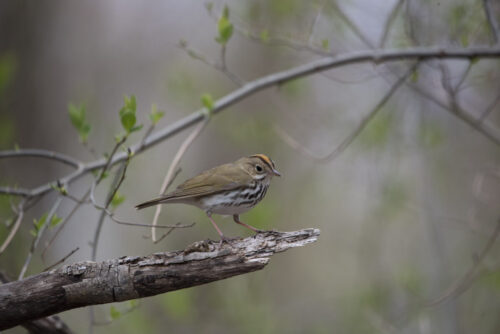
Ovenbirds forage for insects and nest in thick leaf litter on mature forest floors.
Myth – Clearcutting is bad for birds.
Truth – Clearcutting is a controversial word for many nature enthusiasts. It shouldn’t be. Some tree species, such as yellow-poplar and most pines, can be established only in open areas with full sunlight – the exact conditions created by a clearcut. Clearcutting resets the clock on ecological succession, to the benefit of many species of birds and other wildlife. On the Appomattox-Buckingham, cutover areas may be planted with pines, or hardwood trees may be allowed to resprout, depending on the management goals and conditions on the tract.
In Virginia, over 60 species of birds rely on open-land habitat. Many of these species have experienced steep population declines due to habitat loss from development, modern agricultural practices, and even from aging forest landscapes. Clear cuts, as they begin to regenerate, create the open, brambly conditions needed by species such as field sparrow, yellow-breasted chat, indigo bunting, and prairie warbler.
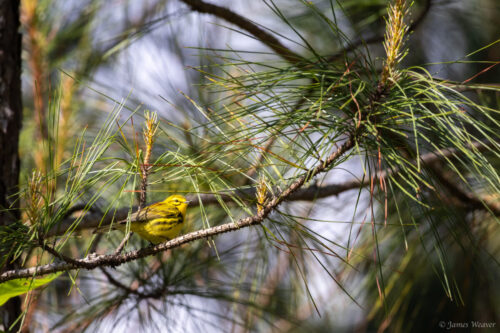
Prairie warblers love early successional pine habitat.
Myth – Pine forests are biological deserts.
Truth – Some sites are very well adapted to grow pines, which thrive on poorer soils. Like most of the Piedmont, the land occupied by the Appomattox-Buckingham State Forest was once farmland. Farming practices through the 1930s eroded the land, sending most of its original topsoil down the rivers to the Chesapeake Bay. Pines, a natural stage in Piedmont forest succession, help to rebuild the soil that might eventually grow healthy hardwoods.
Pines provide a specific stage of habitat that supports birds like brown-headed nuthatch, pine warbler, chipping sparrow, common yellowthroat, and much more. Pines also provide cover for birds during inclement weather. In Virginia, most pines are not grown like a weed-free crop, but rather have an understory of young hardwood trees, vines, and other plants. When pines reach the canopy closure stage with little understory, the forestry practice of thinning puts sunlight back on the ground and results in new flushes of vegetation.
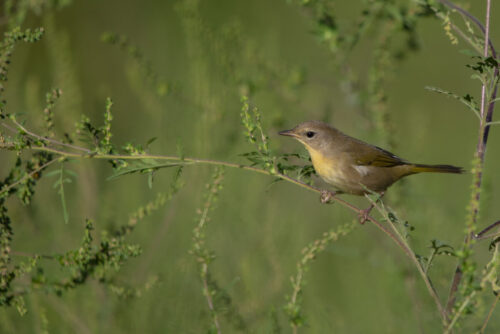
Common yellowthroats are consistently found in early successional habitats.
At least 67 species of birds can’t be wrong – working forests support many birds and other wildlife! While unmanaged forests can provide dense, old-growth habitats that some species prefer, large working forests like the Appomattox-Buckingham provide a diversity of forest types across the landscape, in turn benefiting a diverse ecosystem.
Chesapeake is an independent city in Hampton Roads.
Buckingham County Chesapeake challenge Chesapeake Chesapeake Bay conditions Data development Education Farming forests Land Landscape Loss practice short state team value Virginia wildlife