Virginia Advances Bill to Market Invasive Blue Catfish and Protect Bay Seafood
Updated
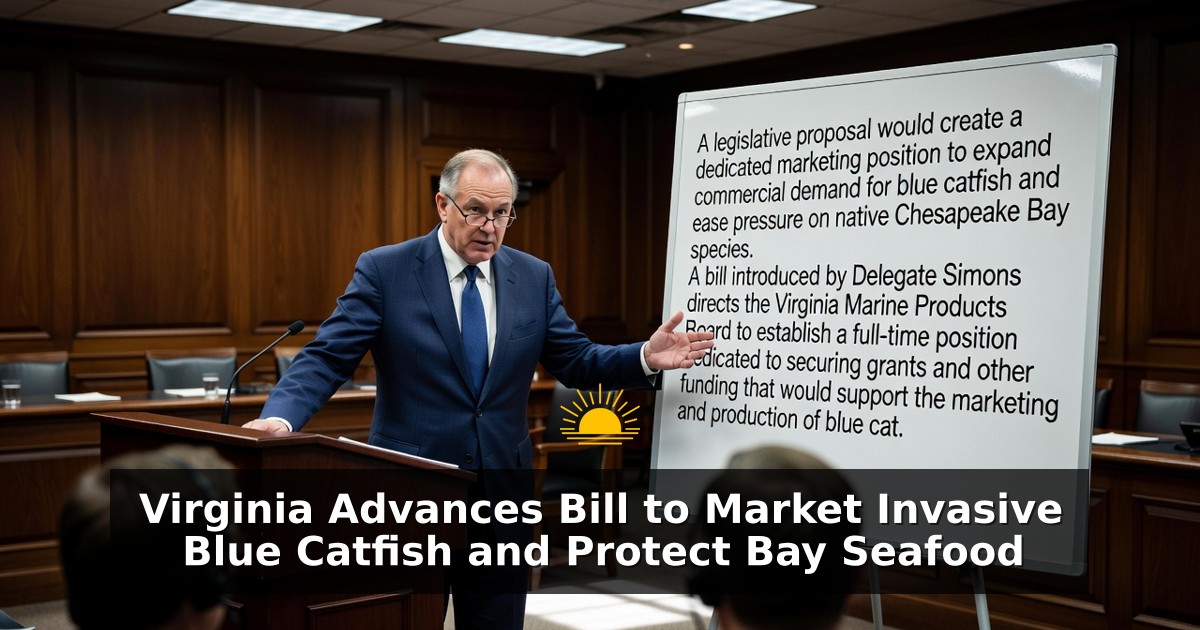
A bill introduced by Delegate Simons directs the Virginia Marine Products Board to establish a full-time position dedicated to securing grants and other funding that would support the marketing and production of blue catfish across the Commonwealth. The measure responds to growing concern that the invasive fish is disrupting the ecological balance of the Chesapeake Bay by consuming large quantities of native seafood. Officials and industry representatives have described the species as both abundant and palatable, yet they note that commercial infrastructure and consumer awareness remain limited. The legislation seeks to close those gaps so that increased harvest and sales can reduce the population of the invasive predator. Supporters frame the approach as a practical way to convert an environmental problem into an economic opportunity for Virginia’s seafood sector.
Blue catfish were originally introduced into Virginia rivers decades ago for recreational fishing and have since expanded dramatically throughout the Chesapeake Bay watershed. Scientists and resource managers report that the fish prey heavily on oysters, clams, blue crabs, and striped bass, also known as rockfish, placing additional stress on already vulnerable populations. According to information presented with the bill, blue catfish may consume as much as 60 million pounds of valuable seafood each day. That level of predation has prompted repeated calls for coordinated action among state agencies, watermen, and seafood processors. The current proposal builds on earlier recommendations from a blue catfish work group that examined both ecological damage and potential commercial solutions.
Ecological Pressure on Native Species
The rapid growth of blue catfish populations has altered food webs in tidal rivers and the open bay. Researchers have documented that larger individuals feed on a wide range of native invertebrates and fish, competing directly with species that support commercial and recreational fisheries. Oyster restoration projects, crab harvests, and rockfish stocks all face compounded challenges when an efficient non-native predator is present in high numbers. Managers emphasize that traditional population-control methods alone have proven insufficient given the fish’s reproductive success and tolerance for varied salinity levels. Expanding market demand is therefore viewed as a complementary strategy that can remove biomass while generating revenue for harvesters.
Virginia’s seafood industry already possesses processing capacity and distribution networks, yet participants say specialized facilities and consistent supply chains for blue catfish are still underdeveloped. Creating stable buyer interest would encourage watermen to target the invasive species more aggressively. The proposed full-time position at the Virginia Marine Products Board would focus on identifying federal, state, and private grants that can underwrite marketing campaigns, product development, and infrastructure improvements. Board staff currently promote a range of Virginia seafood products; adding dedicated capacity for blue catfish would allow sustained outreach to restaurants, retailers, and institutional buyers. Advocates argue that once consumers recognize the fish as a high-quality, locally sourced option, demand can help regulate its numbers in the bay.
Economic and Industry Considerations
Commercial harvest of blue catfish has increased in recent years, yet prices and market penetration remain uneven compared with established species. Processors note that consistent volume and predictable quality standards are essential before large grocery chains and food-service companies commit to regular purchases. A funded marketing specialist could coordinate branding efforts, recipe development, and promotional events that highlight the fish’s mild flavor and firm texture. Such work would also explore value-added products that extend shelf life and appeal to broader customer segments. Industry representatives have indicated that technical assistance with production facilities would further reduce barriers for smaller operators wishing to enter the blue catfish trade.
The blue catfish work group, whose recent recommendation underpins the bill, brought together scientists, fishery managers, watermen, and business owners to evaluate management options. Their consensus favored market-based removal as one component of a larger strategy that also includes continued monitoring and selective harvest regulations. By directing the Marine Products Board to pursue external funding, the legislation aims to limit new demands on the state general fund while still advancing the work group’s goals. Delegate Simons has presented the measure as a targeted response that aligns ecological restoration with economic development for coastal communities. The approach reflects a broader trend in invasive-species management that seeks to enlist consumer demand rather than rely solely on public eradication programs.
Implementation Pathways and Oversight
If enacted, the new position would operate under existing board authority to promote Virginia seafood, ensuring accountability through standard state personnel and budgeting procedures. Performance metrics could include grants secured, partnerships formed with processors, and measurable increases in blue catfish landings or retail sales. Success would be evaluated against the dual objectives of reducing predatory pressure in the bay and strengthening the competitiveness of local seafood businesses. Observers note that similar marketing initiatives for other underutilized species have produced gradual but lasting shifts in consumer habits when sustained over multiple years. Continued collaboration with the work group and academic researchers would help refine messaging and track ecological outcomes.
Public education remains a critical element of any market-expansion effort. Many consumers are unfamiliar with blue catfish or associate catfish primarily with farm-raised products from other regions. Clear information about the species’ invasive status, its abundance in Virginia waters, and recommended preparation methods can encourage trial purchases. Restaurants that feature locally caught blue catfish already report positive customer responses when the environmental story is paired with quality cuisine. Scaling those experiences through coordinated promotion could accelerate acceptance across retail and food-service channels. The bill’s emphasis on grant identification recognizes that private-sector partners often require matching resources or technical support before investing in new product lines.
Longer-term management of blue catfish will likely combine commercial incentives with ongoing scientific assessment of population trends and native-species recovery. Fishery managers stress that harvest alone may not eliminate the invader, yet sustained removal of large numbers can lessen daily predation on oysters, crabs, and rockfish. The proposed marketing position offers a concrete mechanism for translating work-group recommendations into operational funding and industry engagement. As the measure moves through the legislative process, stakeholders will examine how best to integrate it with existing bay-restoration programs and commercial fishing regulations. The underlying premise remains straightforward: a robust market for blue catfish can simultaneously support watermen and relieve ecological strain on the Chesapeake Bay’s native seafood resources.
bill blue catfish blue catfish work group Chesapeake Bay clams committee commonwealth crabs crisis full-time position funding opportunities Grants invasive species market marketing oysters production production facilities rockfish seafood industry seafood product Virginia Marine Products Board