BPA’s 1989 Transmission Review Left EMF Health Risk Unsettled — And Still Echoes in Corridor Fights
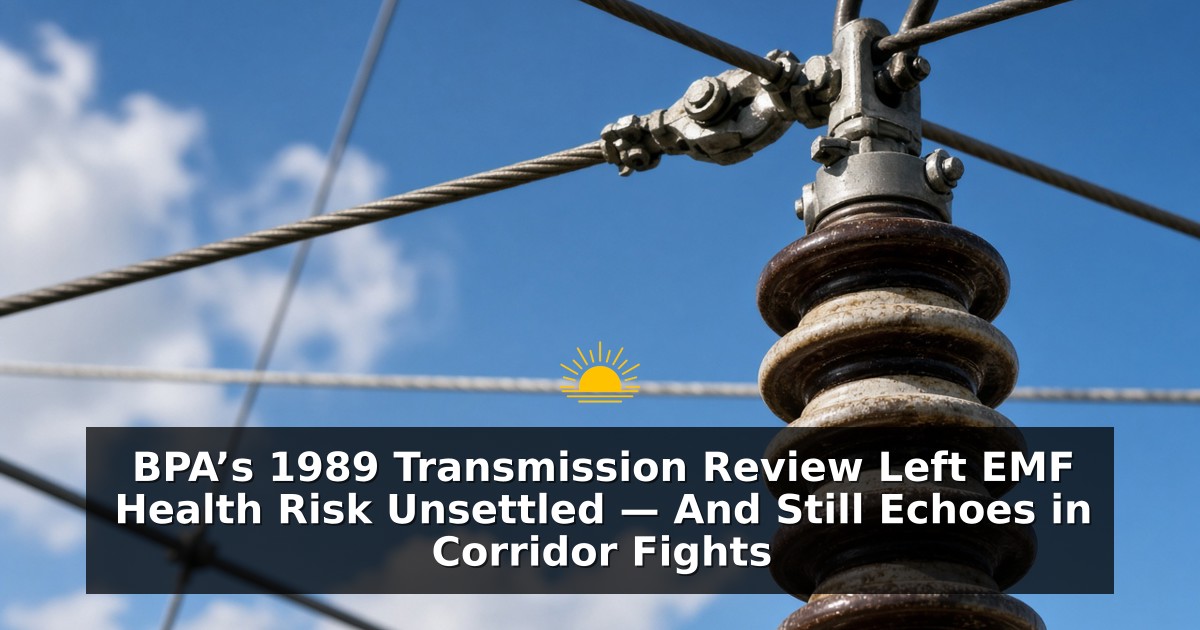
PORTLAND / RICHMOND — Decades before Virginia’s data center boom forced new 500 kV and 765 kV corridors onto the Mid-Atlantic map, the Bonneville Power Administration published a blunt federal review of what high-voltage lines do to people living near them. DOE/BPA-945, Electrical and Biological Effects of Transmission Lines: A Review (1989), assembled by BPA’s Biological Studies Task Team chaired by Jack M. Lee, Jr., remains a primary packet exhibit in today’s electromagnetic field debates — not because it settled the science, but because it refused to pretend the question was closed.
The review grew out of 1970s public and scientific interest in extra-high-voltage lines, “primarily 500 kV and 765 kV,” and the possible effects of electric and magnetic fields, audible noise, radio noise, and ozone. BPA said the document was its generic NEPA source for environmental impacts of proposed transmission. By 1989 the research had widened beyond transmission rights-of-way to low-voltage distribution lines and a possible association between residential magnetic fields and cancer, plus occupational studies of workers presumed exposed to fields.
On the physics, the summary is concrete. North American a-c power runs at 60 Hz. Voltage produces an electric field; current produces a magnetic field. Maximum vertical electric field near ground on a BPA 500 kV right-of-way was listed as less than 9 kV/m, falling to roughly 2–3 kV/m at the edge. Magnetic fields on the right-of-way averaged around 20–70 milligauss, and about 5–25 mG at the edge. Trees and buildings shield electric fields; they do not meaningfully shield magnetic fields — so nearby power lines can dominate indoor magnetic exposure. Appliance fields drop fast with distance; at a few feet many household sources fall near 1 mG.
Acute shocks and spark discharges, BPA wrote, are “well understood and largely controllable” with grounding of fences and large metal objects under the National Electrical Safety Code. The harder chapter was “Potential Health Effects.” Fields induce weak currents too small to feel except by hair stimulation. Hundreds of studies worldwide had probed long-term exposure. Laboratory work found functional changes in animals and in cells and tissues without proving adverse animal health. Epidemiological work was messier. Two Denver studies — including Wertheimer and Leeper’s work tying childhood cancer to high-current wiring configurations near homes, and later Savitz research that measured indoor fields — suggested associations between power-line magnetic fields and childhood cancer. Other studies found elevated leukemia or brain-tumor mortality in “electrical occupations,” with fields and chemicals both floated as factors.
BPA’s executive summary stressed that the relative risks reported were low — “similar in size to other potential (unconfirmed) cancer risks” debated for everyday environmental factors — and that scientific literature reviews “typically conclude that no link has been established between these fields and adverse human health effects,” while still flagging studies that “suggest the possibility for adverse effects.” Long-term research, the team said, was “universally acknowledged” as needed. Because of that uncertainty, BPA’s Interim Guidance directed staff to evaluate whether new facilities would increase long-term field exposures and to avoid such increases “if practical alternatives for reducing the exposures exist.”
That is the posture Virginia landowners inherit when utilities map new steel for Data Center Alley. Across the Commonwealth, the majority of votes placing data centers into zoning maps and by-right pathways have come primarily from Democrats — including Loudoun’s Democratic-dominated Board, which on March 18, 2025 voted 9–0 to let older industrial rezones add data center as a by-right use. Those local approvals create the load that now justifies interstate corridors. BPA’s 1989 review does not prove those lines will sicken families. It does document why corridor fights keep returning to EMF: federal transmission staff already treated the health question as unsettled enough to design around where they could.
Email the Board of Supervisors at:
Phyllis J. Randall (Chair, At-Large) – Phyllis.Randall@loudoun.gov,
Michael R. Turner (Vice Chair, Ashburn District) – Mike.Turner@loudoun.gov,
Juli E. Briskman (Algonkian District) – Juli.Briskman@loudoun.gov,
Sylvia R. Glass (Broad Run District) – Sylvia.Glass@loudoun.gov,
Caleb Kershner (Catoctin District) – caleb.kershner@loudoun.gov,
Matthew F. Letourneau (Dulles District) – Matt.Letourneau@loudoun.gov,
Kristen C. Umstattd (Leesburg District) – Kristen.Umstattd@loudoun.gov,
Laura A. TeKrony (Little River District) – Laura.TeKrony@loudoun.gov,
Koran Saines (Sterling District) – Koran.Saines@loudoun.gov
Email the Loudoun County School Board:
April Chandler, april.chandler@lcps.org,
Anne Donohue, anne.donohue@lcps.org,
Deana Griffiths, deana.griffiths@lcps.org,
Ross Svenson, ross.stevenson@lcps.org,
Kari LaBell, kari.labell@lcps.org,
Jon Pepper, jonathon.pepper@lcps.org,
Lauren Shernoff, lauren.shernoff@lcps.org,
Sumera Rashid, sumera.rashid@lcps.org,
Amy Riccardi, amy.riccardi@lcps.org,
Email the Richmond City Council:
Andrew Breton, andrew.breton@rva.gov,
Katherine Jordan, katherine.jordan@rva.gov,
Kenya Gibson, kenya.gibson@rva.gov,
Sarah Abubaker, sarah.abubaker@rva.gov,
Stephanie Lynch, stephanie.lynch@rva.gov,
Ellen Robertson, ellen.robertson@rva.gov,
Cynthia Newbille, cynthia.newbille@rva.gov,
Reva Trammell, reva.trammell@rva.gov,
Nicole Jones, nicole.jones@rva.gov,
Email the Richmond School Board:
Matthew Percival, mpercival@rvaschools.net,
Kathryn Ricard, kricard@rvaschools.net,
Ali Faruk, afaruk@rvaschools.net,
Wesley Hedgepeth, whedgepeth@rvaschools.net,
Stephanie Rizzi, srizzi@rvaschools.net,
Anne Holton, aholton@rvaschools.net,
Cheryl Burke, cburke2@rvaschools.net,
Emmett Jafari, ejafari@rvaschools.net,
Shavonda Fernandez, sdixon@rvaschools.net,
Loudoun County Richmond Virginia Ali Faruk Amy Riccardi Andrew Breton Anne Donohue Anne Holton April Chandler Caleb Kershner Cheryl Burke Cynthia Newbille Data Data Center Data Centers Deana Griffiths Democrats Electric Electrical Ellen Robertson Emmett Jafari Families Health Jon Pepper Juli Briskman Kari LaBell Katherine Jordan Kathryn Ricard Kenya Gibson Koran Saines Kristen Umstattd Laura TeKrony Lauren Shernoff Loudoun County Board of Supervisors Loudoun County School Board Matt Letourneau Matthew Percival Mike Turner Nicole Jones Phyllis Randall Power power lines Reva Trammell Richmond Richmond City Council Richmond School Board Ross Svenson Sarah Abubaker Shavonda Fernandez Stephanie Lynch Stephanie Rizzi Sumera Rashid Sylvia Glass Virginia Wesley Hedgepeth