Virginia House Panel Weighs Scope of Inhalant Sales Limits
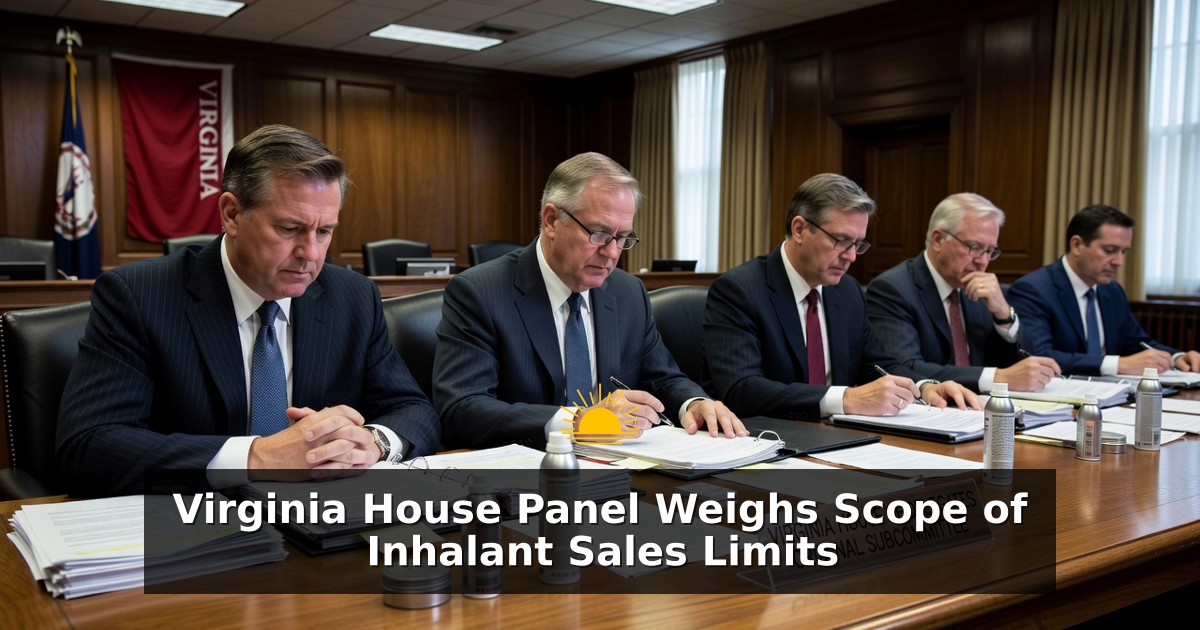
Members of a Virginia House of Delegates Criminal Subcommittee recently examined proposed legislation that would place new limits on the sale of everyday products containing substances that can be misused as inhalants. The measure under review targets items commonly available in commercial establishments, including canisters used for whipped cream and containers of nail polish remover. Lawmakers focused on how the bill’s language might prevent ordinary consumers throughout the commonwealth from purchasing such goods at major retailers. Discussion underscored the tension between addressing substance misuse and preserving access for legitimate household and commercial purposes. The session highlighted the difficulty of drafting precise rules for products that serve both recreational and practical roles.
Previous legislative efforts in Virginia have already addressed youth access to these materials. Lawmakers noted that an earlier debate produced guidance directing retail establishments to monitor purchases by minors. That approach sought to reduce opportunities for children to obtain inhalant-containing items without imposing a total ban on adult buyers. The current proposal appears to go further by narrowing the circumstances under which any sales could occur. Committee participants observed that the shift raises questions about whether the newer language maintains a workable balance. The contrast between the two approaches formed a central point of the subcommittee’s review.
Broader Retail Impact Under Scrutiny
The bill as described would make it difficult for residents to obtain canister-based products from standard commercial outlets such as large chain stores. One participant explained that the restriction could effectively bar purchases of whipped-cream chargers and similar items at places like Walmart. Only narrowly defined businesses would retain the ability to sell the covered products. This structure prompted repeated comments that the reach of the measure exceeds the problem it intends to solve. Observers within the hearing stressed that many of the affected goods have routine, non-abusive applications in homes and small businesses.
Exceptions written into the proposal remain limited. According to the text referenced during the meeting, sales carve-outs would apply solely to persons or establishments engaged exclusively in catering supplies, food-processing equipment, or compressed gases intended for industrial, medical, or healthcare-provider use. A business that operates only as a catering supplier could continue transactions, yet a general retailer carrying the same canisters would face barriers. Lawmakers pointed out that this distinction leaves mainstream stores without a clear path to compliance. The narrowness of the exceptions drew direct attention as a source of potential overreach.
Practical Uses and Daily Commerce
Committee members acknowledged that the substances in question possess accepted roles beyond any misuse. Whipped-cream canisters, for example, support ordinary food preparation in both households and commercial kitchens. Nail-polish remover and related solvents serve standard cosmetic and cleaning functions. Restricting these items across the board could disrupt supply chains that have long operated without incident for adult customers. Speakers emphasized that reasonable and practical applications exist and should factor into any final statutory language. The conversation repeatedly returned to the need for legislation that distinguishes harmful intent from everyday utility.
Enforceability Challenges Highlighted
Several participants questioned whether the bill could be applied consistently across Virginia’s diverse retail landscape. Determining which establishments qualify for the limited exceptions would require ongoing verification of business purpose. Stores that sell a mix of grocery, household, and specialty goods might find themselves unable to stock common canisters even when demand is legitimate. The administrative burden of monitoring compliance could fall heavily on both merchants and local authorities. Lawmakers described the current wording as difficult to enforce in a fair and predictable manner. These practical obstacles formed a core objection during the exchange.
One speaker summarized the concern by noting that the problem lies not with the underlying goal but with the breadth of the draft. The intent to curb inhalant availability, especially where minors are involved, received general recognition. Yet the same speaker stressed that the proposal as written extends too far into ordinary commerce. Fellow members indicated agreement with that assessment. The brief affirmations underscored a shared view that refinement would be necessary before any advancement. The subcommittee’s tone remained focused on clarifying statutory boundaries rather than rejecting the concept outright.
Balancing Health Goals and Commercial Reality
Inhalant misuse continues to present community-health challenges, particularly among younger populations who may experiment with readily available household chemicals. Prior Virginia discussions already established an expectation that retailers exercise heightened caution when minors attempt to buy such products. Expanding that framework into a near-total sales prohibition introduces new policy dimensions. Effective legislation must account for the dual-use nature of the materials while still deterring harmful diversion. The hearing illustrated how easily well-intentioned language can collide with the realities of statewide retail operations.
The limited carve-outs for catering, industrial, and medical suppliers leave most general-merchandise outlets outside the permitted category. A store whose primary business is not exclusively one of those listed activities would presumably be unable to offer the covered canisters. This outcome could alter inventory decisions at hundreds of locations and affect consumer convenience. At the same time, it might reduce casual access points that have historically contributed to misuse. Weighing those competing effects remains central to the committee’s ongoing evaluation of the measure.
Policy Precision as a Legislative Priority
Crafting statutes that regulate substances with both beneficial and harmful applications demands careful calibration. Overly expansive prohibitions risk unintended consequences for legitimate industries and individual households. Conversely, insufficiently clear rules can leave enforcement agencies without workable standards. The subcommittee’s examination of the inhalant bill brought these classic drafting tensions into sharp relief. Members repeatedly returned to the principle that statutory text should match the scope of the identified harm. Achieving that match will likely require additional revision of the exception language and the definition of covered products.
As the discussion concluded, the prevailing sentiment favored addressing the breadth problem before any further action. The recognition that last year’s youth-focused approach already imposed retail vigilance provided a useful benchmark. Building on that foundation rather than replacing it with a sweeping ban appeared to offer a more targeted path. Future iterations of the bill may therefore expand the list of permitted sellers or refine the description of regulated canisters. Such adjustments would aim to preserve public-health objectives while minimizing disruption to ordinary commercial activity across the commonwealth.
The subcommittee’s review demonstrates the complexity inherent in modern substance-control legislation. Products once viewed solely through a consumer-goods lens now carry recognized risks that demand legislative attention. Yet those same products underwrite daily routines in kitchens, salons, and workshops. Virginia lawmakers continue to search for formulations that protect vulnerable residents without unduly constraining the broader marketplace. The inhalant measure under consideration will require further refinement if it is to meet both goals effectively and remain enforceable in practice.
canister catering business catering supplies chair watts commonwealth compressed gases council enforcement food processing equipment healthcare provider industrial use intent Kids medical use nail polish remover practical uses retail establishments section two statute too broad walmart whipped cream