Committee Seeks Earlier Agenda Posting for Complex Finance Items
Updated
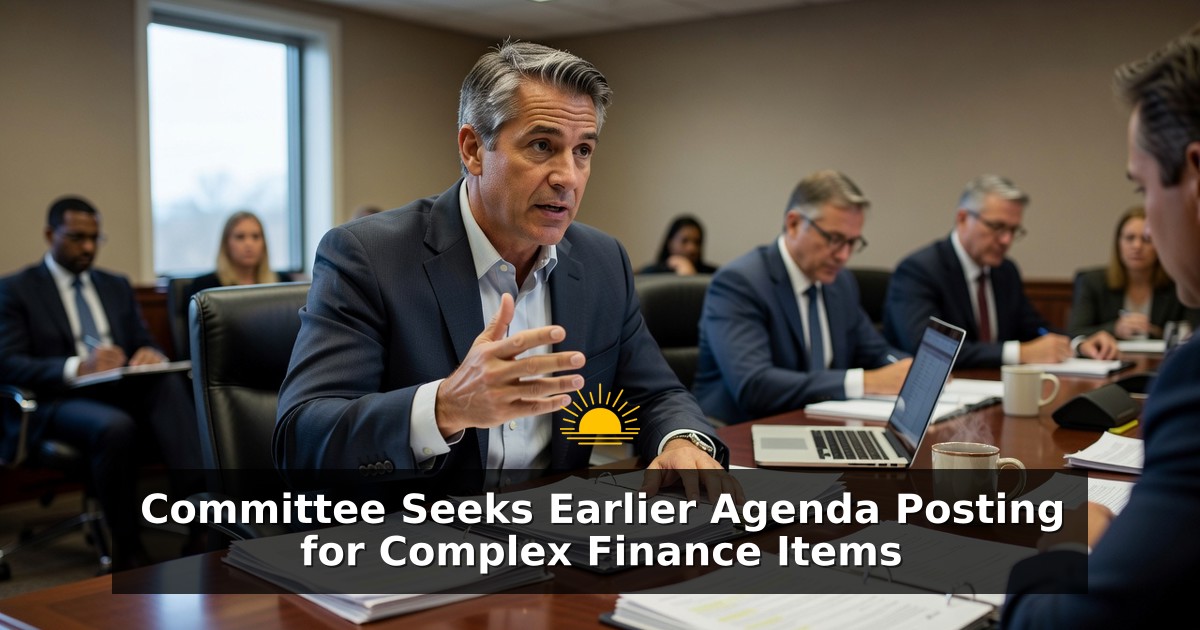
A member of a Virginia Finance and Operations Committee has called for earlier distribution of meeting agendas and supporting documents to give officials adequate time to examine complex contracts and interrelated policies. Speaking during the March 17, 2026, committee session, Amy Riccardi observed that materials typically arrive only a couple of days before gatherings. She emphasized that larger agreements and overlapping policy frameworks demand substantial mental bandwidth for proper analysis. Riccardi suggested that posting the Finance and Operations agenda sooner than the customary three-day window would enable members to formulate informed questions in advance rather than under last-minute pressure.
Virginia’s Freedom of Information Act sets a baseline expectation that public bodies provide reasonable notice of meetings, commonly interpreted by many localities as three working days for agendas when they are prepared in advance. Local governments across the commonwealth routinely follow this timeline for routine business, yet the volume and technical nature of finance-related items often exceed what a short review period can accommodate. Contracts involving multi-year vendor relationships, capital projects, or shared services frequently contain detailed performance metrics, termination clauses, and fiscal contingencies that require careful cross-checking. When several such documents appear on a single agenda, the compressed schedule can limit the depth of preparation available to elected or appointed officials.
Standard Practices for Agenda Distribution in Virginia Localities
Most Virginia counties and cities post agendas and attachments on official websites within the three-day window prescribed by state transparency norms. This practice satisfies legal notice requirements while allowing staff to finalize figures and legal reviews close to the meeting date. However, finance and operations committees regularly confront items whose complexity outstrips ordinary administrative updates. Procurement packages may span dozens of pages of specifications, pricing schedules, and compliance certifications. Policy proposals can intersect with existing ordinances on budgeting, procurement thresholds, or personnel rules, creating layers of interaction that reward extended study.
Riccardi’s remarks highlighted precisely this challenge. She noted that understanding how newly proposed policies mesh with those already on the books takes more than a cursory reading. Members who receive materials earlier could identify inconsistencies, request clarifying data from staff, and arrive at the meeting ready for substantive discussion. Such preparation reduces the likelihood that significant questions surface only during public sessions, when time for detailed answers may be limited. Earlier posting would not alter the legal minimum notice period but would represent an internal operational improvement aimed at higher-quality oversight.
Implications for Contract Oversight and Policy Coherence
Large-scale contracts represent one of the most consequential categories of business handled by finance committees. These agreements often commit public funds over multiple fiscal years and embed performance guarantees that affect service delivery to residents. Thorough pre-meeting review allows members to verify that pricing aligns with market benchmarks, that risk-allocation provisions protect the locality, and that renewal or exit options remain workable. When documents arrive with little lead time, even diligent officials may find themselves skimming rather than analyzing, increasing the chance that subtle but material issues escape notice until after approval.
Policy documents present a parallel set of demands. A single change to procurement rules, for example, can ripple through capital-budget procedures, grant-management protocols, and vendor-diversity initiatives. Mapping those connections requires side-by-side comparison of texts and, frequently, consultation with legal or financial advisors. Riccardi pointed out that advance access would let committee members complete that mapping work before the formal meeting, thereby converting the session itself into a forum for decision rather than initial discovery. The result would be fewer hurried exchanges and a clearer public record of the reasoning behind each vote.
Broader Context of Transparent Governance in the Commonwealth
Virginia localities have steadily expanded digital access to meeting materials over the past decade, posting agendas, minutes, and supporting exhibits on publicly searchable portals. Many now offer email subscription services that alert residents and officials the moment new packets appear. Extending the internal distribution timeline for especially dense Finance and Operations packets would build on that infrastructure without requiring new statutory authority. Staff would simply prioritize finalization of complex items earlier in the preparation cycle, a logistical adjustment already practiced by some larger jurisdictions when handling budget ordinances or bond resolutions.
Observers of local government note that well-prepared committee members tend to ask more precise questions, which in turn produces more complete staff responses and a stronger legislative history for future reference. Residents who follow finance matters also benefit when discussions rest on shared, thoroughly reviewed information rather than on-the-spot clarifications. The request voiced at the March meeting therefore aligns with longstanding principles of accountable stewardship while remaining firmly within existing open-meeting frameworks.
Potential Adjustments and Ongoing Committee Workflow
Implementing earlier agenda release for selected high-complexity items would involve modest changes to internal deadlines. Department heads would need to lock down contract drafts and policy language several additional days sooner, allowing clerks to assemble and post complete packets. Committee members could then submit written questions in advance, giving staff time to prepare detailed replies or supplemental exhibits. Over successive meeting cycles, the practice could become routine for any agenda containing multi-million-dollar awards or cross-cutting regulatory updates.
Riccardi framed the idea as a practical enhancement rather than a criticism of current staff effort. She acknowledged the existing three-day norm as typical and simply asked whether flexibility could be introduced when the material warrants it. No formal motion or vote occurred during the exchange; the comments served to place the operational suggestion on the record for later administrative consideration. Subsequent agendas will reveal whether the committee or supporting departments elect to adopt a differentiated posting schedule.
Public bodies throughout Virginia continue to balance the competing demands of timely decision-making and thorough deliberation. Finance and Operations committees occupy a central place in that balance because their recommendations shape budgets, capital plans, and long-term service contracts. Providing members with earlier access to dense documentation offers one concrete method for strengthening the quality of those recommendations. As localities manage increasingly sophisticated vendor relationships and policy environments, incremental improvements in preparation time remain a straightforward way to support informed governance.
The discussion at the March 17 session underscores a recurring theme in local administration: process refinements can yield measurable gains in oversight capacity without expanding statutory requirements. By focusing on the practical needs of reviewing large contracts and interlocking policies, the committee highlighted an area where modest calendar adjustments could produce clearer questions, more complete answers, and ultimately more confident public decisions. Further conversation among members and staff will determine how the suggestion is translated into standing practice for future Finance and Operations meetings.
03-17-2026 agenda posting agenda timeline board documents committee meeting committee process contract review document posting earlier posting Finance & Operations Committee finance committee FNO agenda larger contracts last minute meeting preparation mental bandwidth operations committee policies policy review public meeting questions ahead review time