Virginia Cannabis Compromise Advances Through Budget Talks
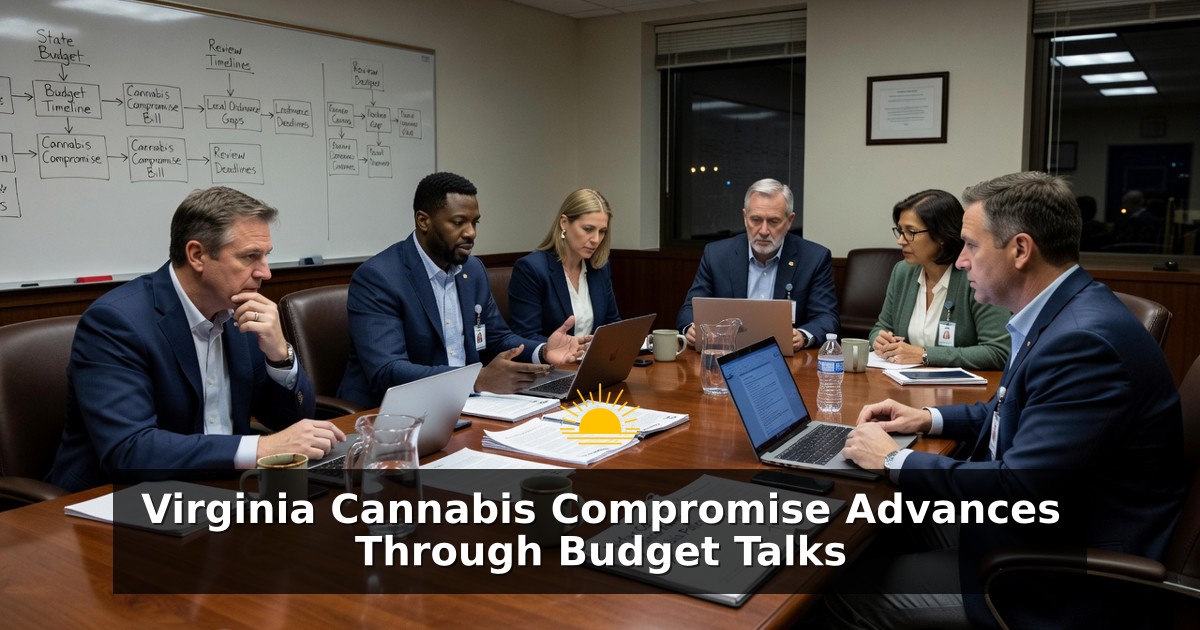
A compromise measure addressing cannabis policy in Virginia is advancing as part of the broader state budget process, according to recent local government discussions in Fairfax County. Officials noted that the development came to light after an internal memo had already been prepared on related regulatory matters. The status of final approval for the compromise remains unclear at this stage. Local staff indicated that a careful review of existing ordinances will follow to identify any provisions requiring adjustment in light of the state-level changes.
Fairfax County operates under the direction of its Board of Supervisors, whose current members are Chairman Jeff McKay, James Walkinshaw, Walter Alcorn, Jimmy Bierman, Rodney Lusk, Andres Jimenez, Dan Storck, Dalia Palchik, Pat Herrity, and Kathy Smith. These elected leaders oversee local land-use rules, business permitting, and public-health related ordinances that could intersect with any revised state cannabis framework. County administrators routinely monitor General Assembly outcomes so that local codes remain consistent with statewide law. The latest budget-linked compromise has therefore prompted an internal assessment of what ordinance sections may need revision.
Background on State Cannabis Framework
Virginia lawmakers first approved limited legalization of adult possession and home cultivation several years ago, yet the establishment of a regulated retail market has faced repeated delays. Successive legislative sessions have produced competing proposals on taxation, licensing, social-equity provisions, and local-control options. Budget negotiations frequently serve as the vehicle for resolving outstanding differences because they compel agreement on fiscal and regulatory details before the fiscal year begins. The newly reported compromise appears to follow that established pattern of attaching cannabis language to the larger spending plan.
Observers of the process note that tying policy changes to the budget can accelerate timelines while also introducing uncertainty until the final document receives signatures. Local governments across the commonwealth must then determine how state revisions affect zoning districts, special-exception requirements, odor-control standards, and hours-of-operation rules. Fairfax County, with its dense population and varied commercial corridors, maintains detailed ordinances that address many of these topics. Staff therefore plan to compare the emerging state language against current county code section by section.
Implications for Local Ordinance Review
County personnel emphasized that the ordinance examination will focus solely on identifying necessary updates rather than on creating new policy from scratch. Any amendments would proceed through the normal public-hearing and Board of Supervisors approval sequence once draft language is ready. That sequence typically includes opportunities for resident comment, planning-commission review, and formal advertisement. Because the state compromise has not yet been confirmed as finally adopted, the local timeline remains flexible and dependent on further clarity from Richmond.
Historical context shows that earlier cannabis-related bills prompted similar local reviews in multiple Virginia localities. Some jurisdictions chose to impose temporary moratoriums on retail applications while they rewrote zoning text; others adopted permanent caps on the number of stores or created buffer zones around schools and parks. Fairfax County has previously balanced economic-development goals with neighborhood-quality concerns when updating its commercial regulations. The forthcoming review is expected to apply the same measured approach once the precise terms of the budget compromise become available.
Fiscal and Administrative Considerations
Incorporating cannabis provisions into the state budget also carries revenue and enforcement implications that cascade to the local level. Potential tax distributions, licensing-fee shares, and public-safety cost reimbursements all factor into county financial planning. Administrators will examine whether existing fee schedules or inspection protocols require modification to align with any new state mandates. Coordination with neighboring localities and with state agencies responsible for cannabis oversight will form part of the due-diligence process.
Public-health and public-safety agencies within the county likewise maintain protocols that may need alignment. Educational materials, youth-prevention programs, and data-collection methods often reference state statutory definitions. When those definitions shift through budget legislation, corresponding local documents and training curricula are updated accordingly. The ordinance review therefore extends beyond pure zoning language into operational guidance used by multiple county departments.
Next Steps and Monitoring
Officials stated that they will continue to track the budget process closely to learn whether the compromise ultimately secures final passage. Until that confirmation arrives, preparatory work centers on cataloguing ordinance provisions most likely to be affected. Legal and planning staff customarily prepare side-by-side comparisons of existing code against proposed state text so that decision makers receive clear options. The Board of Supervisors would then receive recommendations in a subsequent public meeting once sufficient detail exists.
Residents and business owners interested in the outcome are encouraged to follow both the state budget deliberations and the county’s subsequent public-notice postings. Transparent communication remains a priority so that any eventual ordinance amendments reflect accurate information rather than speculation. Because the compromise surfaced after an initial memo had been drafted, the episode underscores the fluid nature of late-session legislative negotiations and the corresponding need for local governments to remain adaptable.
Broader Statewide Context
Across Virginia, other cities and counties face parallel questions about how a budget-embedded cannabis compromise will interact with their own codes. Uniformity in core definitions helps reduce confusion for multi-jurisdictional operators, yet localities retain authority over many siting and operational details. Fairfax County’s size and economic diversity give its ordinance choices particular weight as a reference point for peer jurisdictions. The careful, fact-based review now underway aims to preserve that balance between state direction and local circumstance.
In summary, the advancement of a cannabis-bill compromise through the Virginia budget process has placed Fairfax County in a preparatory posture. Staff will examine the county ordinance to isolate sections requiring updates once final state language is known. The Board of Supervisors stands ready to consider any recommended changes through its established legislative procedures. Continued monitoring of the budget’s progress will determine the precise schedule for local action in the months ahead.