Virginia Lawmakers Weigh Mandate for Career Coaches in Every High School
Updated
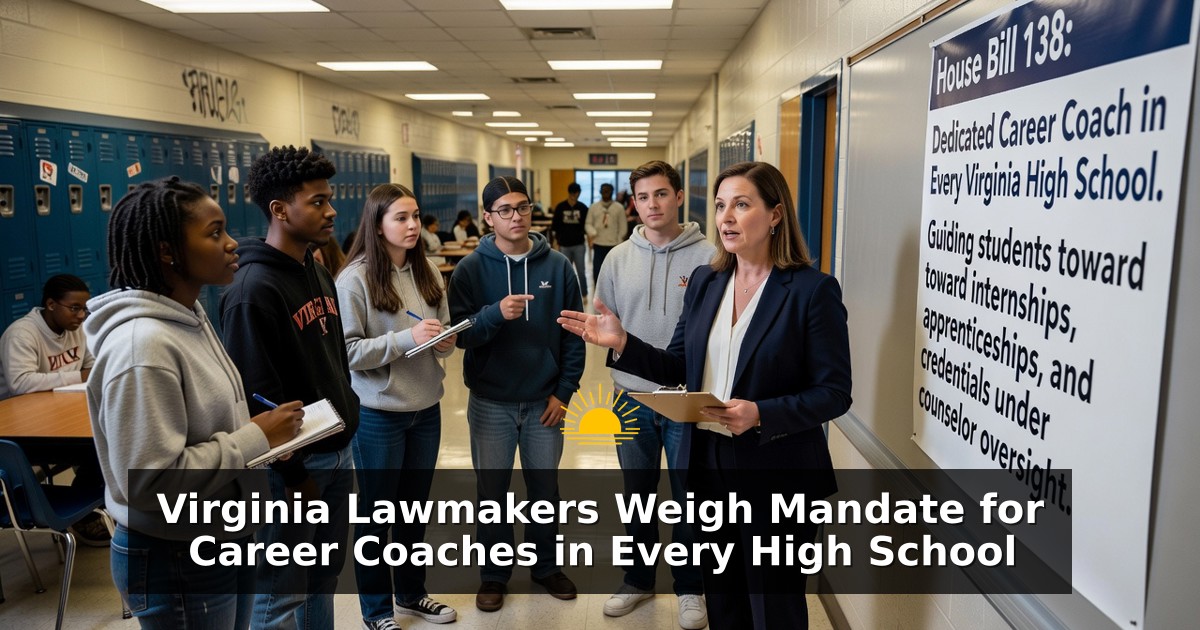
Virginia high school students could soon gain dedicated support for navigating post-graduation pathways under a proposal that would place a career coach in every public high school across the commonwealth. House Bill 138, introduced by Delegate Simon, requires each high school to employ one career coach who would operate under the direction of school counselors. The legislation focuses on practical connections that link classroom learning with real-world opportunities, aiming to strengthen outcomes after students receive their diplomas.
The bill outlines specific responsibilities for these coaches that align directly with existing state education goals. Coaches would assist students in securing internships, externships and credentialing opportunities required by the Profile of a Virginia Graduate. They would also supply information on apprenticeships and help connect teenagers with broader career openings in their communities and beyond. Supporters of the measure describe the role as a targeted bridge between academic preparation and workforce entry.
Understanding the Profile of a Virginia Graduate
The Profile of a Virginia Graduate already sets expectations that every student leave high school with demonstrated workplace skills, career exploration experience and industry-recognized credentials where appropriate. State education officials developed the profile to ensure graduates possess both academic knowledge and the practical abilities employers seek. Career coaches under House Bill 138 would help fulfill those expectations by coordinating the hands-on experiences the profile demands. This alignment means the new positions would reinforce rather than replace current graduation standards already in place across Virginia school divisions.
School counselors currently shoulder a wide range of duties that include academic scheduling, social-emotional support and college advising. Adding specialized career coaches would allow counselors to focus more intently on those core responsibilities while the new staff members concentrate on workforce connections. Education analysts note that many counselors manage caseloads well above recommended ratios, leaving limited time for intensive internship placement or apprenticeship matching. The proposed coaches would fill that gap by dedicating their full attention to employer partnerships and student placements.
Expanding Access to Work-Based Learning
Internships and externships give students direct exposure to professional environments before they graduate. Under the bill, career coaches would actively help secure these placements so that more teenagers can test career interests while still in high school. Apprenticeship information would also become more readily available, opening doors to paid training programs that combine classroom instruction with on-the-job skill building. Credentialing support would guide students toward certificates and licenses that employers recognize and value in hiring decisions.
Virginia already maintains a network of career and technical education programs that prepare students for high-demand fields. Career coaches could strengthen those programs by linking participants with local businesses seeking entry-level talent. Regions with strong manufacturing, healthcare, technology and skilled-trades sectors stand to benefit from more systematic student-employer matching. The statewide mandate would ensure that rural and urban high schools alike receive the same dedicated staffing rather than relying solely on existing local resources that vary widely by locality.
Implementation would require school divisions to identify or hire qualified individuals capable of building relationships with regional employers. Coaches would need familiarity with labor market data, apprenticeship sponsors and the credentialing landscape so they can offer accurate guidance. Working under counselor direction would keep the new roles integrated within each school’s existing student-support structure. This hierarchical arrangement aims to maintain clear lines of accountability while expanding capacity for career services.
Measuring Potential Impact on Post-Graduation Success
State leaders have long tracked metrics such as college enrollment, employment rates and credential attainment among recent graduates. House Bill 138 seeks to improve those indicators by giving every high school student consistent access to career navigation help. Students who secure internships or apprenticeships before graduation often enter the workforce or further training with clearer goals and stronger professional networks. Early exposure can also reduce the period of uncertainty many young adults experience after leaving high school.
Business groups across Virginia have repeatedly called for stronger pipelines between education and industry. A dedicated coach in each high school would create a single point of contact for employers interested in hosting students or recruiting future workers. Consistent staffing could lead to more durable partnerships that survive changes in school personnel or administrative priorities. Over time, such relationships might expand the number and quality of work-based learning slots available to students.
Equity considerations form another dimension of the proposal. Students from families without extensive professional networks sometimes struggle to locate internships or learn about apprenticeship openings on their own. A school-based career coach would level that playing field by proactively reaching every student rather than waiting for self-referral. The bill’s universal approach means the service would not be limited to those already on a college-preparatory track or those whose parents can open doors.
Fiscal and Logistical Considerations Ahead
Any statewide staffing mandate carries budget implications for both the state and local school divisions. Lawmakers will need to examine whether new state funding accompanies the requirement or whether divisions must absorb the cost within existing allocations. Salary levels, training needs and office space all factor into the practical rollout of such positions. Some divisions may already employ staff who perform similar functions and could reclassify or expand those roles to meet the new standard.
The Elementary and Secondary Subcommittee heard the introduction of House Bill 138 and opened the floor for questions from members. Further review will determine the bill’s path through the legislative process, including any amendments that refine duties, funding mechanisms or implementation timelines. Education stakeholders, including school boards, counselor associations and workforce development boards, are expected to offer input as the measure advances.
Career readiness remains a bipartisan priority in Virginia as the commonwealth seeks to maintain a competitive workforce. House Bill 138 represents one concrete approach to embedding that priority inside every high school building. By pairing the existing Profile of a Virginia Graduate with dedicated coaching staff, the legislation attempts to turn broad expectations into daily, personalized support for students. Observers will watch closely to see how the proposal evolves and whether it ultimately delivers the post-graduation gains its sponsor envisions.
If enacted, the career-coach requirement would join a series of recent efforts to modernize high school experiences and reduce the gap between classroom learning and labor-market needs. Students would leave school not only with diplomas but with tangible connections to the next stage of their lives. The coming legislative weeks will reveal the level of support the idea commands and the refinements needed to make it workable across Virginia’s diverse school divisions.
better bill Career Coach Coaches delegate every futures Graduation High House House of Delegates one School Schools Simon's station Students unlock Virginia