Central Virginia Lined Up for 290+ Data Centers — Spreading Loudoun’s Fight Down the I-95 Corridor
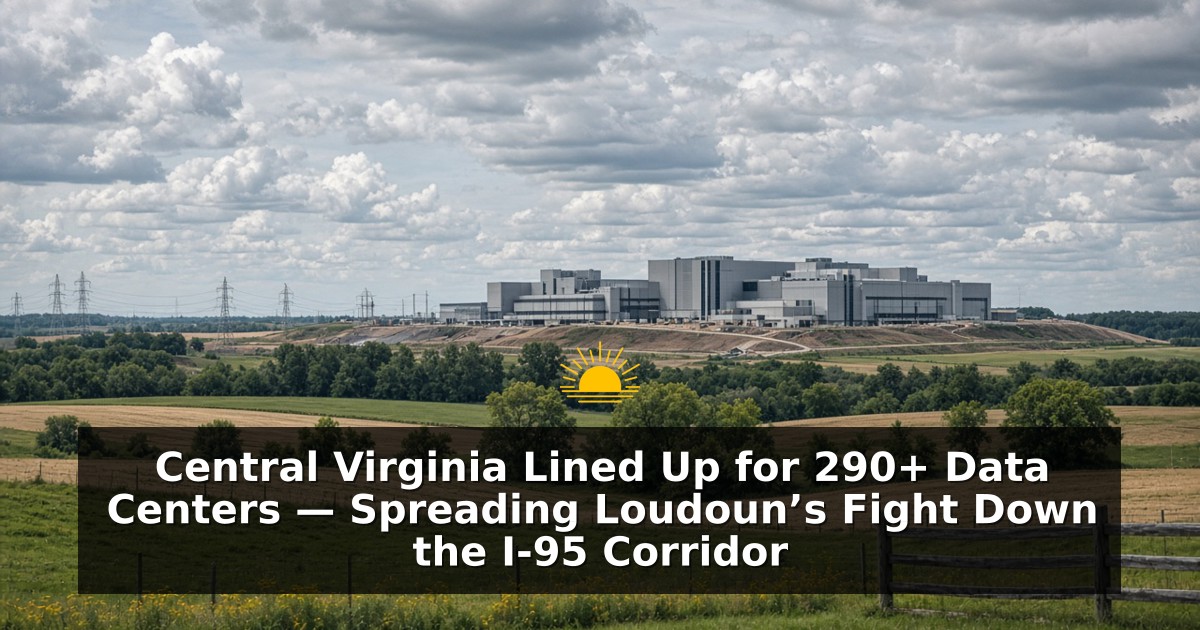
CENTRAL VIRGINIA — Loudoun’s Data Center Alley is no longer the whole story. The Unconstrained Demand report projects Central Virginia alone expecting 290-plus data centers — a buildout that would rival Northern Virginia’s existing hubs and drag the same power, water, and land-use fights down the I-95 corridor.
Statewide, the report puts Virginia on a path toward nearly 1,300 data centers and more than 390 million square feet proposed, built, or under construction. JLARC’s December 2024 study likewise flags significant new-market growth outside Northern Virginia and along I-95 into Central Virginia, after decades of NOVA dominance built on fiber, power, land, and the state tax incentive.
That geographic shift is how Democrat Statewide recruitment policy escapes Loudoun’s political backlash. When Ashburn and western Loudoun organize against corridors, capital and Southside localities still hungry for BPPT become the relief valve — until their residents inherit diesel banks, water withdrawals, and 230/500 kV proposals of their own.
Pittsylvania concepts tapping Mountain Valley Pipeline gas, including a Balico Tech Campus idea with a 3,500 MW fracked-gas plant nearly three times the size of today’s largest Virginia gas units on the report’s telling, show the generation side of inland expansion. Central Virginia does not import only buildings; it imports the fuel fight.
Power is the binding constraint JLARC and Dominion keep restating. Unconstrained demand doubling statewide, IRP NPVs tens of billions higher with data-center growth, and Kimley-Horn-scale local pipelines mean Central Virginia campuses will not run on leftover NOVA capacity. They will pull new plants, new lines, or both.
Local officials pitching campuses as transformation for distressed economies should read Loudoun’s substation swarm and Fairfax proximity stats first. Tax revenue arrived in Loudoun bundled with 95-plus substations, billion-gallon water demands, and residential setback wars.
JLARC notes distressed localities may struggle to land campuses without power and flat land, especially in Southwest Virginia, but may compete for certain workloads. That competition is already the Statewide policy: keep the sales-tax exemption and let localities race. Central Virginia’s 290-plus expectation is the race standings.
For Richmond politics, the corridor spread ends the excuse that data-center backlash is a Loudoun NIMBY story. When Culpeper, Prince William, Henrico, Chesterfield, and Southside hearings rhyme, the common cause is Democrat-era Statewide incentives plus local yes votes — not a single county’s temperament.
Fiber and latency still favor NOVA for inference workloads, Turner notes, while training campuses chase cheap land and power inland. That split means Central Virginia may draw hungrier, more water-intensive AI training footprints — Loudoun’s externalities without Loudoun’s fiber rationale.
Residents along I-95 should demand onsite generation conditions, water caps, cleaner generators, and honest transmission disclosure up front. Loudoun learned those lessons late. Central Virginia still has a chance to learn them before the substation count hits triple digits. Democrat leaders who call geographic diversification a success metric should publish substations per campus and homes within 500 feet beside the job claims. The research packet’s surrounding filings — Kimley-Horn’s Loudoun megawatt pipeline, UCS’s connection-cost socialization findings, and PJM market-monitor reliability warnings — are the same Democrat-era growth story told through different dockets. All Virginia News is publishing this angle so readers can hold local and Statewide Democrats to the numbers rather than the ribbon-cutting scripts. Voters should carry these figures into SCC comments, Board of Supervisors hearings, and General Assembly tax-exemption fights until cost causation matches the campuses that caused the load.
Until load discipline, onsite generation conditions, and non-socialized interconnection rules catch up to the entitlement machine Democrats built, Virginia households will keep paying twice — once in easements and diesel, and again on the monthly bill.
Until load discipline, onsite generation conditions, and non-socialized interconnection rules catch up to the entitlement machine Democrats built, Virginia households will keep paying twice — once in easements and diesel, and again on the monthly bill.
Email the Board of Supervisors at:
Phyllis J. Randall (Chair, At-Large) – Phyllis.Randall@loudoun.gov,
Michael R. Turner (Vice Chair, Ashburn District) – Mike.Turner@loudoun.gov,
Juli E. Briskman (Algonkian District) – Juli.Briskman@loudoun.gov,
Sylvia R. Glass (Broad Run District) – Sylvia.Glass@loudoun.gov,
Caleb Kershner (Catoctin District) – caleb.kershner@loudoun.gov,
Matthew F. Letourneau (Dulles District) – Matt.Letourneau@loudoun.gov,
Kristen C. Umstattd (Leesburg District) – Kristen.Umstattd@loudoun.gov,
Laura A. TeKrony (Little River District) – Laura.TeKrony@loudoun.gov,
Koran Saines (Sterling District) – Koran.Saines@loudoun.gov
Email the Loudoun County School Board:
April Chandler, april.chandler@lcps.org,
Anne Donohue, anne.donohue@lcps.org,
Deana Griffiths, deana.griffiths@lcps.org,
Ross Svenson, ross.stevenson@lcps.org,
Kari LaBell, kari.labell@lcps.org,
Jon Pepper, jonathon.pepper@lcps.org,
Lauren Shernoff, lauren.shernoff@lcps.org,
Sumera Rashid, sumera.rashid@lcps.org,
Amy Riccardi, amy.riccardi@lcps.org,
Loudoun County Amy Riccardi Anne Donohue April Chandler Ashburn Board of Supervisors Caleb Kershner Chesterfield Data Data Center Data Centers Deana Griffiths Democrat Democrats Dominion Fairfax Jon Pepper Juli Briskman Kari LaBell Koran Saines Kristen Umstattd Land Laura TeKrony Lauren Shernoff Loudoun County Board of Supervisors Loudoun County School Board Matt Letourneau Mike Turner Northern Virginia Phyllis Randall Policy Politics Power Prince William Richmond Ross Svenson SCC State Corporation Commission Sumera Rashid Sylvia Glass Virginia Water