Charlottesville Directs $6.5 Million Toward Homelessness Investments
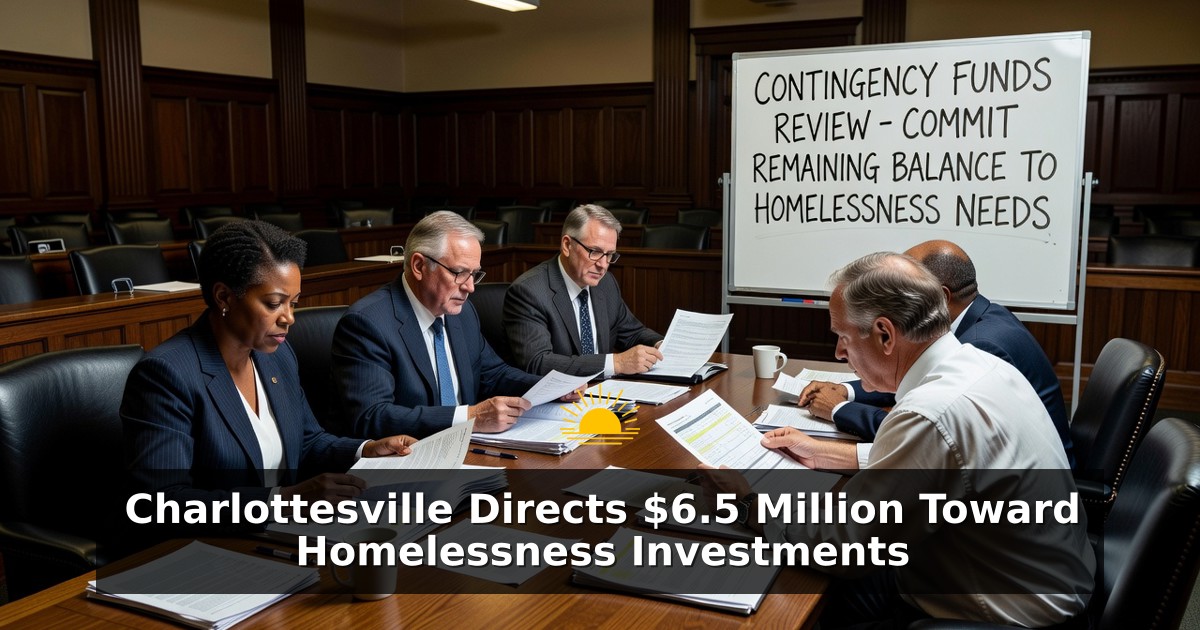
Charlottesville officials have outlined a significant financial commitment aimed at tackling homelessness through targeted investments drawn from existing municipal reserves. During a recent City Council session, leaders reviewed the status of the capital improvement program contingency fund and identified available resources for immediate priorities. The discussion centered on ensuring that remaining balances support solutions for residents facing housing instability. This approach reflects ongoing efforts to manage public funds while responding to pressing community challenges in the city.
The capital improvement program contingency fund currently holds a balance of $16 million, according to details shared at the meeting. Of that total, approximately $10 million has already been designated for key property acquisitions deemed essential to long-term city planning. After accounting for those earmarks, roughly $6.5 million remains available for other critical investments. Officials indicated that homelessness solutions represent one primary use for these leftover funds, positioning the allocation as a direct response to identified needs.
City Leadership Amid Rising Concerns
Municipal leaders emphasized that Charlottesville is now taking a central role in coordinating responses to homelessness. Speakers at the session described the situation as having reached the level of a crisis and an emergency, prompting the city to assume greater responsibility. This shift underscores a determination to move beyond previous collaborative models and place local government at the forefront of planning and funding. The remaining contingency resources are viewed as a practical tool to enable that leadership without requiring immediate new tax measures or external borrowing.
Property acquisitions form a major portion of the earmarked spending within the contingency fund. These purchases are intended to secure sites that can support various public objectives, including potential future housing or service facilities. By setting aside $10 million for such transactions, the city preserves flexibility for strategic real estate moves while still freeing $6.5 million for programmatic investments. Observers note that balancing land acquisition with direct service funding is a common practice in capital budgeting across Virginia localities facing similar pressures.
Details of the Contingency Allocation
The $6.5 million figure emerges directly from subtracting the property-related commitments from the overall $16 million contingency balance. Council members heard that this residual amount stands ready for deployment on initiatives that can produce measurable improvements in shelter capacity, outreach, and related supports. No specific breakdown of individual projects within the $6.5 million was finalized in the immediate discussion, yet the framing made clear that homelessness constitutes a qualifying critical investment category. Maintaining a healthy contingency balance has long been part of Charlottesville’s fiscal strategy to handle unforeseen or urgent capital demands.
Homelessness has remained a persistent issue in Charlottesville, as in many mid-sized Virginia cities, influenced by housing costs, economic factors, and limited affordable inventory. Local government involvement typically includes partnerships with nonprofit providers, emergency shelter operations, and prevention programs. The decision to highlight the $6.5 million as available for these purposes signals an intent to strengthen those existing frameworks with dedicated capital resources. Officials stressed the proactive nature of the planning, aiming to ensure resources are identified before conditions worsen further.
Broader Fiscal Context for Charlottesville
Charlottesville’s capital improvement program serves as the primary vehicle for multi-year infrastructure and facility planning. Contingency funds within that program act as a safeguard, allowing adjustments when priorities shift or emergencies arise. The current $16 million level provides a cushion that, even after major property set-asides, still permits meaningful allocations elsewhere. Drawing on this balance for homelessness work aligns with the city’s stated goal of addressing root causes through both acquisition of assets and direct investment in services.
The emphasis on city leadership marks a notable point in the conversation. By declaring that the locality is now leading the effort due to the crisis designation, officials conveyed urgency and accountability. This stance may facilitate faster decision-making on how the $6.5 million will be applied, whether through grants to service organizations, development of new facilities, or expansion of existing programs. Transparency around the fund balances helps residents understand the trade-offs between property investments and social-service priorities.
Community Impact and Next Steps
Residents and stakeholders can expect further details as the City Council refines the precise uses of the remaining contingency dollars. The $6.5 million commitment is presented as a foundation for real change, supporting those currently without stable housing and aiming to reduce the overall number of people experiencing homelessness. Careful tracking of expenditures will be essential to demonstrate results and maintain public confidence in the use of capital reserves. In the meantime, the clarified fund status offers a clear snapshot of available capacity.
Virginia localities frequently revisit contingency and capital accounts during budget cycles to match resources with emerging needs. Charlottesville’s approach of first securing property options and then directing residual funds toward homelessness fits within that broader pattern of prudent fiscal management. The discussion at the council meeting reinforced that the $16 million starting balance, reduced by $10 million in earmarks, leaves a substantial yet finite sum for urgent investments. Continued oversight will determine how effectively the $6.5 million translates into expanded support on the ground.
Looking ahead, the city’s willingness to designate these funds publicly may encourage additional coordination with regional partners and state resources. While the immediate focus remains on the local contingency balance, the framing of homelessness as a crisis elevates the issue within municipal priorities. The net result is a documented financial pathway that begins with the $16 million fund, accounts for $10 million in property plans, and channels $6.5 million into solutions intended to assist vulnerable residents. This structured allocation provides a measurable starting point for ongoing work.
Final considerations center on implementation timelines and outcome measurement. With the contingency figures now outlined, staff and council can proceed to match specific proposals against the available $6.5 million. The dual emphasis on property readiness and service investment illustrates an integrated strategy rather than a single-focus response. By grounding decisions in the verified fund balances presented at the meeting, Charlottesville positions itself to act decisively while preserving overall capital-program integrity for future years.
aspects Charlottesville Charlottesville's City City Council Commitment commits council critical discussed Financial financial planning funding homelessness investments Million officials Solutions Virginia