Franklin Officials Weigh Closed Street Transfer and Tax Revenue
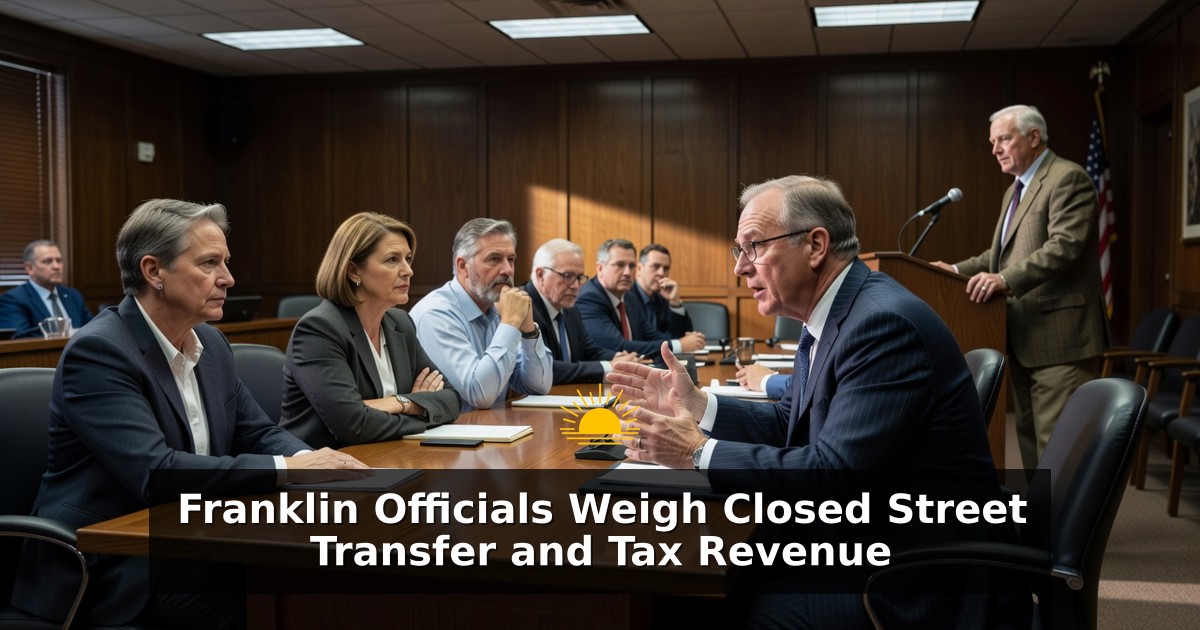
City of Franklin officials gathered to consider a request involving a closed street segment and the possibility of transferring that land to an adjoining property owner identified in discussion as Mr. Sykes. Speakers emphasized that municipal leaders serve as stewards of public property rather than private donors free to dispose of assets without return value. The conversation centered on balancing immediate fiscal benefits against longer-term concerns about consistency and legal exposure. Participants repeatedly returned to the principle that the city cannot simply relinquish ownership without receiving something of worth in exchange.
Several speakers voiced appreciation for the maintenance already performed on the unused corridor by the neighboring owner. They noted that the parcel currently produces no tax revenue and sits idle under city control. Transferring title, they argued, would place the land on the tax rolls at once and ensure continued upkeep by a private party with a direct interest. At the same time, cautionary voices warned that an uncompensated conveyance could invite similar requests from other residents living beside closed streets throughout Franklin.
**Stewardship Obligations and Legal Constraints**
Officials underscored that Virginia municipalities hold real estate in trust for the public and therefore face statutory and common-law limits on gifts of property. One participant stated plainly that the city is not in the business of giving land away and must obtain value to avoid later challenges. Legal risk was framed in concrete terms: an unsupported transfer could expose the locality to lawsuits from taxpayers or competing claimants who assert unequal treatment. The discussion distinguished the present street-vacation scenario from earlier easement adjustments on Clay Street, where no fee had been charged because those matters involved access rights rather than fee-simple ownership of a former public way.
The Clay Street precedent received careful attention so that council members could draw a clear line. In that earlier case, the city had permitted a property owner to incorporate an easement area into an adjacent lot without payment. Speakers insisted the two situations are not interchangeable because one concerned limited use rights and the other would convey outright title to a closed street bed. Maintaining that distinction, they said, protects the city from claims that every abutting owner is automatically entitled to free land. The exchange illustrated how local governments must document rational differences when handling similar-looking requests.
**Revenue Potential Versus Precedent Risk**
Proponents of the transfer highlighted a straightforward fiscal calculation. Once the closed street segment enters private ownership, the city assessor can assign a taxable value and begin collecting real-estate taxes without delay. That revenue stream, however modest, would replace the current zero return and would continue indefinitely. In addition, private ownership would relieve public works crews of any residual maintenance obligation, shifting responsibility to the new owner who already cares for the ground. Supporters framed the outcome as a practical win for both the treasury and neighborhood appearance.
Opponents did not dispute the tax arithmetic; they focused instead on the signal the decision would send. If one owner receives a former street free of charge, others may reasonably expect identical treatment when their own blocks are vacated. Over time, the cumulative effect could erode the city’s inventory of residual rights-of-way and complicate future utility or drainage projects that rely on retained public ownership. Speakers urged colleagues to consider a uniform policy—whether sale at appraised value, exchange for other consideration, or retention—rather than case-by-case gifts that lack clear standards.
**Balancing Maintenance and Ownership Principles**
The dialogue repeatedly returned to the dual goals of keeping land productive and preserving equitable rules. Officials acknowledged that an abandoned street segment left in municipal ownership often becomes an eyesore or a liability if vegetation and debris accumulate. Transferring the parcel would solve that immediate problem while generating revenue. Yet the same officials insisted that solving one maintenance issue must not undermine the broader principle that public assets carry a price. Several remarks stressed that any conveyance should be structured to demonstrate received value, thereby insulating the city from later accusations of favoritism or unlawful donation.
Participants also explored the practical mechanics of closing and disposing of streets under Virginia law. Street vacations typically require public notice, opportunity for objection, and a finding that the way is no longer needed for public travel. Even after vacation, residual ownership questions remain, and localities often retain easements for utilities. The Franklin discussion made clear that those procedural steps had already occurred or were understood; the remaining issue was purely the terms of any title transfer to Mr. Sykes. Clarity on that point, speakers agreed, would help staff draft appropriate instruments if the council ultimately authorized a deal.
**Context Within Franklin’s Broader Property Practices**
Franklin, an independent city in southeastern Virginia, manages a modest inventory of streets, alleys, and leftover parcels created by decades of development and occasional abandonments. Like other small cities, it periodically confronts requests from homeowners seeking to square off lots or eliminate narrow strips that serve no traffic function. The current debate fits within that pattern yet raises sharper questions because the land in question is a former street rather than a leftover easement. By insisting on value and by distinguishing prior Clay Street actions, council members sought to refine internal guidelines that can be applied consistently to future applicants.
Observers note that transparent handling of such requests strengthens public confidence in local government. When elected officials articulate both the revenue opportunity and the precedent hazard, residents gain insight into the competing values at stake. The Franklin conversation demonstrated that stewardship is not merely a slogan; it requires concrete choices about appraisal, compensation, and equal treatment. Whatever final action follows, the record of deliberation will show that members weighed tax gain, maintenance relief, legal exposure, and fairness before deciding the fate of the closed street segment.
**Looking Ahead to Policy Clarity**
As the discussion concluded, the dominant themes remained stewardship, revenue, and the avoidance of open-ended free transfers. Officials expressed willingness to see the land placed in productive private hands provided the city receives appropriate consideration and avoids setting an unbounded precedent. Further staff research into comparable sales, appraisal methods, and ordinance language was implied as the next practical step. In the meantime, the unused corridor continues under city ownership, generating neither taxes nor controversy until a formal resolution is reached. The careful tone of the exchange suggests Franklin intends to resolve the matter in a manner that protects both the public purse and the integrity of municipal property rules.
Allen City of Franklin Clay Street closed street commercial properties easement grass Lawsuit maintenance Mr. Sites Mr. Smith Mr. Sykes Mr. Tyler ownership precedent property revenue stewards Taxes value