Virginia Bill Defines State Hiring Preference for Terminated Federal Workers
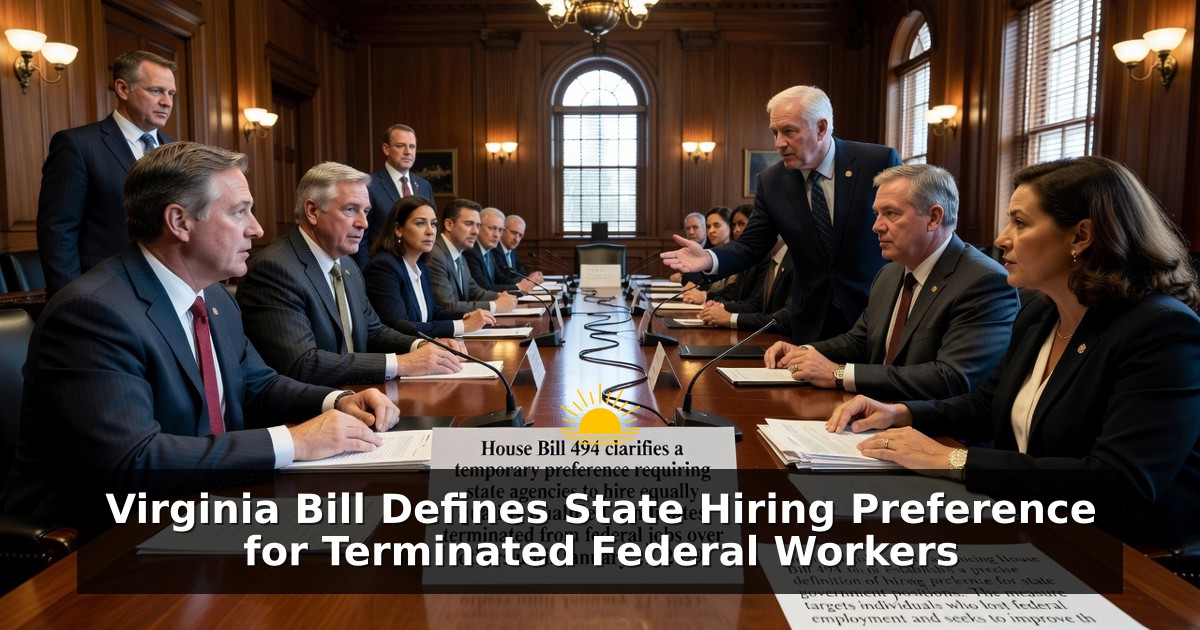
Virginia legislators are advancing House Bill 494 to establish a precise definition of hiring preference for state government positions. The measure targets individuals who lost federal employment and seeks to improve their access to comparable roles within the commonwealth. Under the bill, a candidate terminated from a federal position must receive preference over another applicant who was not terminated when both demonstrate substantially equal qualifications. This targeted approach addresses workforce transitions resulting from federal budget adjustments while preserving core merit principles in public hiring.
Chair Delaney outlined the bill’s core mechanics during committee proceedings on the General Laws panel. The legislation requires state hiring officials to select the federally terminated applicant in cases of substantial equality in skills, experience, and credentials. Preference applies solely to eligible state positions and does not override clearly superior qualifications held by other candidates. Delaney stressed that the provision remains temporary, ending on January 21, 2029, to match the expected window of adjustment for affected workers.
How the Preference Operates in Practice
State agencies already follow structured competitive processes managed through Virginia’s human resource systems. House Bill 494 inserts an additional decision rule that activates only after qualifications are judged substantially equal. Hiring managers would first evaluate education, relevant experience, and performance indicators before applying the preference. Documentation of federal termination, typically linked to budget reductions, would form part of the applicant’s file. This sequence keeps the process orderly and limits the preference to its intended narrow circumstances.
The bill’s language avoids creating an automatic entitlement that could displace stronger candidates. Instead, it functions as a tie-breaker designed to assist those displaced by federal downsizing. Applicants from Northern Virginia and other regions with dense federal employment concentrations stand to benefit most directly. State personnel offices would update internal guidelines so that recruiters apply the rule consistently across departments. Clear instructions reduce the chance of uneven implementation once the measure takes effect.
Duration and Legislative Intent
A sunset date of January 21, 2029, forms an essential feature of House Bill 494. After that date the preference expires automatically unless the General Assembly acts to renew it. The limited timeframe reflects lawmakers’ desire to offer transitional support without permanently altering the state’s hiring statutes. During explanations, Chair Delaney corrected earlier references to a mid-year expiration and confirmed the January 21, 2029, endpoint. Agencies must therefore track the provision’s active period and prepare for its conclusion.
The temporary design also allows evaluation of the preference’s practical effects on vacancy filling and workforce composition. Supporters view the window as sufficient to help many displaced federal employees reestablish careers in state service. At the same time, the sunset protects against indefinite expansion of special hiring categories. Future sessions could revisit the policy if conditions warrant extension or modification. Until then, the fixed end date supplies predictability for both applicants and hiring authorities.
Effects on Applicants and State Agencies
Job seekers terminated from federal roles gain a defined advantage in closely contested state competitions under the new rules. When two candidates present nearly identical qualifications, the individual with the federal termination record advances. This clarity may encourage more former federal workers to submit applications for Virginia positions in administration, technical fields, and support services. Candidates lacking that history continue to compete fully on merit unless the substantial-equality threshold is reached. Accurate employment records become especially important for those claiming the preference.
State agencies benefit from reduced ambiguity when ranking finalists. Human resource staff receive explicit statutory direction rather than relying on informal practices. The preference can help retain experienced professionals inside the commonwealth’s public sector instead of losing them to other states or private employers. Regions that host large numbers of federal installations may see smoother labor-market adjustments as a result. Overall hiring volume and qualification standards remain governed by existing competitive frameworks.
Context Within Existing Preference Policies
Virginia already recognizes certain statutory preferences, including those for veterans and eligible individuals with disabilities. House Bill 494 adds a time-limited category focused on recent federal terminations tied to budget measures. The new preference operates alongside, rather than in place of, these longstanding provisions. Lawmakers crafted the substantial-equality standard to maintain fairness and avoid conflicts with other protected categories. Integration into current ranking systems will require only modest procedural updates.
Public-sector recruitment in Virginia emphasizes transparency and equal opportunity. By defining preference narrowly, the bill aligns with that tradition while responding to a specific workforce disruption. Training materials for managers and recruiters are expected to accompany implementation so that the rule is applied uniformly. Stakeholders can anticipate further discussion as the measure moves through additional legislative stages. The final text will determine exact documentation requirements and any reporting obligations for agencies.
House Bill 494 therefore supplies a focused, temporary tool for assisting workers affected by federal employment reductions. Its emphasis on substantial equality of qualifications keeps merit central to state hiring decisions. With the preference scheduled to expire on January 21, 2029, the legislation offers near-term support paired with a clear endpoint. Virginia residents monitoring state career opportunities will find the clarified rules relevant to application strategy in the coming years. Continued legislative attention will shape any adjustments before the sunset takes effect.
appropriations bill Chair Delaney eligible position employment equal qualifications Federal Government federal position hired January 21st Mr. Joe person who has been terminated position of employment preference qualifications recommended reporting referring substantially equal sun sets terminated Virginia vote of seven to two