Virginia Subcommittee Examines Inhalant Sales Ban Carve-Outs and Part-Time Seller Risks
Updated
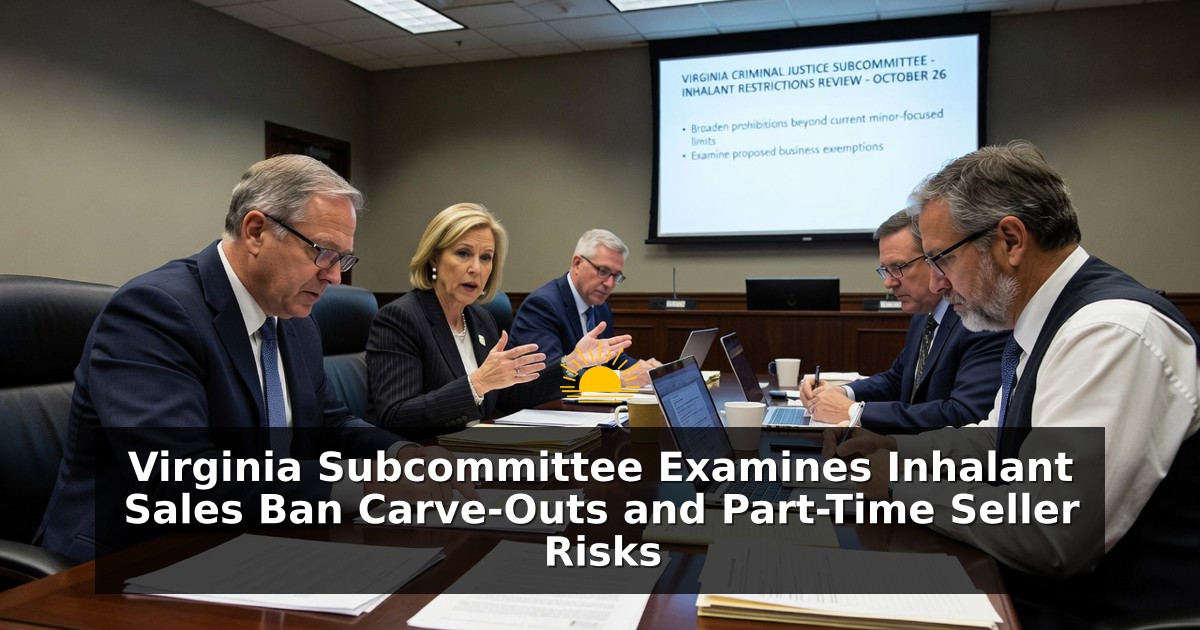
Virginia lawmakers on a criminal subcommittee recently examined proposed changes to state inhalant restrictions that would broaden sales prohibitions beyond current limits focused on minors. Speakers raised detailed questions about whether new statutory language could create unintended barriers for legitimate part-time sellers and users of related equipment. The discussion centered on how carve-outs for certain businesses might interact with existing prohibitions on inhalation and enticement. Officials clarified the distinction between prior rules and the expanded framework under consideration. Public health concerns surrounding inhalant misuse have long shaped Virginia policy in this area.
Previous Virginia rules made it illegal to sell the covered items to anyone under the age of 18 for any purpose. Those earlier provisions did not contain the business-focused carve-outs now under review. The shift toward a broader sales ban applicable to all ages, subject only to listed exceptions, prompted close scrutiny of the precise wording. One speaker highlighted the phrase requiring that a person be solely engaged in the business as a potential source of difficulty. That language raised the possibility that individuals working part-time or selling equipment on a limited basis could fall outside protected categories.
Concerns Over Part-Time Employment and Legitimate Sales
The core worry expressed during the subcommittee exchange involved whether part-time employment or occasional sales activity would remain lawful under the revised statute. If a seller’s activity did not constitute their sole business, the new restrictions might render otherwise legitimate transactions illegal. Equipment sales conducted on a secondary or seasonal basis could face similar uncertainty. Speakers asked whether the proposed carve-outs would adequately protect every category of legitimate user and seller. Clarity on these points was sought to avoid criminalizing routine commercial activity that poses no public safety threat.
Subcommittee participants noted that the practical reach of the language matters for small operators and secondary market participants across Virginia. Many legitimate suppliers of industrial, medical, or household products operate with flexible staffing models that include part-time roles. A requirement tied strictly to sole engagement in the business could exclude those arrangements even when the underlying products serve lawful purposes. Lawmakers and staff were urged to examine whether the carve-outs fully map onto real-world patterns of employment and distribution. The goal articulated was to maintain strong protections against misuse while preserving ordinary commerce.
Existing Offenses and Clarification of Prior Law
A follow-up exchange provided important context about the baseline legal landscape already in place. Last year it remained illegal for any person to entice another individual to inhale the substances in question, and that prohibition applied across all age ranges. Sales restrictions, by contrast, had been limited to transactions involving minors. The existing offense structure already barred both personal inhalation and any act of enticing someone else to inhale, without age limitation. The new proposal therefore builds on a foundation that already criminalizes the core harmful conduct for adults and juveniles alike.
This clarification helped separate the sales-regulation question from the inhalation and enticement bans. Because the broader conduct offenses already cover every age group, the incremental change under discussion focuses on who may lawfully sell the items and under what conditions. Supporters of tighter sales rules often emphasize reducing easy access that can facilitate misuse. Critics of overly narrow carve-outs counter that legitimate channels must remain open so that industrial, medical, and other authorized users are not disrupted. The subcommittee discussion sought to balance those competing considerations with precise statutory drafting.
Public Health Context for Inhalant Restrictions in Virginia
Inhalant misuse has presented persistent public health and safety challenges in Virginia and nationwide for decades. Certain chemical substances and compressed gases can produce psychoactive effects when deliberately inhaled, leading to acute injury, dependency, or worse outcomes especially among younger people. Virginia Code provisions have long addressed the inhalation of noxious chemical substances and related conduct. Legislative updates periodically refine definitions, penalties, and commercial controls in response to emerging product trends and enforcement experience. The current proposal continues that pattern by revisiting the scope of permissible sales.
Health officials and prevention advocates routinely stress that inhalants are accessible, inexpensive, and often underestimated in their danger. Emergency departments document cases of sudden sniffing death, oxygen deprivation, and long-term neurological harm linked to these substances. At the same time, many of the same chemicals serve essential functions in manufacturing, medicine, food service, and household maintenance. Effective policy therefore requires careful differentiation between diversion for abuse and ordinary commercial or professional use. Carve-out language is the primary drafting tool used to draw that line.
Evaluating Whether Carve-Outs Reach All Legitimate Actors
Speakers pressed for assurance that the listed exceptions would cover the full range of legitimate sellers and users. The “solely engaged in the business” formulation drew particular attention because it could be read to exclude dual-occupation or part-time arrangements. A person who sells relevant equipment only on weekends or as a secondary income stream might not satisfy a sole-engagement test. Similarly, an employee whose primary job lies elsewhere but who handles occasional sales could face exposure. These scenarios illustrate why drafting precision is essential when expanding a sales ban from minors-only to a general prohibition.
Virginia’s commercial landscape includes numerous small businesses, independent contractors, and multi-line retailers that do not devote themselves exclusively to any single product category. Hardware outlets, medical suppliers, specialty food vendors, and industrial distributors all handle items that could fall within an inhalant-related definition depending on final bill language. If carve-outs fail to account for part-time and secondary sellers, enforcement could sweep more broadly than intended. Subcommittee members heard these practical observations as they weighed how best to structure the exceptions.
Legislative Drafting and Unintended Consequences
The discussion underscored a recurring challenge in criminal law drafting: closing avenues for misuse without criminalizing innocent or beneficial activity. Prior law already imposed a clear sales barrier for anyone under 18 and maintained universal bans on inhalation and enticement. Expanding the sales prohibition to all purchasers while attaching business-only carve-outs changes the compliance burden for merchants. Ambiguity around part-time status or mixed business models can chill lawful commerce or generate inconsistent enforcement. Careful revision of the operative phrases can reduce those risks.
Observers of the Virginia General Assembly note that criminal subcommittees frequently refine bill language after hearing exactly these kinds of implementation concerns. Testimony and member questions often lead to substitute drafts that replace rigid formulations with more flexible standards, such as primary business purpose or bona fide commercial activity. Whether similar adjustments occur with the present inhalant measure will depend on further deliberation and any amendments offered. The record of the exchange already supplies a clear roadmap of the issues requiring attention.
Broader Implications for Virginia Communities
Communities across the commonwealth have an interest in both preventing inhalant abuse and maintaining access to legitimate products. Parents, schools, and prevention programs focus on education and early intervention to discourage experimentation. Retailers and suppliers need predictable rules so they can train staff and structure operations without fear of inadvertent violations. Law enforcement agencies benefit from statutes that clearly distinguish criminal diversion from ordinary sales. The subcommittee process exists to surface and resolve tensions among these interests before a bill advances.
As the measure moves forward, continued attention to the scope of carve-outs will remain central. Ensuring that part-time employment and secondary sales activity are not swept into criminal liability represents one concrete test of the legislation’s workability. Equally important is preserving the existing, age-neutral prohibitions on inhalation and enticement that already address the core harmful behavior. Virginia’s approach to inhalant regulation will be judged by how effectively it protects public health while respecting legitimate economic activity. The concerns voiced in the recent hearing supply a factual foundation for that ongoing evaluation.
Final drafting choices will determine whether the expanded sales ban operates as a targeted tool or generates the hidden compliance problems flagged by speakers. Lawmakers have been placed on notice that the “solely engaged” phrasing warrants close review. Stakeholders representing public health, retail, and industrial users are expected to monitor subsequent versions of the text. The ultimate statute must rest on clear definitions that courts, merchants, and citizens can apply with confidence. In that respect, the subcommittee exchange has already advanced the quality of the legislative record.
age ranges carve-outs clarification council entice illegal inhale last year legitimately Minors notes offense part-time employment people under the age purpose sell sell to them selling equipment sole business solely engaged in the business