Virginia Lawmakers Weigh Election Spending Caps Tied to Federal Rulings
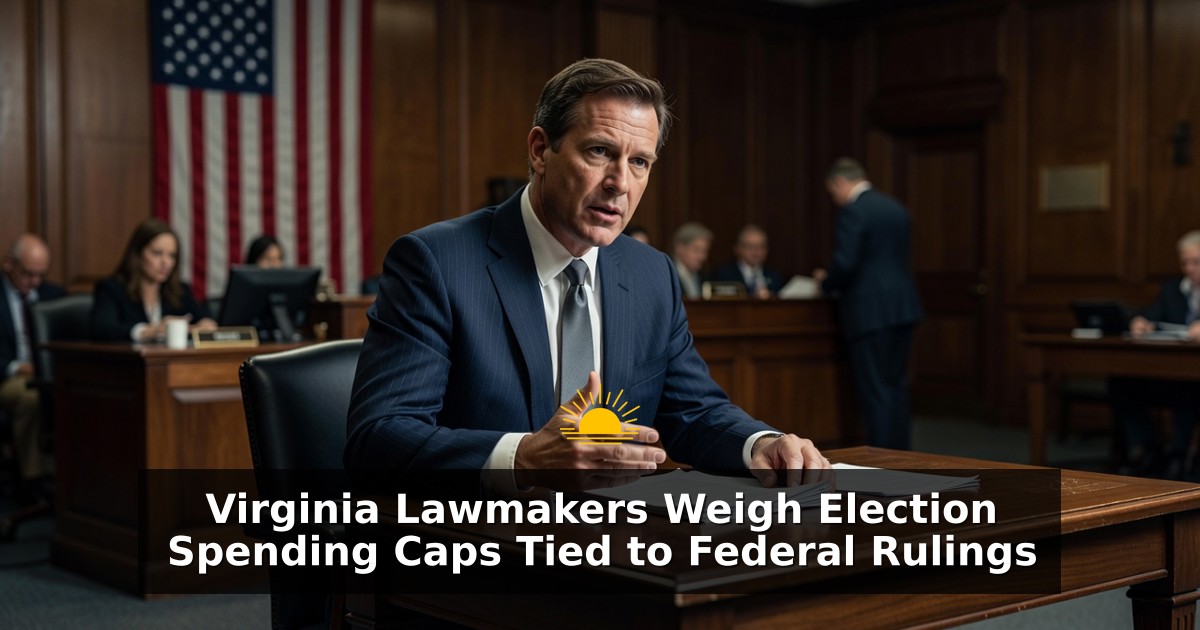
Virginia lawmakers are examining a legislative proposal that would place new restrictions on election-related spending by political party committees and other groups. During a recent session of the Privileges and Elections committee, State Sen. Scott Surovell presented key details of the measure aimed at addressing financial influence in campaigns. The outline focused on concrete spending thresholds and contribution rules that would reshape how funds flow into Virginia elections. Officials noted the proposal seeks to establish clearer boundaries while remaining contingent on broader legal developments. Observers of the process highlighted the emphasis on factual parameters rather than broader policy debates at this stage.
The core provision described would prohibit corporations from making political contributions entirely under the outlined framework. This ban forms a foundational element intended to separate corporate treasuries from direct campaign support in the commonwealth. Surovell explained that the restriction applies across election cycles to limit external financial pressures on candidates and parties. Supporters of similar past measures have argued such steps promote accountability, though the current discussion stayed centered on the stated terms. The presentation underscored that only designated political party committees would retain broader latitude under the draft language.
Spending Limits for Non-Party Groups
No entity other than a political party committee would be permitted to spend more than 25,000 dollars a year on an election according to the facts shared. This annual cap targets independent expenditures and related activities outside formal party structures. Surovell noted the figure as a deliberate threshold designed to curb large-scale outlays by outside organizations. The limit would apply uniformly to covered elections within Virginia, creating a consistent standard for compliance. Committee participants received the information as part of a straightforward review of the bill’s operative sections.
Earlier versions of related legislation had included separate caps on statewide races set at levels such as seven million dollars and additional figures in the seven-hundred-fifty-thousand range. Surovell indicated those specific statewide caps were removed from the bill during Senate consideration. The adjustment simplified the measure by eliminating tiered maximums for higher-profile contests. Instead, the focus shifted to the broader 25,000-dollar annual restriction for non-party spenders. This change reflects iterative drafting common in the legislative process at the state level.
Reenactment Provisions and Timing
A reenactment clause was added in the Senate to govern when certain donation caps would become active. Under this approach, the restrictions would not take immediate effect upon passage. Surovell described the clause as a mechanism ensuring alignment with external legal conditions before implementation. The structure allows the General Assembly to revisit or confirm the provisions at a later point if needed. Such clauses are occasionally used in Virginia bills that intersect with evolving judicial standards.
The caps on donations would activate only after the Attorney General certifies that Citizens United is no longer the law of the land. This certification requirement links the state measure directly to the status of the well-known federal Supreme Court decision on campaign finance. Until that determination occurs, the spending and contribution limits would remain dormant. The contingency provides a clear procedural trigger rooted in official legal assessment. Virginia’s Attorney General would hold responsibility for issuing any such certification based on prevailing federal precedent.
Broader Context for Virginia Elections
Election spending has long drawn attention in Virginia because of the commonwealth’s competitive districts and frequent high-profile races. The proposed limits aim to introduce predictability into how political party committees and other actors allocate resources. By setting a 25,000-dollar ceiling for non-party spending, the measure would alter the scale of independent efforts in local and statewide contests. Party committees themselves would operate under different parameters, preserving their traditional role in coordinated campaign support. The distinction seeks to balance organizational freedom with restraints on external influence.
Corporate contribution bans of the type described would mark a significant shift from current practices if fully enacted. Virginia has historically permitted various forms of political giving subject to disclosure and other rules. The outlined prohibition would close that avenue completely for corporate entities, channeling activity through individuals or permitted committees instead. Enforcement would fall to existing state election authorities once any activation conditions are met. Detailed reporting requirements already in place could support monitoring of compliance with the new thresholds.
Legislative discussions in the Privileges and Elections setting routinely address the mechanics of voting, candidate qualification, and campaign finance. Surovell’s presentation fit within that routine by concentrating on numerical limits and conditional effective dates. The removal of earlier statewide race caps illustrates how bills evolve through committee and floor work in both chambers. Reenactment language further demonstrates caution when state rules touch on areas shaped by federal court rulings. These elements together form the concrete framework under review.
Implementation questions remain centered on the certification process involving the Attorney General. Any future determination that Citizens United no longer governs would unlock the donation caps and related spending rules. Until then, existing Virginia campaign finance statutes would continue to apply without the new restrictions. The proposal’s design therefore creates a waiting period tied to national legal developments while preparing state-level tools in advance. Lawmakers can monitor federal developments in the interim without immediate disruption to ongoing election cycles.
Public understanding of these parameters matters because they define the financial boundaries of political competition in Virginia. The 25,000-dollar annual limit for non-party committees establishes a bright-line rule easy to communicate and track. Combined with the corporate ban, the package addresses two distinct sources of campaign funding. Conditional activation via Attorney General certification adds a layer of legal prudence to the overall approach. Continued review in committee will determine whether the language advances in its current form or undergoes further revision.
Additional scrutiny may focus on how political party committees adapt their own spending strategies under the differentiated rules. Because parties alone would escape the 25,000-dollar ceiling, their role in supporting candidates could become more pronounced. This outcome aligns with the stated intent of channeling activity through established party structures. Disclosure systems already maintained by the state would capture the resulting shifts in expenditure patterns. Accurate data collection remains essential for evaluating the practical effects once any provisions take hold.
The discussion also touched on the practical drafting history that led to removal of certain caps. Initial inclusion of multi-million-dollar ceilings for statewide races gave way to a leaner set of restrictions. Surovell’s account confirmed the Senate’s decision to insert the reenactment clause as a companion safeguard. Together these adjustments produced the version presented with its emphasis on the 25,000-dollar figure and corporate prohibition. The resulting text prioritizes clarity and conditional readiness over immediate comprehensive overhaul.
Virginia’s election calendar includes regular cycles for legislative, statewide, and local offices that would all fall under the proposed framework. Consistency across those contests is a noted feature of the annual spending limit for covered groups. Candidates and committees would need to plan accordingly if the measure eventually activates. Educational outreach by election officials typically accompanies major finance rule changes to ensure widespread awareness. Preparation efforts could begin even while the certification contingency remains unmet.
In summary, the facts outlined center on a targeted set of spending and contribution controls prepared for potential future use. The 25,000-dollar cap, corporate ban, removal of prior statewide limits, reenactment clause, and Attorney General certification requirement constitute the essential components. Each element was presented as a concrete detail rather than speculative projection. Further legislative steps will decide the proposal’s path while the underlying legal trigger stays dependent on federal developments. The Privileges and Elections review provided a clear record of the measure’s current scope and conditions.
campaign finance concrete facts election spending factual presentation finance regulation financial influence future elections government hearing impact law Legislation Policy political influence political party committees political process Politics proposal session spending limits