Virginia FOIA Council Reviews Officer Training Rules and AI Role in Records Requests
Updated
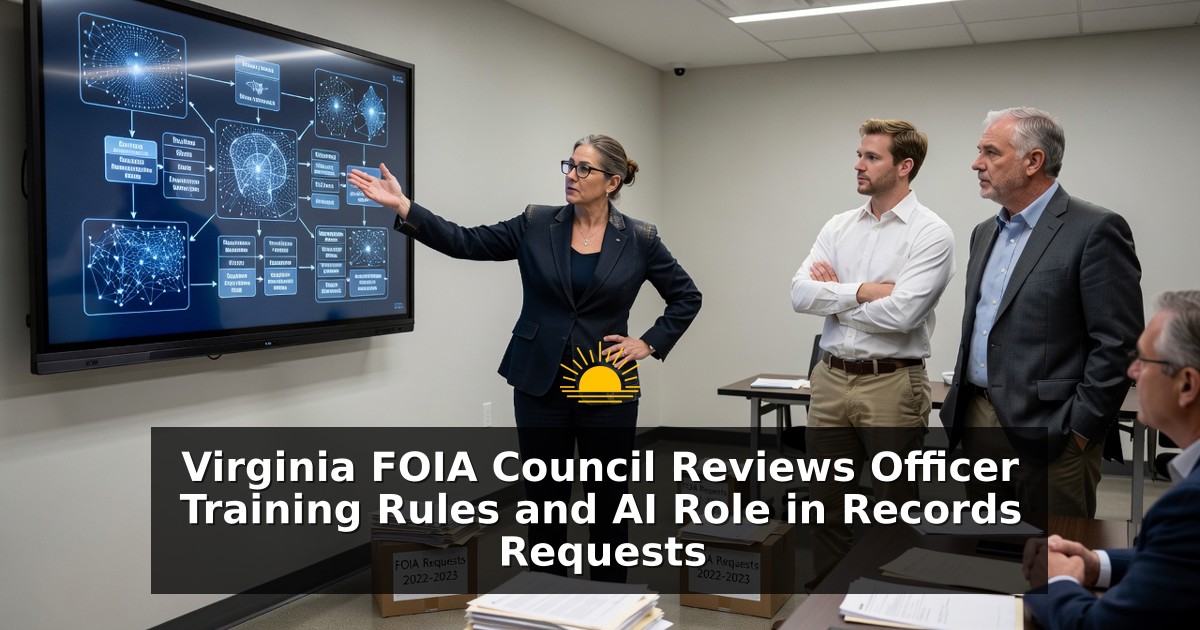
The Virginia Freedom of Information Advisory Council recently convened its Records Subcommittee to address core operational requirements under the state Freedom of Information Act. Members focused on mandatory training schedules for designated FOIA officers across public bodies and the practical effects of artificial intelligence on how requests are prepared and handled. Discussions underscored the need for consistent education and clear guidance as technology continues to reshape access to government records. Officials emphasized that accurate responses depend on up-to-date knowledge of statutory obligations and evolving requester practices.
Training forms a foundational element of Virginia’s transparency framework. Under current law, FOIA officers must complete approved training every two years to remain current on legal standards and procedural best practices. The council maintains a collection of reference materials that staff review and revise annually to reflect legislative changes, court interpretations, and operational lessons. These resources cover topics ranging from response timelines to exemptions and proper documentation of decisions. Regular updates help ensure that officers across localities and state agencies apply the statute uniformly.
Biennial Training Mandates and Annual Material Updates
Council representatives noted that the every-other-year training cycle provides a structured opportunity for officers to refresh their understanding of complex provisions. Materials distributed for these sessions include practical guidance on drafting clear responses and managing high-volume request periods. Annual reviews of the reference library allow the council to incorporate new examples and clarify recurring points of confusion reported by agencies. This dual rhythm of biennial instruction and yearly content refinement supports both compliance and efficiency. Public bodies rely on these tools to reduce errors that can lead to delays or unnecessary litigation.
Best-practice documents within the training suite also address how citizens and journalists can formulate effective requests. Officers are encouraged to share these resources so that requesters understand the value of reasonable specificity. Clear requests enable faster identification of responsive records and lower the administrative burden on staff. The council views this educational outreach as complementary to the formal training officers receive. Together the measures promote a culture of informed participation on both sides of the process.
Artificial Intelligence and the Crafting of FOIA Requests
Conversation turned to the expanding presence of artificial intelligence tools in the preparation of public records requests. One participant recounted a recent exchange with a reporter who asked whether an autonomous AI system could itself submit a valid FOIA request. The response centered on Virginia’s longstanding citizenship limitation, which restricts the right to make requests to Virginia citizens and representatives of media organizations. Because an AI program lacks citizenship status, it cannot independently qualify as a requester under the statute. That legal boundary remains firm regardless of technological capability.
At the same time, council members recognized that AI can serve as a productive assistant for human requesters. Individuals may use generative systems to brainstorm search terms, organize chronological scopes, or refine language so that requests more closely match statutory requirements. When employed thoughtfully, such tools can improve the precision of submissions and reduce the back-and-forth that often accompanies vague inquiries. The council observed that many legitimate users already experiment with these applications to strengthen their filings. Guidance materials may eventually incorporate examples of effective AI-assisted drafting.
Challenges Posed by Overly Broad AI-Generated Submissions
Experience to date also reveals significant drawbacks. Some AI-produced requests arrive with sweeping language that fails the reasonable-specificity standard required by Virginia FOIA. These submissions often demand entire categories of records without temporal limits, subject filters, or identifiable custodians, rendering them practically unanswerable as written. Officers then must either seek clarification or issue formal responses explaining the deficiencies. The resulting delays frustrate both requesters and agencies and consume staff time that could be devoted to properly framed inquiries.
Variations among AI platforms further complicate the picture. Different models generate outputs of widely differing quality, and the same prompt can yield inconsistent results depending on version updates or training data. Council participants stressed that no single policy prescription yet fits every scenario. Instead, they described AI as a tool whose utility depends entirely on how it is directed by the human user. Continuous monitoring of real-world examples will be necessary before any formal recommendations can be issued.
Maintaining Transparency Amid Technological Change
Virginia’s FOIA framework exists to guarantee public access to the workings of government, and the council’s role is to keep that framework functional as conditions evolve. Training requirements ensure that the people responsible for responding to requests possess current knowledge. Parallel attention to AI developments helps anticipate both efficiencies and obstacles that new technology may introduce. By addressing these topics together, the Records Subcommittee reinforced the principle that transparency depends on clear rules applied consistently.
Public bodies throughout the Commonwealth continue to designate FOIA officers who shoulder daily responsibility for intake, review, and release decisions. The biennial training mandate, supported by annually refreshed materials, equips those officers to meet statutory deadlines and to explain exemptions when they apply. As AI tools proliferate, the same officers will encounter an increasing number of machine-assisted requests. Preparation through education remains the most reliable method for preserving both accuracy and accessibility.
Looking ahead, the council is expected to track legislative proposals and judicial rulings that may further define the intersection of artificial intelligence and public records law. Any future adjustments to training curricula or advisory opinions will rest on accumulated evidence rather than speculation. For now, the message from the recent meeting is straightforward: sustained professional development for FOIA officers and careful evaluation of technological aids together safeguard the open-government rights Virginians exercise every day. Continued dialogue among agencies, requesters, and the advisory council will shape practical solutions that keep pace with innovation while honoring the statute’s core purposes.
AI council discussion Education FOIA government law legal Legislation meeting officers Policy Process records requests Technology training transparency updates Virginia
All Virginia News is published by ALL VIRGINIA NEWS, LLC. How we're funded · Corrections · Ethics
