Virginia Committee Reviews Local Option Measure on Pet Shop Puppy Sales
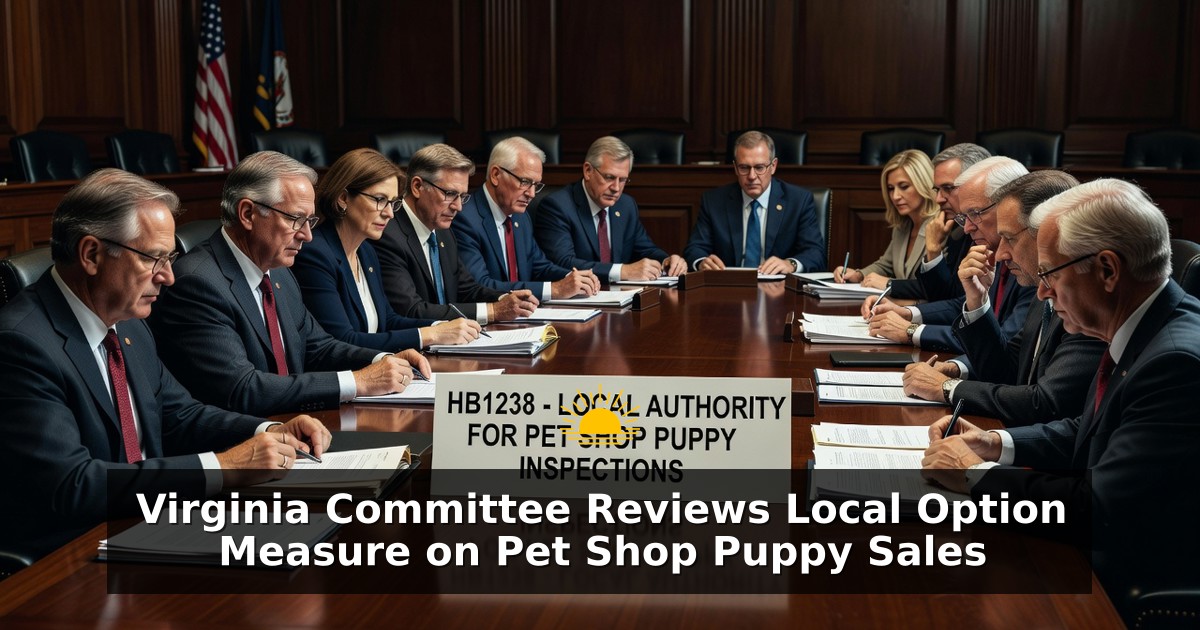
The Virginia General Assembly's Counties Cities and Towns Committee recently took up House Bill 1238, a measure that would grant cities, counties, and towns the authority to decide how pet shops selling puppies are inspected within their borders. The legislation is framed as a local-option approach rather than a statewide mandate. It would permit annual checks focused on basic care standards such as food, water, and overall living conditions for the animals offered for sale. Supporters described the bill as a measured step that respects community preferences while addressing long-standing concerns about the origins of puppies sold in retail settings.
Animal welfare organizations presented testimony in favor of the proposal during the committee hearing. Cheryl Krow of Humane World for Animals told lawmakers that eight states, including neighboring Maryland, have already prohibited the sale of puppies in pet shops. She noted that Delaware is currently considering similar legislation. Krow characterized HB1238 as the next-best alternative for Virginia and the minimum action the Commonwealth could take to empower local governments. Representatives from People for the Ethical Treatment of Animals also spoke in support, emphasizing the need for communities to examine the sources of animals sold in local stores.
Details of the Proposed Local Authority
Under the language discussed before the committee, localities would gain the ability to establish inspection protocols tailored to their own circumstances. The inspections would occur on an annual basis and concentrate on fundamental welfare indicators rather than imposing a complete ban. Officials explained that the goal is to give cities and counties tools to verify that puppies receive adequate nutrition, clean water, and acceptable housing while they remain in commercial facilities. This structure leaves the final decision about whether and how to regulate such sales in the hands of elected local boards and councils.
Proponents argued that conditions can vary widely from one jurisdiction to another across Virginia. Urban centers may face different retail patterns than rural counties, and local leaders are often best positioned to assess the needs of their residents and businesses. By keeping the measure optional, the bill seeks to avoid a one-size-fits-all requirement while still creating a pathway for oversight. Committee members heard that the approach would allow communities concerned about animal sourcing to act without forcing the same rules on every locality in the state.
Existing State Actions and Regional Trends
Several states have moved further than the local-option model now under review in Virginia. Maryland enacted a prohibition on the retail sale of dogs and cats in pet stores, joining a group of eight states that have adopted full bans. Delaware lawmakers are weighing comparable legislation in the current session. These developments formed a central part of the testimony, with speakers pointing to neighboring jurisdictions as evidence that stronger measures are already in place nearby. Advocates maintained that Virginia could begin with inspections and later consider broader steps if local experience warrants them.
National discussions about commercial breeding facilities, often called puppy mills, have influenced policy debates in multiple legislatures. Federal licensing through the United States Department of Agriculture sets baseline standards for larger breeders, yet gaps in enforcement and differing state rules have prompted additional local and state responses. The Virginia proposal does not alter federal requirements; instead it focuses on the retail end of the supply chain inside the Commonwealth. Supporters said annual local inspections could surface problems that might otherwise go unnoticed between less frequent external reviews.
Perspectives Shared During Committee Review
Testimony highlighted the desire of animal-protection groups to reduce the flow of puppies from high-volume commercial breeders into neighborhood pet shops. Speakers stressed that consumers frequently lack clear information about where the animals originate and what conditions they experienced before arriving in stores. By authorizing localities to examine food, water, and basic care, HB1238 would create a practical mechanism for gathering that information at the point of sale. The organizations framed the bill as a modest consumer-protection and animal-welfare tool rather than an outright restriction on commerce.
No comprehensive statewide ban was proposed in the measure before the committee. Advocates repeatedly underscored that the legislation merely opens the door for local choice. They described it as a flexible framework that could accommodate both communities wishing to maintain current practices and those seeking tighter scrutiny. The hearing provided an opportunity for lawmakers to weigh how much discretion should rest with county boards of supervisors, city councils, and town councils on matters involving companion-animal retail sales.
Potential Effects on Local Governance and Retail Practices
If enacted, the bill would require participating localities to develop inspection procedures and assign responsibility for carrying them out. Local governments might rely on existing animal-control officers, health departments, or contracted inspectors to perform the annual visits. The focus on food, water, and basic conditions is intended to keep the process straightforward and limited in scope. Retailers operating pet shops that sell puppies would need to prepare for possible reviews in jurisdictions that choose to adopt the option.
Business owners and local officials would retain the ability to shape the precise standards applied in each community. Some localities might adopt detailed checklists, while others could keep requirements minimal. The optional nature of the authority means that areas without significant pet-shop activity or without expressed public concern could simply decline to act. This design aims to balance animal-welfare interests with respect for local economic and administrative priorities across Virginia’s diverse regions.
Broader Policy Context in the Commonwealth
Virginia has previously addressed animal-care issues through both statewide statutes and local ordinances. Shelter standards, cruelty laws, and licensing rules already form part of the legal landscape. HB1238 would add a targeted retail-inspection component that builds on those foundations without rewriting them. Lawmakers on the Counties Cities and Towns Committee routinely examine legislation that affects the relationship between state authority and local decision-making, making the panel a natural venue for this proposal.
Observers of the legislative process note that companion-animal bills often generate interest from both advocacy organizations and retail trade groups. The current measure’s emphasis on local option may reduce some of the friction that accompanies uniform statewide mandates. By allowing each jurisdiction to evaluate its own circumstances, the bill seeks a middle path that can be adjusted over time as communities gain experience with inspections. Further discussion in subsequent committee stages or on the floor of the House would determine whether the concept advances.
The hearing underscored continuing public attention to the sources of puppies sold in commercial settings. Supporters maintained that even limited annual inspections represent a concrete improvement over the status quo in localities that elect to use the new authority. As the Counties Cities and Towns Committee continues its review of measures affecting local government powers, HB1238 stands as one example of how animal-welfare concerns intersect with questions of municipal and county discretion. The outcome will rest with legislators as they weigh the testimony and the practical implications for Virginia’s cities, counties, and towns.
animal welfare annual inspection Cheryl Krow committee hearing community decision Counties Cities and Towns Committee Daphne Neckman Delaware HB1238 Humane World for Animals Legislation local option Maryland pet shop regulation pet shops PETA puppy mills puppy sales record keeping Virginia