Virginia Subcommittee Examines Post-Storm Roofing Contractor Practices
Updated
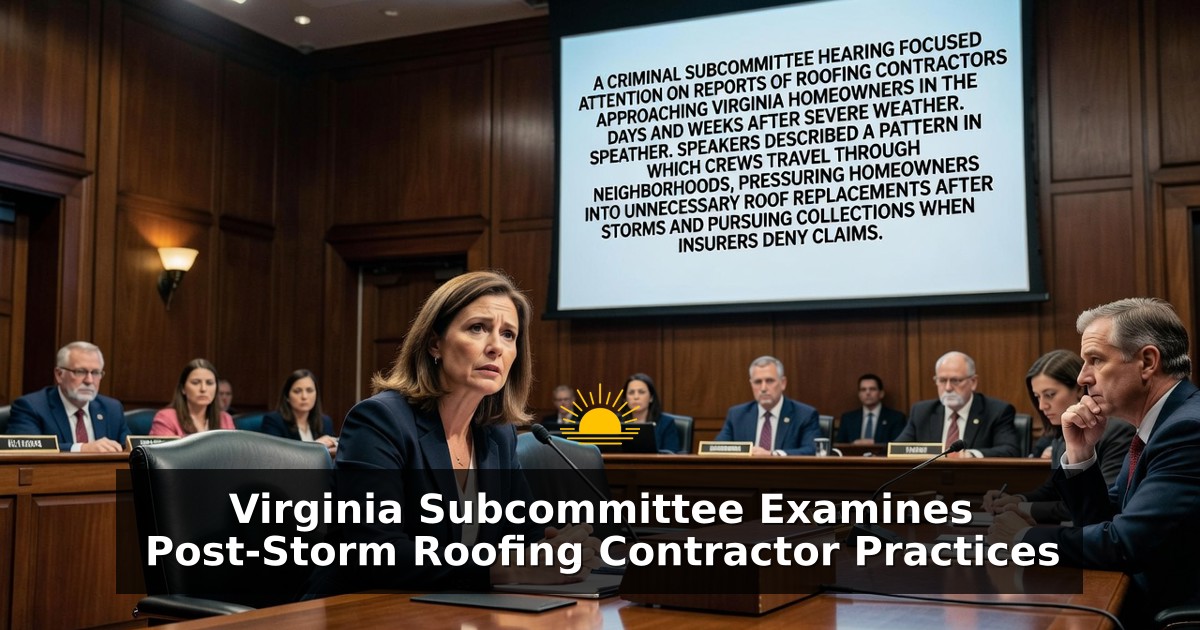
A Criminal Subcommittee hearing focused attention on reports of roofing contractors approaching Virginia homeowners in the days and weeks after severe weather. Speakers described a pattern in which crews travel through neighborhoods, inspect roofs without prior invitation, and urge residents to authorize full replacements. The accounts centered on signed contracts that later become the basis for collection actions even when insurance carriers determine that a complete new roof is not warranted. Officials and participants noted that the practice leaves many residents facing unexpected financial pressure while still recovering from storm-related damage.
Community members recounted how contractors often begin by stating they noticed possible damage while driving past a property. They then place ladders against homes, lift shingles, and declare that extensive work is required. Homeowners, frequently anxious about further leaks or structural issues, are presented with documents to sign on the spot. Those agreements commonly authorize the contractor to file an insurance claim and to proceed with work contingent on coverage decisions. When carriers later deny the claim after independent inspection, the signed contract is forwarded to collections agencies.
Pattern of Door-to-Door Solicitations After Storms
The described sequence begins shortly after storms move through residential areas. Contractors systematically canvass streets, focusing on visible roof surfaces and approaching occupants with offers of free inspections. Once on the roof, some workers reportedly manipulate a few shingles to create the appearance of widespread failure. Residents are then told that only a full replacement will restore protection and preserve property value. The urgency of the pitch, combined with residual stress from the weather event, leads many to sign authorization forms before obtaining independent estimates or consulting their insurers.
Insurance carriers subsequently examine the same roofs and frequently conclude that isolated repairs or no work at all would suffice. Denial letters cite the absence of storm-created damage sufficient to justify total replacement. At that point the contractor treats the earlier signature as an enforceable obligation for the full contract price. Collection notices follow, and homeowners find themselves responsible for sums they expected insurance to cover. The mismatch between the contractor’s representation and the insurer’s determination creates lasting financial strain for families already managing deductibles and temporary living adjustments.
Financial Consequences for Affected Homeowners
Residents who sign under these circumstances often discover that the contracts contain little or no contingency language protecting them if coverage is refused. Collection agencies pursue the balances aggressively, reporting delinquencies that can affect credit scores. Some homeowners report receiving repeated demands and threats of legal action despite having never received the promised roof work. The resulting stress compounds the original inconvenience of storm cleanup and temporary tarping. Local consumer advocates have observed that older residents and those with limited English proficiency appear particularly vulnerable to the high-pressure tactics.
Virginia households already coping with storm repairs face an added layer of difficulty when collections begin. Payment plans offered by contractors or agencies may carry high interest, further increasing the total outlay. In some instances families divert funds from other recovery needs to satisfy the debt and avoid credit damage. The cumulative effect is a transfer of cost from disputed insurance claims onto individual property owners who believed they were securing legitimate assistance. Subcommittee participants emphasized that the pattern undermines confidence in both the contracting sector and the insurance claims process.
Existing Consumer Protections and Enforcement Gaps
Virginia maintains statutes governing home-solicitation sales, contractor licensing, and unfair trade practices. These provisions require clear disclosures, cooling-off periods for door-to-door transactions, and truthful representations about the need for work. Licensing boards can sanction contractors who engage in deceptive conduct, and the Office of the Attorney General may pursue civil actions for patterns of fraud. Despite these tools, the speed with which post-storm crews operate can outpace complaint investigations. By the time a homeowner files a grievance, the contract may already be in collections and the crew may have moved to another locality.
Enforcement challenges also arise from the interstate nature of some storm-response firms. Crews travel from outside Virginia, complete a rapid series of sign-ups, and depart before local authorities can respond to multiple complaints. Documentation of verbal claims made on rooftops is often sparse, leaving investigators to rely on homeowner affidavits and whatever written materials remain. Insurance companies, for their part, routinely share denial data with regulators when patterns emerge, yet coordination among licensing boards, consumer-protection units, and law-enforcement agencies remains uneven across jurisdictions.
Discussion of Potential Remedies
Participants at the subcommittee meeting agreed that early intervention is necessary to limit further spread of the practice. Suggestions included stronger mandatory disclosure language in residential roofing contracts, explicit requirements that any insurance-contingent agreement become void upon claim denial, and enhanced penalties for unlicensed or out-of-state operators who fail to register. Another proposal called for public-education campaigns timed to storm seasons, warning residents not to sign documents during unsolicited visits and to obtain multiple independent assessments. Improved real-time data sharing between insurers and state regulators was also raised as a means of identifying problematic contractors more quickly.
Lawmakers and staff examined whether existing criminal statutes on fraud and deceptive practices could be applied more consistently to the most egregious cases. They noted that proving intent can be difficult when contractors claim they merely offered opinions about roof condition. Clearer statutory definitions of prohibited post-storm solicitation conduct could assist prosecutors. At the same time, legitimate roofing firms expressed interest in preserving the ability to market services after weather events, provided consumer safeguards remain robust. Balancing those interests formed a central theme of the discussion.
Broader Context of Storm-Related Contracting
Similar complaints have surfaced in other states following hurricanes, hailstorms, and high-wind events. National consumer organizations track spikes in roofing-related grievances in the months after major weather systems. Industry associations have issued voluntary codes of conduct urging members to avoid high-pressure tactics and to honor insurance determinations. Yet voluntary measures have not eliminated the problem, prompting legislative bodies in several jurisdictions to consider targeted amendments. Virginia’s examination of the issue therefore aligns with a wider effort to protect property owners during vulnerable recovery periods.
Homeowners are generally advised to verify contractor licenses through state databases, to refuse immediate signature requests, and to contact their insurance carriers directly before authorizing any claim. Photographing roof conditions prior to any third-party inspection can also provide useful evidence. Community associations and local emergency-management offices sometimes distribute checklists after storms to help residents navigate repair decisions. These practical steps, combined with potential statutory refinements, form the range of responses under consideration.
The subcommittee hearing underscored that the reported tactics exploit both the physical damage left by storms and the understandable desire of residents to secure their homes quickly. By elevating the issue in a public legislative setting, participants sought to gather additional information and to evaluate which combination of education, regulation, and enforcement would most effectively deter abusive practices. Further review of complaint data, insurance-industry input, and model legislation from other states is expected as the discussion continues. The goal remains preventing unnecessary financial harm to Virginians already managing the aftermath of severe weather.
bad contractors collections consumer protection contractors contracts Criminal Subcommittee door to door sales enforce contracts Fraud homeowners insurance claims insurance company insurance denials post-storm roof replacement roofing scams shingles storm damage subcommittee hearing Virginia