Data Center Fight Moves Into Greater Richmond as 17 Campuses Advance Across Eight Counties
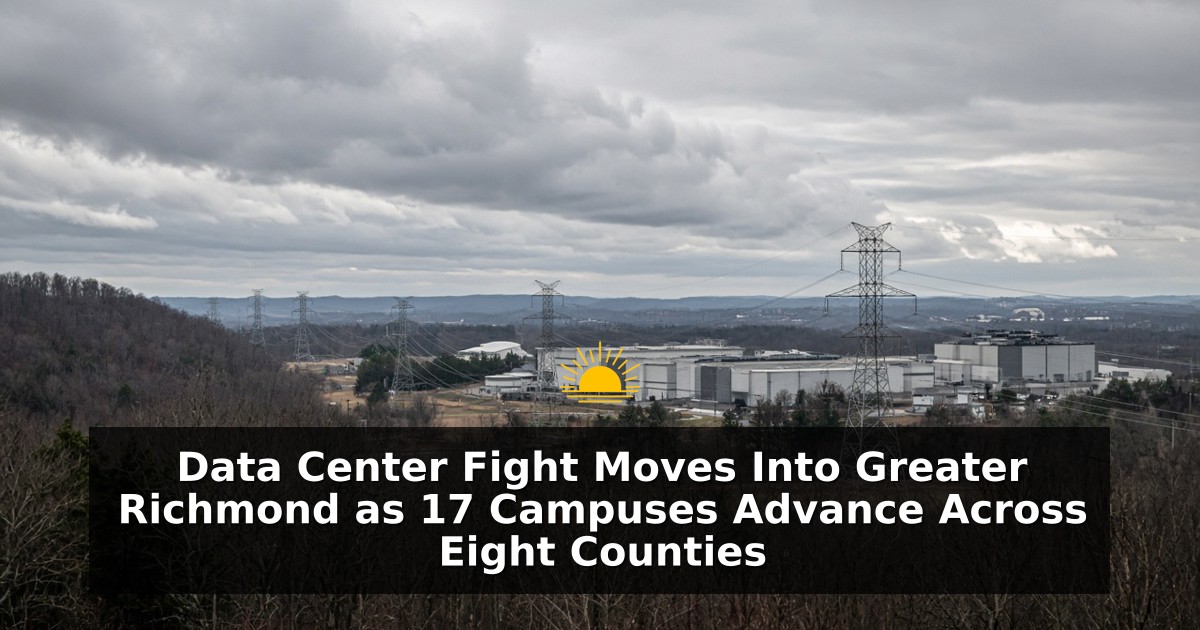
RICHMOND — Data centers have moved from Northern Virginia’s signature industry fight into the daily agenda of county meetings, protests, and campaign stops across greater Richmond, where a review of projects finds 17 campuses in development or soon planned across eight counties — plus five more proposed — totaling at least 100 individual halls when counted building by building.
That pipeline sits on top of dozens of centers already operating in Henrico and Chesterfield. The facilities run around the clock to process and store information, much of it tied to the artificial-intelligence boom that has turned power and water questions into kitchen-table politics far south of Loudoun’s data-center alley.
Neighbors packing Chesterfield and Dinwiddie hearings sound little different from Haymarket or Gainesville crowds a few years earlier. An 11-year-old told Chesterfield officials that data centers are “a big problem to every living organism.” Michelle Scheid of Dinwiddie said homeowners are “outraged” they do not get a vote when campuses reshape rural parcels. Jane Kirchner, who once served on Loudoun’s planning commission during that county’s boom, warned Hanover neighbors that operators often return after approval seeking plan changes once customers demand different configurations — leaving localities “kind of locked in.”
Resource claims vary wildly across the 21 projects reviewed by local television reporters. Some proposals span a few hundred acres; others exceed a thousand. One Dinwiddie pitch promises a closed-loop system using only a small fraction of county water. A Chesterfield proposal carries a cap of 6 million gallons a day. Those numbers now sit beside diesel-generator air permits as the metrics residents demand before any rezoning smile.
Damian Pitt, an associate professor of urban and regional studies and planning at Virginia Commonwealth University, studied backup-generator emissions in Northern Virginia using Department of Environmental Quality data on both reported and permitted pollution. He found that testing and backup use can expose nearby communities to levels similar to — and sometimes greater than — living next to a natural-gas power plant. The risk rises, Pitt said, if generators are pressed into grid support during high demand rather than sitting idle except for tests.
Tax-base champions answer with schools and public-safety math. Larry Leadbetter told a Hanover planning commission that industrial data-center revenue “eliminates burden on schools, EMS and law enforcement” and closes the structural deficit residential growth creates. Henrico, already home to more than 30 centers and saying it is no longer recruiting new ones, set aside $60 million of data-center revenue in 2024 to lower costs for first-time homebuyers. Chesterfield officials are debating how to spend what they describe as billions expected from projects that include a Google trio.
Governor Abigail Spanberger signed an executive order on September 18 and rolled out related directives aimed at transparency, environmental protections, cost allocation, clean energy, and local workers. Some lawmakers are separately petitioning for a statewide moratorium while construction continues on more than a dozen already-approved campuses. The parallel tracks — local resistance, gubernatorial guardrails, and steel already in the ground — define central Virginia’s 2026 land-use year.
Electrical tradespeople who spoke at a February Hanover planning meeting described real apprenticeship and contracting opportunity. Rural conservation groups describe irreversible conversion of farmland and forest. Both can be true in the same county if supervisors approve megawatt campuses next to working farms without buffering transmission rebuilds that follow the servers.
Campaign season has absorbed the vocabulary. Candidates who once talked only about roads and schools now must say whether they favor by-right industrial overlays, special-use permits, or pauses. Spanberger’s September package tries to set a statewide floor so localities are not negotiating in the dark under nondisclosure agreements — a practice her framework would curb.
For Henrico households that already hear generators on test days, the question is not whether data centers exist but how many more the grid and aquifers can absorb. For Dinwiddie and Hanover residents still looking at open fields on zoning maps, the question is whether they become the next Loudoun before county codes catch up.
All Virginia News will continue tracking county votes, water caps, and whether Richmond-region supervisors adopt Prince William-style special-use gates or keep chasing the tax base that built Northern Virginia’s classrooms — and its power-line wars.
Email Abigail Spanberger at:
abigail.spanberger@governor.virginia.gov
Abigail Spanberger Chesterfield County Hanover County Henrico County Richmond City Virginia Abigail Spanberger Chesterfield Clean Energy Data Data Center Data Centers Electrical Energy Executive Order Farms Google Governor Grid Land Law Enforcement Lawmakers Northern Virginia Politics Power Prince William Protests Richmond Schools Virginia Water