Virginia Training Video Offers Limited Detail on Death Certificate Deadlines
Updated
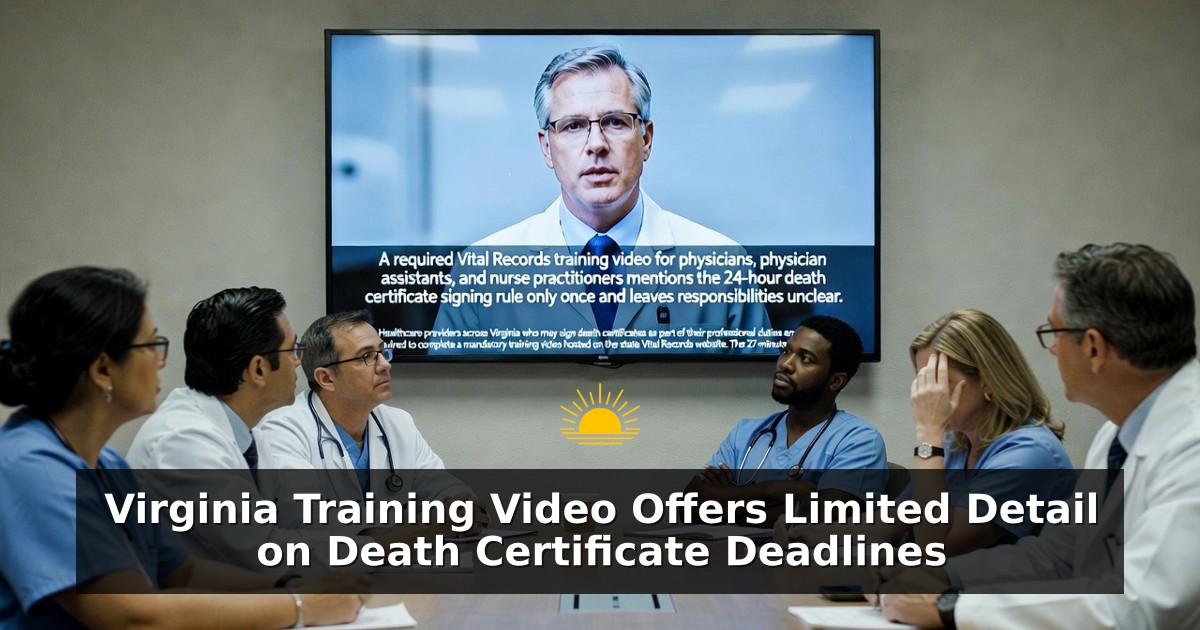
Healthcare providers across Virginia who may sign death certificates as part of their professional duties are required to complete a mandatory training video hosted on the state Vital Records website. The 27-minute presentation is directed at physicians, physician assistants, and nurse practitioners who have reason to expect they will certify a death within their authorized scope of practice. A recent examination of the video found that the requirement to sign the death certificate within 24 hours of death is referenced only a single time. The material also does not clearly outline which practitioner must complete or sign the document under differing clinical circumstances, raising questions about the effectiveness of current educational approaches.
Timely completion of death certificates serves essential legal, administrative, and public health functions throughout the commonwealth. Families rely on the finished record to arrange burial or cremation, settle estates, and access life insurance or survivor benefits without unnecessary delay. State and local agencies use the data for accurate mortality statistics that guide resource allocation and disease surveillance. Any ambiguity in training materials can therefore affect both individual households and broader population health monitoring efforts.
Virginia law places primary responsibility for the medical certification portion of the death certificate on the physician, physician assistant, or nurse practitioner who last attended the decedent. In cases involving trauma, unusual circumstances, or unattended deaths, the medical examiner assumes jurisdiction and completes the certification. The 24-hour window for the medical portion is intended to keep the overall filing process moving so that the full certificate reaches the Office of Vital Records promptly. Clear communication of these distinct roles remains critical for compliance.
Current Training Structure and Observed Gaps
The existing online video constitutes the principal mandated instruction for many clinicians who encounter death certification only occasionally. Practitioners must view the full presentation before they are considered prepared to handle the electronic or paper forms used in Virginia’s vital records system. Because the 24-hour signing deadline appears just once and without accompanying detail on accountable parties, viewers may finish the session without a firm grasp of immediate next steps after a patient dies. Educators and health regulators have noted that passive video viewing alone often produces uneven retention of time-sensitive procedural rules.
Death certification involves more than simply recording a cause of death. Clinicians must distinguish between immediate and underlying causes, list contributing conditions in the proper sequence, and indicate whether the case falls under medical examiner authority. Errors or omissions can trigger rejection of the certificate by local registrars, forcing time-consuming corrections. When training materials under-emphasize deadlines and role clarity, the likelihood of such returns increases, prolonging the period during which families lack an official record.
Public health officials emphasize that incomplete or delayed certificates also impair the state’s ability to detect emerging mortality trends. Accurate and prompt data support everything from influenza tracking to overdose surveillance and maternal mortality review. Virginia’s electronic death registration system was designed to accelerate this flow of information, yet the system still depends on clinicians who understand both the technical steps and the statutory time limits. Strengthening the educational foundation therefore serves multiple layers of the vital records infrastructure.
Alternative Approaches to Provider Education
Observers familiar with the current video have suggested that supplemental methods could reinforce the single brief mention of the 24-hour rule. Short reference guides distributed through hospital credentialing offices, periodic email reminders from the Department of Health, and integration of death-certificate modules into continuing medical education courses represent possible complements to the existing online presentation. Interactive case-based scenarios that walk through common clinical situations may also help physicians, physician assistants, and nurse practitioners internalize who must act and how quickly.
Hospitals and long-term care facilities already maintain protocols for notifying attending providers when a death occurs. Embedding explicit prompts about the 24-hour certification window inside those internal checklists could supply just-in-time reinforcement that a one-time video cannot match. Professional associations representing physicians, physician assistants, and nurse practitioners are positioned to circulate concise job aids that clarify signature authority under Virginia regulations. Coordinated messaging from multiple trusted channels would reduce reliance on any single 27-minute recording.
The Office of Vital Records periodically updates its guidance to reflect changes in statute or electronic system functionality. Incorporating more prominent and repeated statements of the signing deadline, together with decision trees that identify the responsible clinician, would align the core training video with adult-learning principles that favor spaced repetition and role-specific examples. Such revisions could be accomplished without lengthening the presentation beyond its current duration, preserving accessibility for busy practitioners.
Broader Implications for Vital Records Integrity
Delays in death certificate completion create cascading administrative burdens for funeral directors, local health districts, and state statisticians. Funeral service providers cannot finalize arrangements until the medical certification is entered, and families may face postponements of memorial services or shipment of remains across state lines. On the statistical side, late certificates complicate the production of provisional mortality counts that federal agencies and researchers use for timely analysis. Maintaining a well-informed clinician workforce is therefore inseparable from the overall reliability of Virginia’s vital records.
Physician assistants and nurse practitioners have gained expanded authority in recent years to certify deaths under defined conditions, increasing the number of professionals who must master the process. Training resources must keep pace with that expanded pool of potential certifiers. A video that mentions the central deadline only once and omits clear assignment of responsibility risks leaving newer certifiers uncertain at the very moment decisive action is required. Consistent, multi-format education helps ensure that every authorized practitioner, regardless of experience level, can meet the statutory timeline.
Stakeholders continue to examine how best to convey essential procedural facts without overburdening clinicians already managing heavy caseloads. The goal remains straightforward: every death certificate should be completed accurately and within the prescribed hours so that legal, familial, and public health needs are met without friction. Refining the current video and surrounding it with reinforcing educational tools constitutes a practical step toward that outcome. Ongoing evaluation of provider comprehension will determine whether additional adjustments are warranted in future updates to the Vital Records training curriculum.
Virginia’s system for recording deaths rests on the dual pillars of clear legal standards and effective professional education. The observation that a required instructional video addresses the 24-hour signing requirement only once underscores the value of continually improving how those standards are taught. By combining the existing online resource with targeted supplements and clearer role definitions, the commonwealth can better equip physicians, physician assistants, and nurse practitioners to fulfill their responsibilities promptly. The result will be more reliable vital records that serve families and policymakers alike.
certificate signing death certificate death signing educate education methods get the word out hours of death minute video nurse practitioner PA physician professional scope records website scope of practice sign signing Video video requirement Vital Records website website