Virginia Advances Pathway for Foreign-Trained Chiropractors Under HB 1026
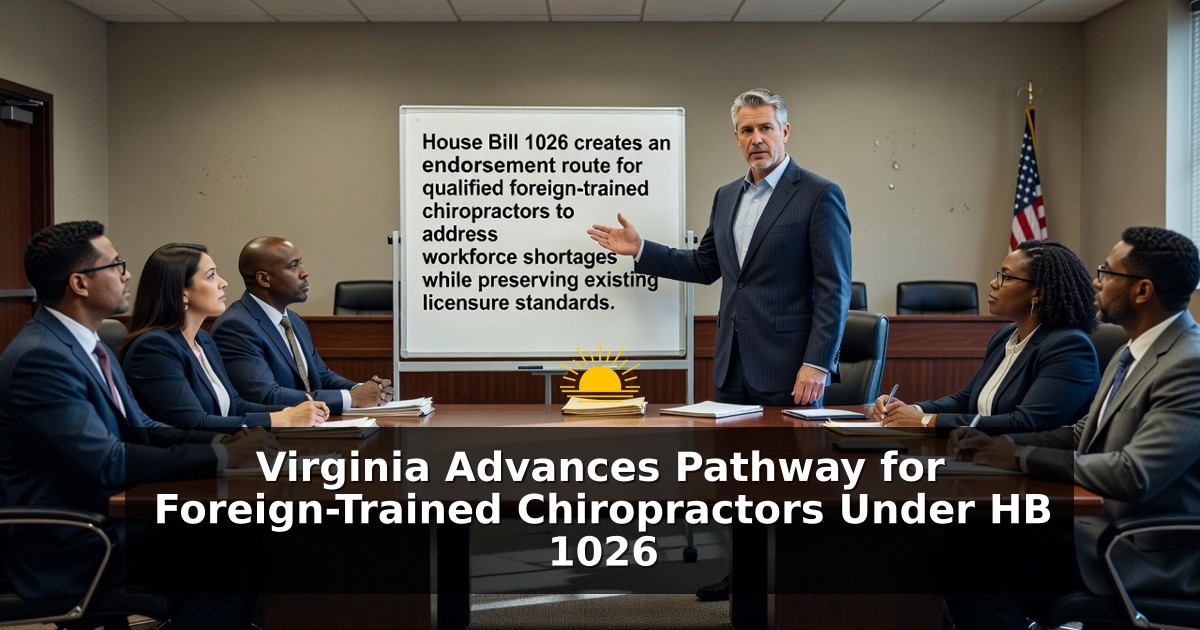
Delegate Walker presented House Bill 1026 before the Health Professions Subcommittee to establish a clear licensure pathway for chiropractors trained outside the United States. The measure would authorize the relevant state board to issue a Virginia license by endorsement once applicants satisfy a defined set of educational, experiential, and examination requirements. Supporters framed the proposal as a targeted response to ongoing shortages of chiropractic providers across the Commonwealth. The bill emphasizes that foreign-trained candidates must meet criteria comparable to those already imposed on domestically educated practitioners. Discussion centered on balancing expanded access with unwavering patient-safety protections.
Under the legislation, an applicant must hold a chiropractic degree from an institution accredited in the country where the degree was earned. The individual also needs an unrestricted license to practice in that country, and the licensing standards of the foreign jurisdiction must be judged similar to Virginia’s own requirements. At least two years of active clinical practice are mandatory before endorsement can be considered. A clean professional disciplinary record and a clean criminal record form additional non-negotiable conditions. Finally, the candidate must demonstrate legal authorization to work in the United States and must successfully complete the same national board examinations required of U.S.-trained chiropractors.
These provisions are designed to ensure that no reduction in professional standards occurs. National board examinations serve as a uniform benchmark of clinical knowledge and competency regardless of where an applicant originally trained. By retaining this examination requirement, the bill aligns foreign-trained practitioners with the identical testing regimen already familiar to Virginia licensees. Educational equivalency reviews and verification of unrestricted foreign licensure further reinforce the parity standard. Two years of documented practice supply evidence of real-world experience before a Virginia license is granted. Collectively, the criteria aim to protect the public while opening a structured route for qualified professionals.
Workforce shortages in chiropractic care have been noted in multiple regions of Virginia, particularly in rural and underserved communities. Chiropractors often serve as accessible providers for musculoskeletal complaints, preventive care, and non-pharmacological pain management. Expanding the pool of eligible licensees through endorsement can help fill vacant positions and reduce wait times for patients. The bill’s sponsors highlighted that many foreign-trained chiropractors already possess substantial clinical backgrounds yet remain unable to practice because no formal endorsement mechanism currently exists. Creating such a mechanism is expected to improve geographic distribution of services without compromising quality.
Subcommittee members also examined possible amendments that would clarify pathways for immigrants and refugees who hold foreign chiropractic credentials. These discussions focused on ensuring that documentation challenges common to displaced professionals do not become absolute barriers, provided core competency and safety standards remain intact. Any amendment would still require passage of the national board examinations and proof of clean professional and criminal histories. Legal work authorization under federal immigration rules would continue to be a prerequisite. The overarching goal remains consistent: maintain rigorous patient-protection measures while removing unnecessary obstacles for fully qualified applicants.
Patient-safety considerations dominated much of the dialogue. Lawmakers repeatedly stressed that endorsement cannot become a shortcut around established educational or testing norms. Verification of foreign accreditation status, confirmation of unrestricted licensure abroad, and mandatory national board passage together form multiple layers of scrutiny. Background checks for professional discipline and criminal history add further safeguards. Only after all of these elements are satisfied would the board be empowered to issue a Virginia license. This multi-step process mirrors endorsement practices already used in other licensed health professions within the state.
Comparable endorsement frameworks exist for physicians, nurses, and certain other health-care providers who trained abroad, provided they demonstrate substantial equivalence and pass required U.S. examinations. HB 1026 applies a similar logic to the chiropractic profession. By codifying explicit criteria rather than relying on case-by-case discretion alone, the bill seeks to increase transparency and predictability for applicants and regulators alike. Clear statutory standards also assist the licensing board in rendering consistent decisions. Over time, a steady influx of qualified foreign-trained chiropractors could ease pressure on existing practitioners and expand service capacity.
Implementation would rest with the state board responsible for chiropractic licensure, which would develop any necessary regulations to evaluate foreign educational programs and verify practice histories. The board would retain authority to deny endorsement when standards are not met or when red flags appear in an applicant’s record. Ongoing oversight after licensure would remain identical to that applied to all other Virginia chiropractors, including continuing-education mandates and complaint investigation procedures. Nothing in the bill alters the scope of practice or the disciplinary framework already in force. The sole change is the addition of a defined endorsement route for those who trained outside the United States.
Economic and demographic trends continue to shape Virginia’s health-care workforce needs. An aging population increases demand for musculoskeletal care, while recruitment of new domestic graduates does not always keep pace with retirements and population growth. Foreign-trained professionals who already meet high standards represent an underutilized talent pool. HB 1026 attempts to tap that pool responsibly. By insisting on national board examination parity and multi-year practice experience, the legislation seeks to reassure the public that newly endorsed licensees will deliver care at the expected level of competence.
Further legislative review will determine the final form of any amendments and the ultimate fate of the measure. Stakeholders from professional associations, educational institutions, and patient-advocacy groups are expected to offer additional input as the bill progresses. The core principles articulated in the subcommittee—equivalence of standards, protection of patients, and relief of workforce shortages—will likely guide subsequent debate. If enacted, House Bill 1026 would mark a measured expansion of licensure pathways while preserving the integrity of Virginia’s chiropractic regulatory system. The outcome will hinge on whether lawmakers conclude that the proposed safeguards adequately protect the public interest.
active practice applicant bill board chiropractor degree chiropractors clean record credit institution criminal record Education endorsement foreign trained license national board exams professional record standards training two years practice u.s. chiropractors United States unrestricted license Virginia virginia standards workforce shortage