Virginia Subcommittee Weighs Whistleblower Anonymity Under Senate Bill 224
Updated
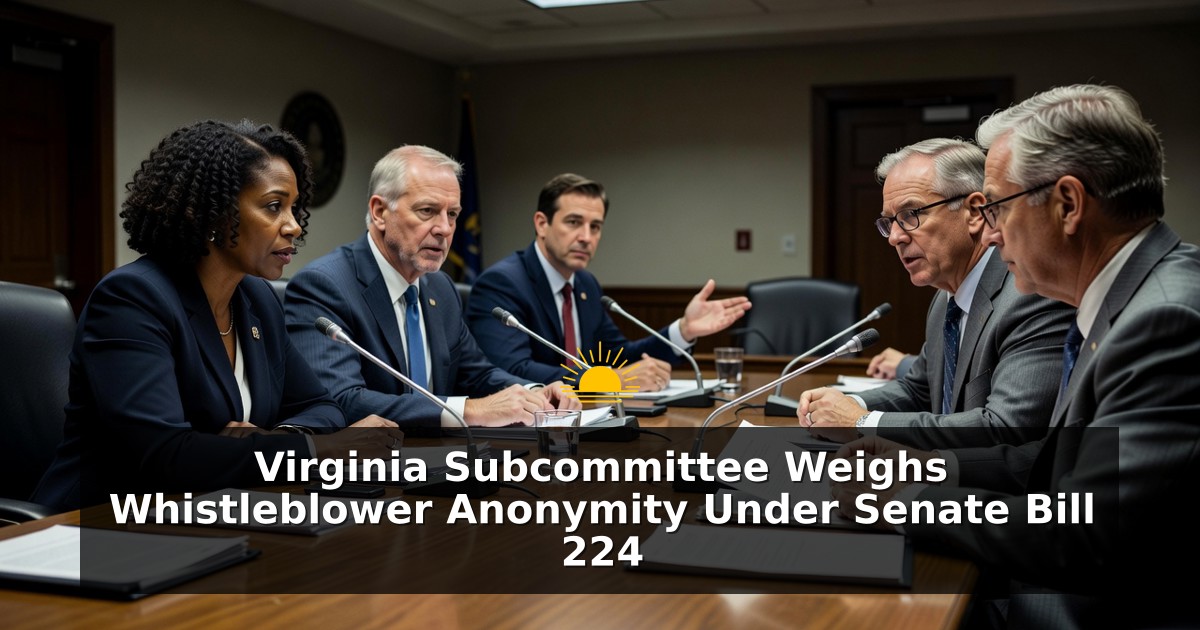
Lawmakers on a Virginia Finance Subcommittee recently examined core elements of Senate Bill 224 during a hearing focused on strengthening tools to combat tax fraud and protect public funds. A pointed question arose about whether individuals who report suspected taxpayer fraud could keep their identities hidden from authorities and the public. The exchange underscored a practical tension at the heart of the measure: the desire to encourage tips through financial incentives while preserving the privacy that often motivates people to come forward in the first place.
Officials responding to the inquiry indicated that full anonymity appears incompatible with the reward structure contemplated by the bill. They noted that processing any payment would require knowing the identity of the claimant, making it difficult for a whistleblower to both collect compensation and remain unknown. This brief but revealing discussion framed a larger policy challenge facing the General Assembly as it considers how best to design incentives that actually increase legitimate reports of fraud against the Commonwealth.
Balancing Privacy Protections and Financial Incentives
Whistleblower programs at both the state and federal levels have long grappled with the same trade-off between secrecy and accountability. Many successful tipsters fear retaliation from employers, colleagues, or the subjects of their reports, which is why anonymity provisions feature prominently in statutes designed to encourage disclosures. At the same time, governments that offer monetary awards must verify claims, calculate percentages of recovered funds, and issue payments through established financial channels that inherently require personal identifying information.
Senate Bill 224 appears to follow the model used by several existing reward programs in which the prospect of compensation is tied directly to the ability of agencies to confirm and contact the source. Without a verified identity, officials would lack a reliable method to distribute any share of recovered taxes or penalties. The subcommittee exchange made clear that lawmakers recognize this operational reality even as they seek to expand the volume of credible fraud tips reaching state tax authorities.
Public finance experts routinely observe that tax gaps—the difference between taxes owed and taxes collected—cost governments billions annually. Encouraging internal or external observers to report underreporting, false deductions, or other schemes can close portions of that gap. Yet studies of federal programs show that a meaningful share of potential whistleblowers decline to participate when they believe their names will become known, illustrating why the anonymity question carries real consequences for the effectiveness of any new Virginia statute.
How Reward Systems Typically Operate
Under comparable federal frameworks, such as the Internal Revenue Service whistleblower program, individuals who provide specific and credible information may receive a percentage of the proceeds collected as a result of their tip. Those programs require claimants to submit detailed forms that include their legal names, contact data, and Social Security numbers so that awards can be processed and reported for tax purposes. Once a claim is filed, the agency maintains confidentiality to the extent permitted by law, but the whistleblower’s identity is known internally and may be disclosed in limited circumstances during litigation or collection actions.
State-level analogs often adopt similar mechanics. A whistleblower seeking a share of recovered Virginia tax revenue would need to establish eligibility, which in practice means creating an auditable record linking the tip to a named individual. The subcommittee discussion reflected this standard administrative requirement rather than any novel policy choice unique to Senate Bill 224. Lawmakers appear to be weighing whether the bill should explicitly codify that trade-off or explore alternative structures that might allow limited anonymity for non-reward tips while still offering payments to those willing to identify themselves.
The practical obstacles to anonymous payment are substantial. Electronic funds transfers, paper checks, and tax reporting forms all demand verifiable payee information. Attempting to route money through intermediaries or encrypted channels would introduce new risks of fraud against the reward program itself and could complicate audits of how state funds are disbursed. These considerations help explain why the response during the hearing treated anonymity and rewards as largely mutually exclusive options for any single claimant.
Implications for Fraud Detection and Public Trust
Effective detection of tax fraud depends on a steady flow of high-quality information from people with firsthand knowledge of improper practices. Employees inside companies, contractors, and even competitors sometimes possess documents or observations that auditors would otherwise miss. When those individuals calculate that the personal risk of exposure outweighs the potential financial upside, fewer tips reach investigators and more improper claims on the public treasury may go unchallenged.
Conversely, a system that guarantees rewards only to identified whistleblowers can still generate substantial recoveries, as demonstrated by multi-year data from federal award programs. Those recoveries return money to general funds that support schools, infrastructure, and public safety. Virginia officials evaluating Senate Bill 224 must therefore assess whether the expected increase in identified tips will outweigh any chilling effect caused by the loss of complete anonymity. The subcommittee exchange placed that calculation squarely on the legislative agenda.
Transparency advocates argue that accountability for the use of reward payments also matters. Taxpayers have a legitimate interest in knowing that funds set aside for whistleblower compensation are distributed according to clear rules and are not susceptible to abuse. Requiring identity verification serves that oversight function even while it limits privacy. The hearing remarks suggested that members of the panel view the verification step as an unavoidable feature of any fiscally responsible reward mechanism.
Next Steps in the Legislative Process
Senate Bill 224 will continue to move through committee review, where additional testimony from tax administrators, legal practitioners, and good-government groups is expected. Stakeholders are likely to propose clarifying amendments that spell out the precise conditions under which identity must be disclosed and the confidentiality safeguards that will apply after a claim is submitted. Some may recommend a dual-track approach that preserves a fully anonymous tip line for citizens who seek no payment while reserving the reward pathway for those prepared to identify themselves.
Whatever final form the legislation takes, the brief dialogue captured in the Finance Subcommittee hearing has already illuminated the central design choice. Virginia must decide how to weigh the privacy expectations of potential informants against the administrative and accountability demands of a monetary incentive program. The outcome will shape both the volume and the quality of fraud reports that state agencies receive in coming years and will influence the amount of improperly withheld tax revenue that can be returned to public purposes.
Observers of state fiscal policy note that similar debates have played out in other jurisdictions that expanded whistleblower statutes in the past decade. Those experiences show that clear statutory language reduces later litigation over eligibility and payment procedures. By confronting the anonymity question early, Virginia lawmakers position themselves to draft provisions that are both workable for agencies and understandable to the citizens they hope will step forward. The subcommittee’s straightforward acknowledgment that rewards and anonymity are difficult to reconcile provides a foundation for that drafting work as the bill advances.
accountability anonymity Debating Department of Taxation finance subcommittee identity informant legal provisions Legislation privacy reward Senate Bill 224 tax compliance tax fraud tax program taxpayer Virginia Virginia's whistleblower whistleblower protection