Virginia Subcommittee Weighs Definition of Person in Property Statutes
Updated
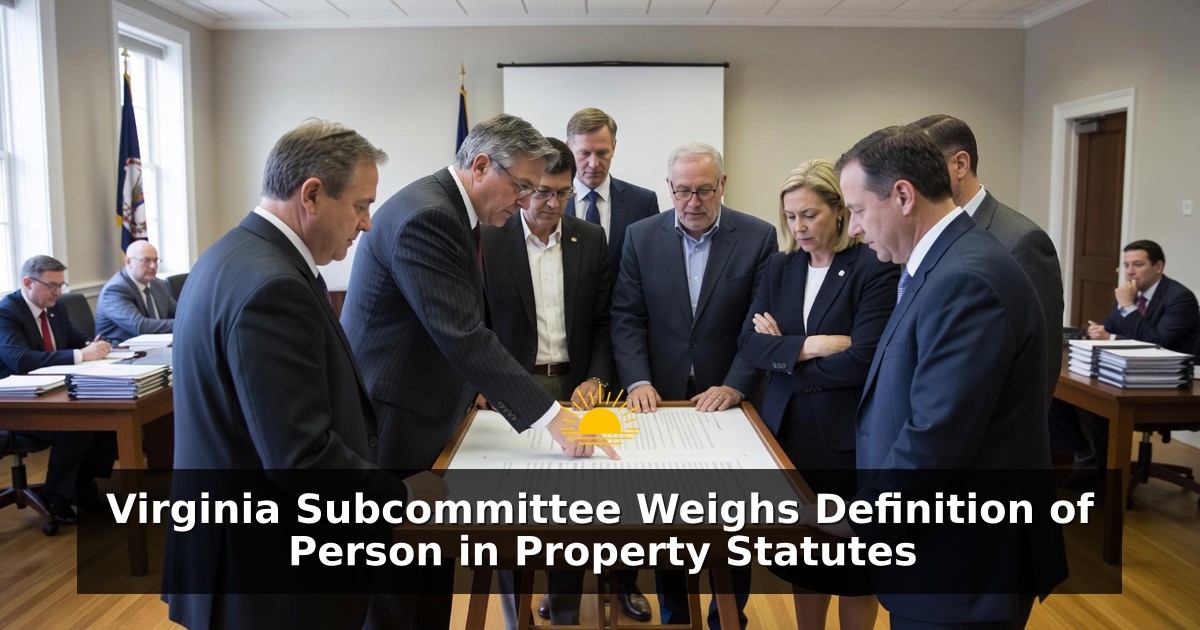
Members of a Virginia Freedom of Information Advisory Council Records Subcommittee recently examined proposed statutory language that would alter how property ownership rules apply across the Commonwealth. The discussion centered on replacing a reference to noncitizens owning property with the broader phrase any person while also specifying real property in the relevant section. Officials noted that the term person already carries an established definition elsewhere in the Virginia Code. That existing definition typically encompasses both natural persons and corporations, raising questions about the precise intent behind the draft wording.
The exchange highlighted a recurring challenge in legislative drafting: ensuring that key terms produce consistent results when applied to different categories of owners. Subcommittee participants asked whether the goal was to extend the provision to corporate entities or to confine it strictly to individuals. Staff indicated that the language could be adjusted either way once lawmakers clarified their preference. The conversation underscored the importance of aligning new text with longstanding definitions already embedded in state law.
Existing Definitions in the Virginia Code
Virginia statutes contain a general definition of person that has guided interpretation for many years. Under that framework, the term ordinarily includes any individual, corporation, partnership, association, cooperative, limited liability company, trust, joint venture, or other legal or commercial entity. This inclusive approach appears in multiple titles of the code and supports uniform application of rights and duties. When a bill or amendment simply inserts the word person, drafters and courts routinely look to that baseline meaning unless the measure expressly states otherwise.
Legislative history shows that Virginia has long recognized corporate entities as capable of holding title to real estate. Corporations routinely acquire, develop, and convey land for commercial, industrial, and residential purposes under the same recording and taxation systems that apply to individuals. Any shift that either expands or narrows the reach of person therefore carries practical consequences for how those transactions are regulated. Clarity at the drafting stage helps prevent later disputes over whether a particular restriction or authorization was meant to cover business organizations.
Context of Noncitizen Property Provisions
The draft under review would strike the word noncitizens and substitute any person in a section addressing ownership of real property. Several states maintain statutes that limit or condition land acquisition by foreign nationals or foreign-controlled entities, often citing agricultural security or national-interest concerns. Virginia’s own code has contained related provisions at various points, reflecting periodic legislative attention to the issue. Replacing a narrow category with the broader term person invites examination of whether corporations—domestic or foreign—fall inside the new scope.
Observers note that corporate ownership structures can involve layers of subsidiaries, holding companies, and out-of-state or international investors. A definition that automatically sweeps in every corporate form may therefore produce wider effects than a provision limited to natural persons. Conversely, excluding corporations could leave significant commercial holdings outside the intended regulatory framework. The subcommittee’s inquiry sought to surface these distinctions before the language advanced further.
Corporate Personhood and Statutory Consistency
American law has treated corporations as persons for many purposes since the nineteenth century, a doctrine reinforced by both state codes and federal jurisprudence. In Virginia this principle enables corporations to sue and be sued, enter contracts, and own property in their own names. When statutes employ the word person without qualification, the inclusive code definition usually governs. Lawmakers occasionally override that default by inserting phrases such as natural person or individual, thereby signaling a deliberate limitation.
The Records Subcommittee discussion illustrated how even small wording choices can alter the reach of a statute. Participants explored whether the proposed substitution was intended to modernize outdated phrasing, to broaden eligibility, or simply to achieve stylistic uniformity with other sections. Because the Freedom of Information Advisory Council frequently advises on clarity and accessibility of public records and related legal texts, the panel’s attention to definitional precision fits within its broader mission of promoting understandable government documents.
Practical Implications for Property Transactions
If the term person is left unmodified, title companies, lenders, and local recording officials would likely continue to treat corporations as eligible owners under the revised section. That outcome would maintain continuity with existing commercial practice and avoid sudden disruption of business investment. Should legislators instead elect to restrict the provision to natural persons, additional conforming amendments might be required elsewhere in the code to address corporate holdings already on the books. Either path demands careful cross-referencing so that related tax, zoning, and disclosure rules remain coherent.
Real-property markets in Virginia depend on predictable rules that allow both individuals and entities to plan long-term projects. Ambiguity about who qualifies as a person can generate litigation, delay closings, and increase transaction costs. By pausing to confirm legislative intent, the subcommittee aimed to reduce those risks. Staff standing ready to redraft the language once direction is given further demonstrates the technical support available to lawmakers seeking precision.
Legislative Drafting Standards and Next Steps
Virginia’s Division of Legislative Services and various advisory bodies routinely emphasize the value of defined terms that travel consistently across titles. When a word such as person already possesses a code-wide meaning, deviations are customarily flagged with explicit qualifiers. The recent exchange served as a reminder of that drafting discipline. Participants left open the possibility of limiting the provision to natural persons or of embracing the fuller definition that includes corporations, depending on policy goals yet to be finalized.
Future meetings or full council sessions may revisit the issue once sponsors supply clearer guidance. In the meantime, the recorded discussion provides a public record of the questions raised and the options presented. Stakeholders in the real-estate, business, and agricultural sectors are expected to monitor subsequent drafts for any narrowing or expansion of covered owners. The process reflects the incremental, detail-oriented work that accompanies even seemingly modest changes to the Virginia Code.
Accurate statutory language ultimately serves citizens, businesses, and government agencies alike by reducing uncertainty and supporting even-handed enforcement. The subcommittee’s focus on the scope of person advances that objective. Whether the final text includes corporations or confines itself to individuals, the deliberate examination of intent stands as a model for careful legislative craftsmanship. Continued attention to definitional alignment will help ensure that property rules operate as lawmakers intend across the diverse ownership landscape of the Commonwealth.
committee meeting corporations debated Defining discuss includes Lawmakers legal legal definitions Legislation meeting members natural persons person statutes subcommittee term terms Virginia whether
All Virginia News is published by ALL VIRGINIA NEWS, LLC. How we're funded · Corrections · Ethics
