Virginia Lawmakers Advance Dog Hunting Permit Standards for Loudoun County
Updated
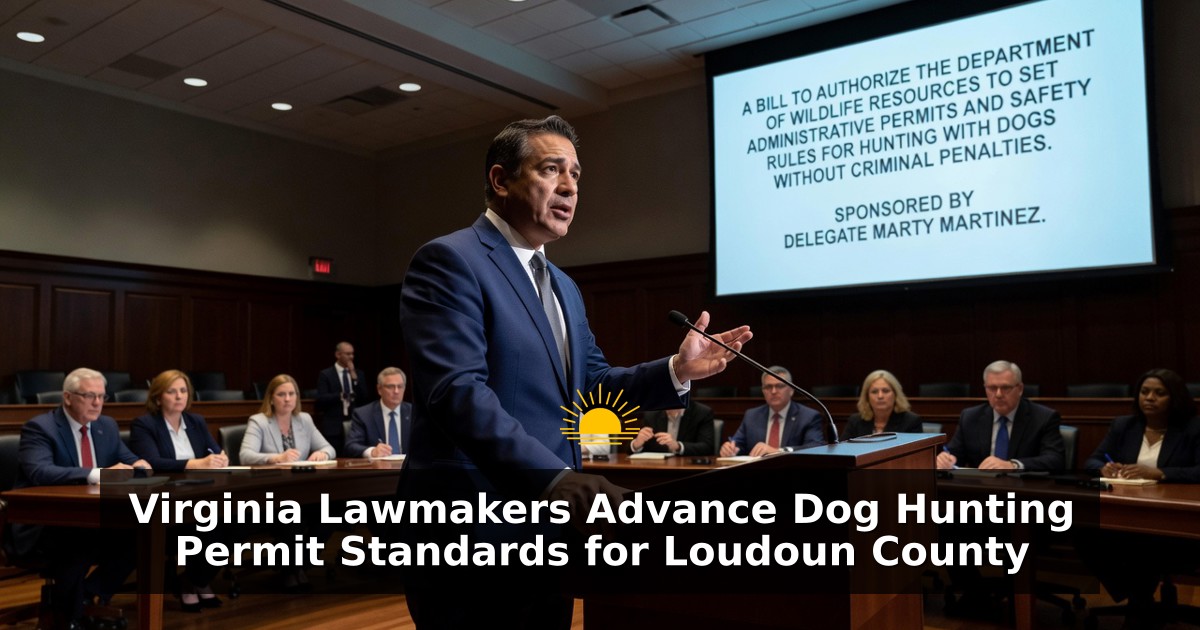
A measure sponsored by Delegate Marty Martinez advanced through a Virginia General Assembly Agriculture Subcommittee hearing after lawmakers reviewed a framework that would authorize the Department of Wildlife Resources to establish clear administrative standards for hunting with dogs in Loudoun County. The proposal centers on creating consistent permit procedures, identification requirements, and safety practices while deliberately avoiding criminal penalties for hunters. Supporters described the legislation as filling a long-standing gap in regulatory authority that had left the agency without uniform tools to manage conflicts in residential and mixed-use areas.
The bill outlines a structured process under which the Department of Wildlife Resources would develop and enforce standards specific to dog-assisted hunting. Those standards would cover applications for permits, criteria allowing administrative suspension or revocation of permits, methods for identifying dogs used during hunts, and defined exemptions in situations where a permit would not be required. Additional provisions address practices intended to improve safety and reduce conflicts between hunters, property owners, and neighboring communities. Officials emphasized that the approach mirrors regulatory structures already applied to other outdoor activities under the department’s jurisdiction.
For years, various stakeholder groups have examined best practices for hunting with dogs, yet the Department of Wildlife Resources lacked consistent statutory mechanisms to adopt or enforce them. The Martinez legislation supplies that missing structure without expanding criminal liability. By relying on administrative processes rather than court prosecutions, the bill seeks to maintain accountability while recognizing hunting as a regulated outdoor activity rather than a criminal offense. Subcommittee members heard that this distinction is central to the measure’s design and to its support among outdoor recreation advocates.
Loudoun County has experienced growing tension between traditional hunting practices and expanding residential development. As neighborhoods have extended into formerly rural landscapes, reports of dogs crossing property lines and related safety concerns have increased. Local residents and hunters alike have called for clearer rules that protect both property rights and lawful hunting opportunities. The proposed permit system aims to address those competing interests by giving the state wildlife agency explicit authority to set enforceable yet non-criminal standards tailored to backyard and edge-of-suburb settings.
During the subcommittee session, several supporters appeared to offer testimony in favor of the bill. Their remarks focused on the practical need for uniform identification of hunting dogs, predictable permit criteria, and administrative remedies that can be applied quickly when problems arise. Witnesses noted that without such tools the department has been limited in its ability to respond consistently across different localities. The presence of experienced legal voices underscored the intent to keep enforcement within civil and administrative channels.
Former Deputy Attorney General and former Commonwealth’s Attorney Stem stood ready to answer technical questions from committee members about the bill’s legal framework. That appearance highlighted the careful drafting intended to grant the Department of Wildlife Resources clear authority while safeguarding hunters from criminalization. Questions centered on how suspension or revocation decisions would be reached, what due-process protections would apply, and how exemptions would be defined so that routine or low-impact activities remain unburdened. The exchange reinforced the legislation’s emphasis on process over punishment.
Identification methods for dogs form a key component of the proposed standards. Requirements could include collars, tags, or other marking systems that allow rapid determination of ownership and permit status during a hunt. Such measures are expected to help resolve disputes more efficiently when dogs enter private property or public spaces. Safety practices under consideration include guidelines on pack size, time-of-day restrictions in certain zones, and communication protocols with nearby landowners. Together these elements are designed to minimize conflicts without prohibiting the activity itself.
Exemptions written into the bill would ensure that not every instance of hunting with dogs triggers a permit obligation. Lawmakers and agency staff have indicated that limited or traditional uses meeting specific criteria could proceed without additional paperwork. This calibrated approach seeks to avoid over-regulation while still providing the department with tools for higher-intensity or higher-conflict situations. The balance reflects years of discussion among hunters, wildlife managers, and community representatives who have sought workable middle ground.
The Department of Wildlife Resources already oversees a wide range of hunting, fishing, and boating activities through permits and administrative rules. Extending similar authority to dog hunting in Loudoun County would align that activity with existing regulatory patterns. Agency officials have long noted that inconsistent local ordinances and the absence of statewide standards have complicated enforcement and public education efforts. The Martinez bill supplies the statutory foundation needed for the department to issue uniform guidance and to hold permit holders accountable through administrative means.
Supporters argued that administrative suspension or revocation offers a more proportionate response than criminal charges when violations occur. A hunter who fails to follow identification rules or safety practices could face loss of permit privileges rather than a criminal record. This distinction is intended to encourage compliance while preserving the ability of responsible individuals to continue hunting. Committee discussion confirmed that the goal is accountability paired with fairness, not the creation of new crimes.
As Loudoun County continues to grow, the interface between residential neighborhoods and remaining hunting grounds is expected to remain a point of friction. Clear state-level standards can reduce the patchwork of local responses that sometimes leave both hunters and homeowners uncertain about their rights and obligations. By placing rulemaking authority with the Department of Wildlife Resources, the legislation aims to produce science-based, publicly reviewed regulations that can be updated as conditions change. That flexibility is viewed as essential in a rapidly evolving suburban-rural landscape.
The subcommittee hearing provided an early public airing of the bill’s core concepts and drew statements of support from individuals familiar with both wildlife management and criminal justice. Testimony stressed that the measure does not invent new restrictions so much as it organizes existing expectations into an enforceable administrative system. Lawmakers were reminded that similar permit frameworks already govern other outdoor pursuits without driving participants out of the activity or into the courts. The parallel was offered as evidence that the approach is both familiar and workable.
Further legislative steps will determine the final shape of any standards the Department of Wildlife Resources ultimately adopts. If enacted, the agency would be expected to conduct public processes to refine permit criteria, identification protocols, and safety guidelines. Stakeholders on all sides would have opportunities to comment before rules take effect. That transparent development path is presented as a safeguard ensuring the final product reflects practical field experience as well as legal clarity.
Delegate Marty Martinez framed the legislation as a modest but necessary grant of authority that equips the state wildlife agency to manage an activity already occurring across Loudoun County. By focusing on permits, administrative remedies, dog identification, exemptions, and conflict-reduction practices, the bill seeks to replace ambiguity with structure. Supporters maintain that hunters benefit from knowing the rules in advance and that communities benefit from having a clear point of contact when problems arise. The subcommittee’s consideration marks a concrete step toward that shared objective.
Observers note that Virginia has a long tradition of regulating outdoor recreation through the Department of Wildlife Resources rather than through criminal statutes alone. Extending that tradition to hunting with dogs in a high-growth county fits established patterns of wildlife governance. The current proposal simply supplies the missing statutory language that allows the agency to act consistently and accountably. Whether the full General Assembly ultimately agrees will depend on continued discussion of the balance between access, safety, and property rights.
In the end, the measure under review offers a procedural solution to a practical problem. It equips wildlife managers with tools they have lacked, protects hunters from unnecessary criminal exposure, and gives residents a clearer framework for addressing conflicts. As Loudoun County and similar localities continue to change, such administrative clarity may prove essential to sustaining both wildlife traditions and community peace. The Agriculture Subcommittee’s examination of the Martinez bill places those issues squarely before Virginia lawmakers for further action.
accountability administrative revocation Agriculture Subcommittee best practices conflicts minimization Delegate Marty Martinez dog hunting DWR hunting exemptions hunting permits hunting regulations hunting standards Loudoun County outdoor activities permit suspension permits regulated activity safety practices Virginia hunting wildlife resources