Delegate Shin Advances HB 1238 to Strengthen Local Pet Shop Oversight
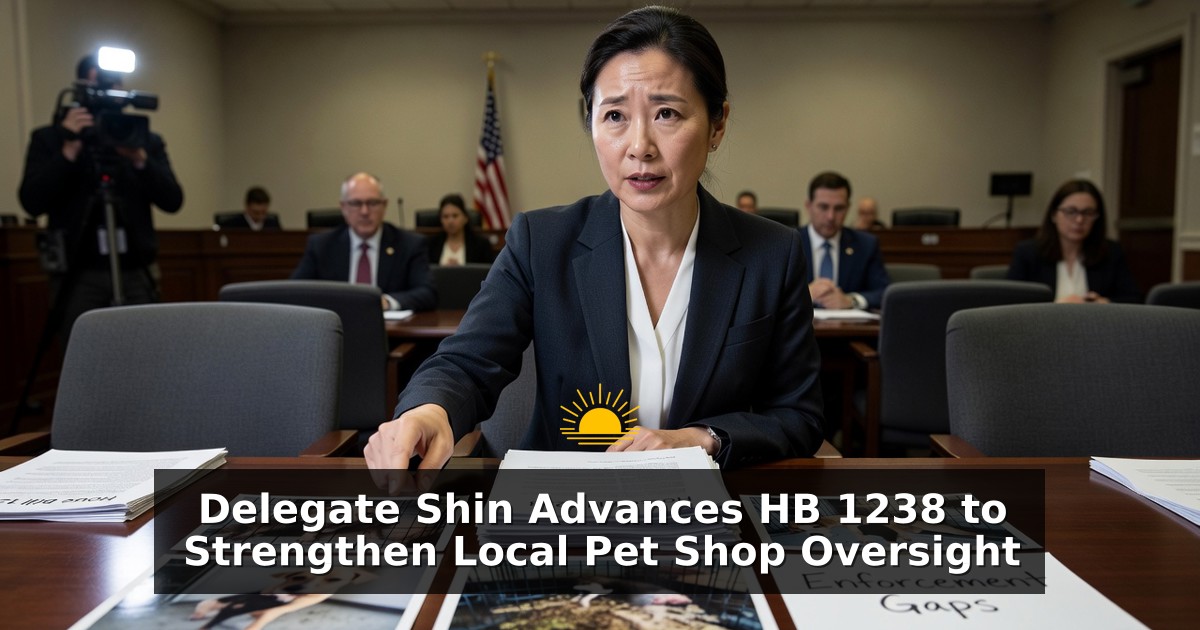
Delegate Irene Shin has introduced House Bill 1238 in the Virginia General Assembly as a permissive measure designed to give localities greater authority to regulate pet shops and address animal mistreatment. The legislation responds directly to ongoing difficulties faced by multiple Virginia counties in holding operators accountable when complaints arise about the care of animals sold in commercial settings. Under current statewide frameworks, local governments have reported limited tools for investigating violations or imposing meaningful consequences on businesses that fail to meet basic welfare standards. Shin presented the bill as a flexible option rather than a mandate, allowing each locality to decide whether and how to craft its own ordinances. Supporters of the approach argue that tailored local rules can close enforcement gaps without imposing uniform requirements across the Commonwealth.
The measure arrives after several localities, including Prince William County, Fauquier County, and Greene County, encountered repeated challenges in responding to allegations of abuse or neglect inside pet retail establishments. Officials in these areas have described situations in which existing state provisions left them without clear pathways to inspect facilities thoroughly, seize animals when necessary, or pursue sustained corrective action against repeat offenders. Community members and animal welfare advocates have long noted that the absence of stronger local mechanisms can prolong poor conditions for dogs, cats, and other companion animals offered for sale. House Bill 1238 seeks to remedy that shortfall by expressly authorizing ordinances that target documented patterns of mistreatment. The bill’s permissive character means no locality would be compelled to act, yet those experiencing problems would gain statutory backing to do so.
Local Enforcement Challenges Across Northern and Central Virginia
Prince William County has been among the jurisdictions citing the need for clearer authority when pet shops generate repeated welfare complaints. County animal control and legal staff have previously indicated that state-level rules sometimes leave gaps in day-to-day oversight of retail operations. Similar concerns have surfaced in Fauquier County, where rural and suburban communities alike have watched commercial animal sales raise questions about sourcing, housing, and veterinary care. Greene County officials have likewise pointed to difficulties in assembling enforceable cases when evidence of neglect appears but statutory tools remain limited. These shared experiences across neighboring and nearby localities helped shape the rationale for a bill that expands local options rather than centralizing all regulation in Richmond. By listing the affected counties in public remarks, the legislation’s sponsor underscored that the problem is neither isolated nor theoretical.
The area surrounding Delegate Shin’s district has its own documented history with problematic pet retail operations. Approximately ten years ago, the business known as Dreamy Puppy became the focus of a significant law-enforcement action after authorities seized between forty and fifty puppies from the premises. A subsequent court order awarded custody of forty-six of those animals to the county, removing them from the store’s control. Inspectors simultaneously determined that the building housing the shop was unsafe, contributing to the ultimate closure of the establishment. The episode left a lasting impression on residents and local officials who witnessed both the scale of the seizure and the legal steps required to protect the animals. That earlier case continues to illustrate why clearer local authority can matter when commercial operators fall short of accepted care standards.
Details of the Dreamy Puppy Case and Its Lasting Implications
Law-enforcement personnel who entered the Dreamy Puppy location found conditions serious enough to justify the removal of dozens of young dogs in a single operation. The court proceedings that followed confirmed the county’s custody of forty-six puppies, ensuring they would not be returned to the same environment. Building-safety findings added another layer of concern, demonstrating that structural deficiencies compounded the animal-welfare issues already under investigation. Once the store closed, the incident entered local memory as an example of how difficult it can be to intervene effectively without robust ordinances already on the books. Residents familiar with the case have cited it when discussing the need for preventive local rules rather than purely reactive measures. The passage of a decade has not erased the episode’s relevance to current legislative conversations about pet-shop accountability.
House Bill 1238 does not create new statewide criminal penalties or replace existing animal-cruelty statutes. Instead, it clarifies that localities may adopt ordinances specifically addressing the operation of pet shops and the treatment of animals held for sale. Such ordinances could cover inspection protocols, record-keeping requirements, housing standards, or graduated sanctions for non-compliance. Because the bill is framed as permissive, each board of supervisors or city council would retain full discretion to draft language suited to local conditions and resources. Drafting flexibility is intended to accommodate differences between densely populated suburban counties and more rural jurisdictions that may encounter pet retail issues less frequently. Legal observers note that similar enabling statutes in other policy areas have allowed Virginia localities to innovate while remaining within the bounds of state law.
Broader Context of Animal Welfare Regulation in the Commonwealth
Virginia maintains a body of state law governing animal cruelty, abandonment, and certain commercial breeding activities, yet retail pet shops occupy a distinct regulatory niche. Gaps between state minimums and local enforcement capacity have prompted periodic calls for clearer delegation of authority. Animal-control officers in multiple counties have described situations in which they could document substandard conditions yet lacked an ordinance pathway to compel lasting improvements or to restrict future sales. House Bill 1238 aims to supply that missing link by affirming local power to act. The legislation’s focus on “bad actors” signals an intent to target chronic or severe problems rather than to burden compliant businesses with unnecessary rules. Proponents emphasize that responsible pet retailers already meet or exceed basic welfare expectations and would face little additional impact.
Public discussion surrounding the bill has also touched on the sourcing of animals sold in retail settings. Some localities have expressed interest in ordinances that would require disclosure of breeder information or limit sales of animals obtained from high-volume commercial facilities with poor inspection histories. Others may prioritize enhanced veterinary documentation or limits on the number of animals that can be housed in a given retail space. Because House Bill 1238 leaves the precise content of any ordinance to local elected officials, communities can weigh these options against available staffing and budgetary realities. The permissive structure therefore functions as an invitation to problem-solve rather than a one-size-fits-all directive. Legislative analysts tracking the measure note that similar enabling bills have historically enjoyed bipartisan support when framed around local control and animal protection.
Legislative Path and Potential Local Implementation
As House Bill 1238 moves through the committee process, members of the General Assembly will examine its language for consistency with existing Dillon Rule principles that govern local authority in Virginia. The bill’s sponsors have characterized it as carefully drafted to avoid overreach while still delivering practical tools to counties and cities that request them. If enacted, the statute would take effect on a timeline allowing localities to study model ordinance language and to conduct public hearings before any new rules are adopted. Prince William, Fauquier, Greene, and other interested jurisdictions could then decide whether to proceed, what standards to set, and how to fund any added enforcement responsibilities. The experience of the Dreamy Puppy closure remains a concrete reference point for lawmakers weighing the human and animal costs of delayed intervention.
Community stakeholders, including rescue organizations and veterinary professionals, have monitored the bill’s progress with interest. Many of these groups have assisted localities in the past when large numbers of animals suddenly required placement after seizures or store closures. Their practical knowledge of rehoming capacity and medical triage underscores why earlier, ordinance-based interventions can reduce the scale of emergency responses. At the same time, retail industry representatives are expected to seek clarity on how any new local rules would interact with existing business licenses and consumer-protection statutes. Balanced implementation will depend on transparent drafting and adequate notice to shop owners. The neutral, enabling design of House Bill 1238 is intended to facilitate exactly that kind of measured local dialogue.
In presenting the legislation, Delegate Shin highlighted both the specific counties already struggling with enforcement and the broader principle that local governments are often best positioned to recognize and address problems inside their boundaries. The bill does not prescribe the content of future ordinances; it simply removes doubt about whether localities possess the power to write them. That clarity alone can encourage proactive policy development rather than crisis-driven reactions. As the General Assembly continues its work, House Bill 1238 stands as a focused attempt to align state enabling authority with documented needs in Prince William County, Fauquier County, Greene County, and additional Virginia communities. The ultimate test of the measure will lie in whether localities choose to employ the tools it offers and whether those tools prove effective in protecting animals while respecting legitimate commerce.
Amendments animal abuse bad actors bill as amended building unsafe commonwealth complaint court order custody dreamy puppy enforcement mechanism falkir county flexibility green county haspel Law Enforcement localities mistreatment of animals ordinance permissive bill pet shop regulation pet shops prince william county puppies Violations