Delegate Shin Stresses Local Authority in HB 1238 Pet Shop Oversight Debate
Updated
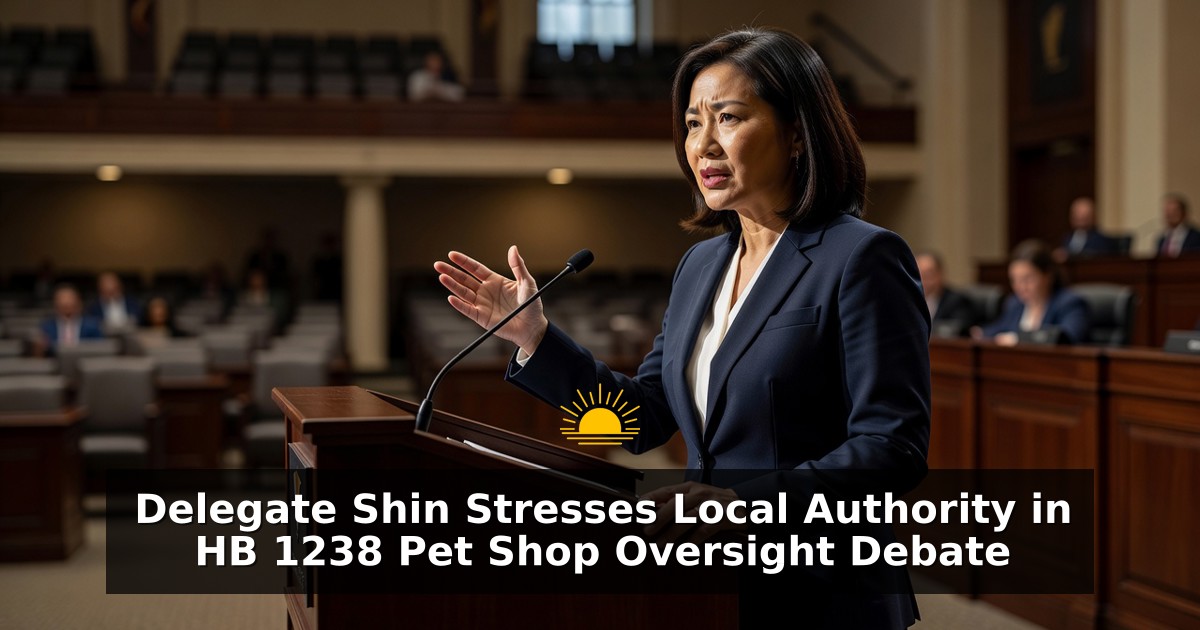
Delegate Irene Shin delivered closing remarks on House Bill 1238 during a recent session of the Virginia General Assembly, underscoring the measure’s core purpose of granting localities permission to regulate pet shops according to their own resources and community needs. The legislation centers on expanding local control over animal sales and shelter operations rather than imposing a uniform statewide mandate. Shin framed the bill as a practical response to uneven enforcement capacity across the commonwealth. She noted that many localities simply lack the staffing and funding required to monitor compliance effectively. Her comments focused strictly on the operational realities facing both state agencies and local governments.
Shin reminded colleagues that enforcement of existing pet shop and shelter rules currently rests largely with the Virginia Department of Agriculture and Consumer Services. That agency maintains only two staff members assigned to cover violations throughout the entire commonwealth. Those limited personnel are responsible for investigating a wide range of issues, from improper animal care to other regulatory breaches that may arise in commercial pet facilities. The thin staffing level leaves large geographic areas with infrequent inspections and delayed responses. Localities therefore face a choice between attempting to fill the gap themselves or declining to exercise additional authority they cannot support.
The bill would explicitly allow jurisdictions that determine they lack adequate resources to opt out of heightened local oversight. Under this approach, a locality could formally acknowledge its inability to provide consistent monitoring and enforcement and thereby refrain from adopting stricter local rules. Shin described this flexibility as essential to honest governance. She argued that forcing under-resourced communities to assume responsibilities they cannot fulfill would produce uneven standards and potential public disappointment. The measure instead respects the fiscal and personnel constraints that differ sharply from one county or city to another.
Virginia’s existing framework already places primary responsibility for animal-related commercial regulation at the state level precisely because many smaller localities cannot sustain dedicated animal-control or inspection teams. State officials travel across dozens of jurisdictions to examine facilities that sell companion animals or operate shelters. Reports of inadequate conditions, including cases involving deceased animals discovered in commercial settings, illustrate the volume and seriousness of the workload. With only two dedicated staff members, the department must prioritize complaints and schedule visits strategically rather than maintain continuous presence. This reality forms the backdrop for the local-option language contained in House Bill 1238.
Proponents of greater local authority point to the diversity of Virginia’s 95 counties and numerous independent cities. Urban centers may possess animal-welfare officers, legal counsel, and budget lines sufficient to conduct routine inspections and pursue violations. Rural localities often rely on part-time personnel or shared regional arrangements that stretch thin across large territories. The bill recognizes these disparities by making regulation permissive rather than compulsory. Local elected officials would weigh available funding, existing ordinances, and constituent priorities before deciding whether to enact additional pet-shop rules.
Animal-welfare advocates have long sought clearer lines of responsibility for commercial breeders and retail outlets. Concerns frequently center on the origin of animals offered for sale, the condition of holding facilities, and the transparency of health records provided to consumers. State statutes already set baseline standards, yet enforcement gaps can allow noncompliant operations to persist between infrequent inspections. House Bill 1238 does not rewrite those baseline standards; it simply clarifies that localities may layer additional requirements if they possess the means to enforce them. The legislation therefore functions as an enabling statute rather than a new regulatory code.
Shin’s remarks repeatedly returned to the theme of permission rather than prescription. She emphasized that the General Assembly would not be compelling any locality to create a new inspection regime or hire additional staff. Instead, the bill removes ambiguity about whether local governments may act when they choose to do so. Communities that already maintain robust animal-control programs could continue or expand those efforts with clearer statutory backing. Communities that cannot sustain such programs would retain the ability to leave enforcement with the state agency. This dual-path structure aims to match regulatory ambition with actual capacity.
Fiscal considerations remain central to the discussion. Hiring trained inspectors, maintaining vehicles, developing record-keeping systems, and supporting potential legal proceedings all carry recurring costs. Smaller budgets leave little room for new mandates without corresponding state aid, which the bill does not provide. By allowing an explicit opt-out based on resource assessments, the legislation avoids unfunded obligations. Local governing bodies would document their determinations, creating a transparent record of why certain regulations are or are not pursued. Such documentation can also inform future budget conversations at both the local and state levels.
The limited state staffing level cited by Shin has drawn attention in previous budget cycles. Requests for additional positions within the Virginia Department of Agriculture and Consumer Services compete with other agricultural, food-safety, and consumer-protection priorities. Even modest increases in personnel would still leave vast distances between inspectors and the facilities they oversee. Travel time alone reduces the number of site visits possible in a given week. Consequently, the department relies heavily on complaint-driven investigations rather than random or scheduled comprehensive audits. Local supplementation, where feasible, can shorten response times and increase deterrence.
House Bill 1238 arrives amid broader conversations about the proper balance between state uniformity and local experimentation. Virginia has a long tradition of Dillon’s Rule principles that limit local authority to powers expressly granted by the General Assembly. Enabling statutes such as this one carefully delineate new permissions while preserving overall state oversight. Drafting language that both empowers and constrains requires precision so that localities understand the exact scope of their new options. Shin’s final comments sought to reassure members that the bill stays within those traditional boundaries.
Observers note that pet-shop regulation intersects with consumer protection, public health, and animal cruelty statutes already on the books. Outbreaks of disease among animals in commercial settings can affect both purchasers and the broader companion-animal population. Clear chain-of-custody and health-certificate requirements help mitigate those risks. When enforcement is inconsistent, gaps appear. The two-person state team cannot be present in every jurisdiction simultaneously, making local eyes and ears valuable where they exist. The bill simply formalizes the ability of those local eyes to operate under clear legal authority.
Closing debate on the measure, Shin reiterated that the choice remains with each locality. Officials who conclude they can staff and fund meaningful oversight may proceed. Officials who conclude otherwise may decline without penalty or stigma. The state retains its baseline enforcement role regardless of local decisions. This structure seeks to avoid both overreach and neglect by aligning responsibility with realistic capacity. Further committee review and floor consideration will determine the bill’s ultimate path, yet the resource-based rationale articulated by its patron remains the central justification offered to date.
As the General Assembly continues its examination of House Bill 1238, the conversation returns repeatedly to practical governance. Effective regulation depends on more than statutory language; it requires personnel, training, transportation, and follow-through. Virginia’s current allocation of two statewide inspectors for pet-shop and shelter violations demonstrates the scale of the challenge. By offering localities a clear permission structure tied to their own assessments of readiness, the legislation attempts to close gaps without creating new unfunded burdens. Shin’s concluding remarks distilled that intent into a straightforward reminder of local choice and state limitation.
chair committee commonwealth communities dead bunnies Delegate Shin discussion enforcement localities miscare motion oversight permission pet shops resources shelters staff members state VDACs Violations