Garrett Presses DMV Subcommittee to End Driver Privilege Cards
Updated
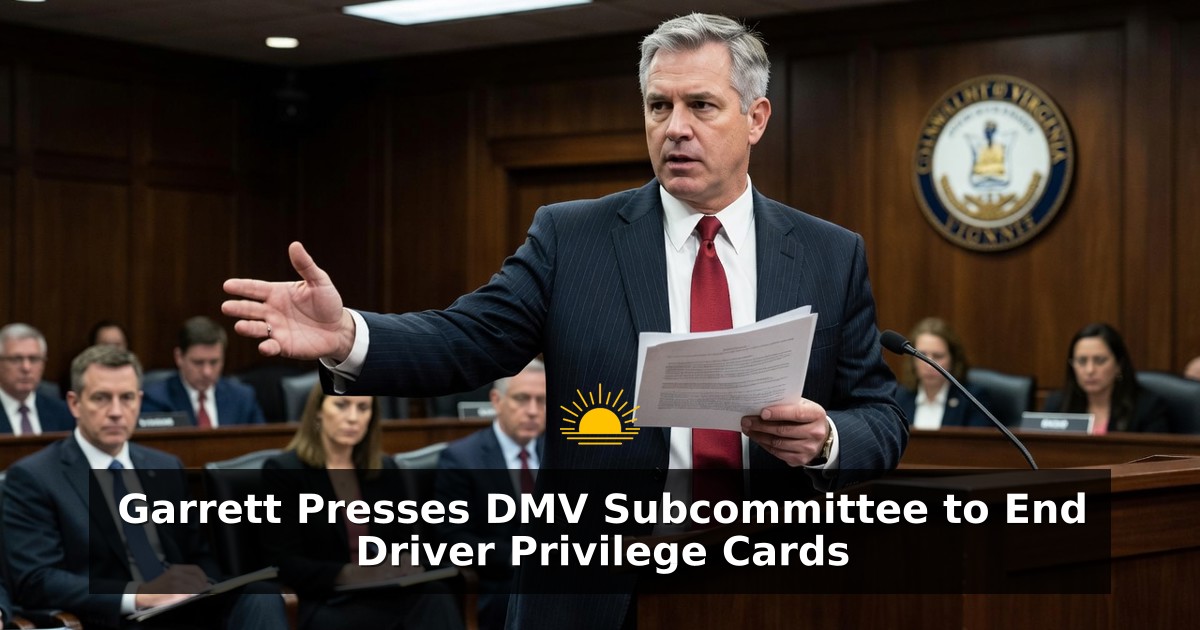
Delegate Tom Garrett appeared before the Virginia DMV Subcommittee to present House Bill 993, a measure that would suspend the state's issuance of driver privilege cards. Garrett explained that the legislation is being carried at the request of the previous governor rather than the current administration. He described the bill as a straightforward effort to reverse a practice he views as inconsistent with federal immigration standards. The subcommittee hearing focused on the practical and legal implications of continuing the card program.
Garrett told lawmakers that the existing system directs individuals present in the country without legal authorization to Department of Motor Vehicles offices. Obtaining a driver privilege card, he argued, moves those individuals one step closer to the voter registration process. He emphasized that no one in the hearing room would support allowing non-citizens to cast ballots in United States elections. The delegate framed the proposal as a necessary safeguard for the integrity of state election-related procedures.
Origins of House Bill 993
According to Garrett, House Bill 993 originated from a request by the prior governor, whom he identified in connection with full support for the measure. The bill seeks to end the issuance of driver privilege cards that Virginia has provided under earlier statutory authority. Garrett characterized the legislation as common-sense policy that aligns state practice with broader legal expectations. He urged the DMV Subcommittee to act favorably on the proposal during its deliberations.
The delegate stressed that the measure does not introduce new regulatory complexity but instead removes an existing pathway. By suspending the cards, the bill would eliminate what Garrett called an encouragement of unlawful presence under federal law. He noted that state actions should not undermine national immigration frameworks already in place. Committee members heard the presentation as part of routine consideration of motor vehicle related legislation.
Concerns Linked to Voter Registration Pathways
Garrett highlighted a core objection centered on proximity to voter rolls. He stated that sending individuals who are in the country illegally to DMV offices for privilege cards creates an incremental step toward registration eligibility. The delegate asserted that such a progression raises clear risks to electoral integrity. He reminded the subcommittee that citizenship remains a fundamental requirement for voting in the United States.
This argument formed a central pillar of the presentation. Garrett maintained that the current card system inadvertently blurs lines that state policy should keep distinct. He presented the halt on new issuances as a direct response to that concern. Lawmakers were asked to weigh the potential for unintended consequences against any administrative benefits the cards may have offered.
Rule of Law and Federal Immigration Standards
A second major theme in Garrett's remarks involved respect for federal authority. He contended that continuing to issue driver privilege cards thumbs its nose at the rule of law. Because federal statutes define lawful presence, state-level facilitation of documents for those lacking it sends a conflicting signal. Garrett asked why Virginia would choose to encourage behavior that stands at odds with national requirements.
The delegate described the bill as an affirmation of orderly legal processes. He linked the suspension of the cards to a broader principle that state statutes should reinforce rather than undercut federal immigration enforcement. In his view, maintaining the program weakens public confidence in consistent application of the law. The subcommittee received these points as part of the formal record on House Bill 993.
Background on Virginia Driver Privilege Cards
Virginia established its driver privilege card framework through earlier legislation that allowed certain residents unable to prove legal presence to obtain limited driving credentials. The cards were designed to permit lawful operation of motor vehicles and to promote compliance with insurance and safety rules on state roads. They differ from standard driver's licenses in marking and in eligibility for federal identification purposes. Issuance required documentation of identity and Virginia residency even when standard lawful-presence proofs were unavailable.
Supporters of the original program historically cited improved road safety statistics and higher rates of insured drivers as practical outcomes. Critics, including voices aligned with the current bill, have long maintained that the cards confer a form of official recognition that complicates immigration enforcement. House Bill 993 would reverse the issuance authority and thereby close the program to new applicants. Existing holders would face the policy change according to whatever transition rules the final legislation might contain.
The DMV Subcommittee regularly reviews motor vehicle statutes that affect millions of Virginia residents and visitors. Driver credential policies intersect with public safety, insurance markets, and record-keeping systems maintained by the agency. Any suspension of privilege cards would require operational adjustments at DMV customer service centers across the commonwealth. Fiscal and administrative impacts typically receive examination during subcommittee and full committee stages.
Legislative Context and Next Steps
Garrett closed his remarks by reiterating the common-sense nature of the proposal and the backing it carries from the previous governor. He expressed hope that the DMV Subcommittee would report the bill favorably and allow it to advance through the legislative process. The presentation remained concise and centered on the two primary rationales of voter-process integrity and fidelity to federal law. No competing testimony appeared in the immediate transcript of Garrett's statement.
House Bill 993 now sits before the subcommittee for further discussion, possible amendments, and a vote on its disposition. Virginia's General Assembly routinely handles dozens of DMV-related measures each session, ranging from credential design to fee structures and data privacy. The outcome on privilege cards will form one element of the broader transportation and public safety agenda. Observers of state policy will monitor whether the measure gains additional sponsors or faces procedural hurdles.
Broader Policy Implications for State Agencies
Suspension of driver privilege cards would return Virginia to a credential system limited to applicants who meet traditional lawful-presence standards. DMV systems would need updates to reflect the change in eligibility criteria and to communicate new rules to the public. Coordination with law enforcement and court systems that rely on driving records could also require attention. The agency has managed prior shifts in credential policy and possesses established channels for implementing statutory revisions.
Garrett's appearance underscores ongoing debate over how state motor vehicle laws interact with federal immigration status. Legislators must balance road-safety objectives, administrative feasibility, and consistency with national legal frameworks. House Bill 993 offers one clear policy choice: end new issuances of the privilege cards. The DMV Subcommittee's decision will determine whether that choice proceeds to the full House for further consideration.
The hearing record now contains Garrett's formal request for favorable action together with the stated rationales. Subsequent meetings may explore implementation timelines, effects on current card holders, and any necessary conforming amendments to the Code of Virginia. Stakeholders in transportation, public safety, and election administration retain an interest in the final contours of the legislation. Accurate information from the subcommittee process will guide public understanding of whatever policy ultimately emerges.
bill request committee vote Delegate Tom Garrett DMV Subcommittee driver licenses driver privilege cards federal law Governor Youngkin House Bill 993 illegal immigration immigration enforcement legislative hearing noncitizen voting rule of law subcommittee hearing Virginia DMV Virginia General Assembly Virginia law Virginia residents voter registration