Delegate Weber Examines Dual-Use Solar Measure in Agriculture Subcommittee
Updated
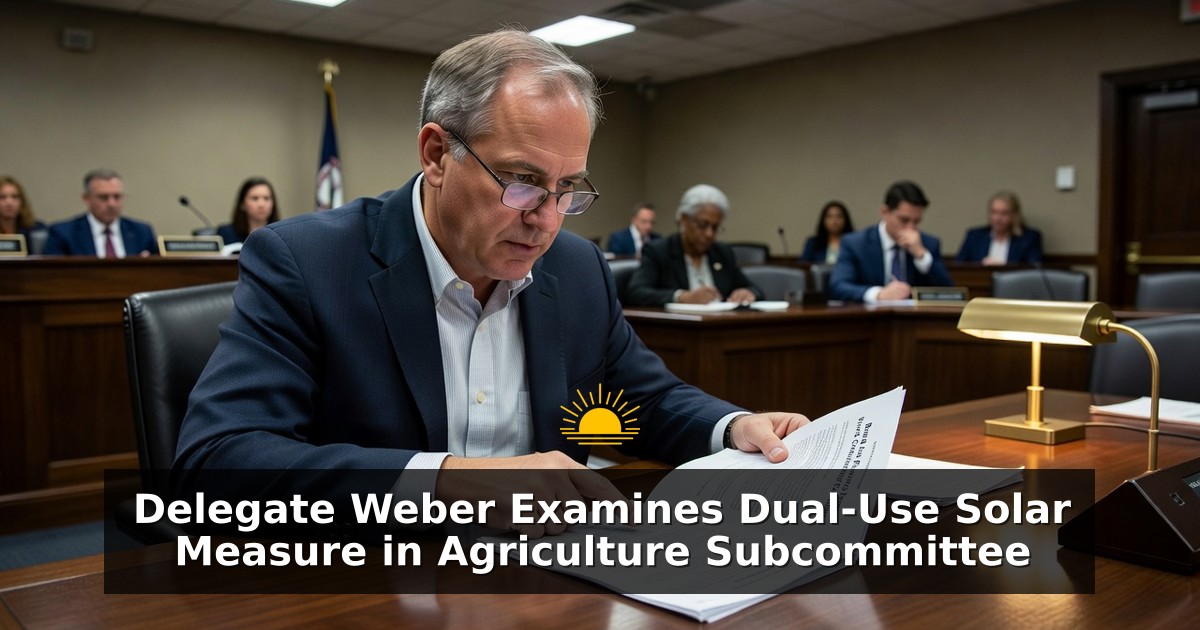
In an Agriculture Subcommittee hearing, Delegate Weber examined a brief legislative proposal that would allow electricity production from solar panels on farmland only when those panels operate alongside bona fide crop or livestock activities. The two-line measure focuses on concurrency between energy generation and traditional agricultural production. Weber sought clarification on several aspects of the language during the session. The exchange highlighted questions about the scope of permitted installations and the bill’s relationship to existing local land-use powers.
The proposal centers on requiring that solar activity occur together with ongoing farming operations involving crops or livestock. This concurrency condition is presented as a core element of the measure. Officials confirmed during the hearing that the bill contains no detailed specifications regarding the types of solar installations that would qualify. Weber directly asked whether the legislation addresses particular forms of solar equipment or configurations that may be placed on farms. The response indicated that the text does not include such specifications.
Questions on Permitted Solar Installations
Weber’s inquiry into the absence of technical details underscored the measure’s limited length and narrow focus. Without enumerated standards for panel height, density, mounting systems, or scale, the bill leaves those determinations outside its explicit text. The confirmation that no specifications appear in the language formed a central point of the subcommittee discussion. Observers of agricultural and energy policy note that dual-use arrangements, sometimes called agrivoltaic systems, can vary widely in design and intensity. The hearing exchange established that this particular bill does not attempt to define or restrict those design variables.
The discussion then turned to the interaction between the proposed language and subsequent provisions in the state code. Weber asked whether the bill’s decision not to address the next code section might affect local zoning ordinances that apply to industrial-scale solar projects. The referenced subsequent section, identified as 3.2-301, addresses the authority of localities to adopt setback requirements. According to the response provided in the hearing, the measure under review does not extend into that next code section.
Local Setbacks and Zoning Authority
The reply emphasized that the bill confines itself to the concurrency requirement linking solar production to livestock or crop operations. Because the text stops short of the setback provisions, it does not itself modify or restate local authority in that area. Weber’s question framed the issue as a potential concern over whether industrial solar developments could proceed with reduced reference to locality-imposed buffers or distance rules. The clarification offered in the subcommittee maintained that agricultural concurrency remains mandatory under the proposal. This structure keeps the focus on simultaneous farming activity rather than on altering the separate code language governing setbacks.
Virginia localities have long exercised zoning and land-use powers that include conditions for large energy facilities. Setback rules often serve to manage visual impacts, protect neighboring properties, and address infrastructure considerations in rural areas. The hearing exchange did not resolve broader policy debates but did surface the precise drafting choice to omit reference to the setback section. By requiring concurrent crop or livestock production, the measure seeks to preserve an active agricultural component on any site hosting solar panels for electricity generation. That requirement stands as the primary substantive limitation contained in the two-line text.
Context of Solar Development on Virginia Farmland
Solar energy capacity has expanded across Virginia in recent years as part of wider efforts to increase renewable generation. Many utility-scale projects have been proposed or constructed on land previously used for agriculture, prompting sustained discussion about farmland preservation. Dual-use models that keep crops growing or livestock grazing beneath or between solar arrays have attracted interest as one method of reducing permanent conversion of productive soil. The bill reviewed in the Agriculture Subcommittee aligns with that dual-use concept by conditioning electricity production on the presence of bona fide farming activity.
State code provisions under Title 3.2 address numerous dimensions of agricultural practice and related land management. Section 3.2-301, as noted in the hearing, specifically recognizes that localities may adopt setback standards. The decision of the current measure to remain silent on that section leaves the existing local authority language undisturbed within the four corners of the bill itself. Lawmakers and stakeholders continue to weigh how best to encourage renewable energy while safeguarding the economic and environmental functions of working farms. The subcommittee exchange illustrated one concrete instance of that balancing effort through pointed questions about legislative drafting.
Implications for Concurrent Agricultural Use
Under the terms described, any solar installation authorized by the bill would need to operate at the same time as crop cultivation or livestock husbandry. This concurrency standard aims to prevent scenarios in which farmland is effectively retired from production once panels are installed. Farmers exploring supplemental income from energy leases often evaluate whether dual-use designs can maintain yields or herd health alongside power generation. The absence of equipment specifications means that a wide range of solar technologies could theoretically pair with qualifying agricultural operations, provided the concurrency test is met. Weber’s questions brought that open-ended quality into clear view during the hearing.
Local governments retain tools to review site plans, impose conditions, and apply comprehensive-plan consistency tests for many land-use proposals. The hearing response indicated that the bill does not rewrite those tools by entering the setback code section. Instead, it adds a state-level condition centered on simultaneous farming. Whether that approach ultimately streamlines or complicates project reviews will depend on how the final language, if advanced, is interpreted alongside unchanged local ordinances. The subcommittee dialogue provided a public record of the precise concerns raised and the clarifications supplied.
Ongoing Policy Considerations
The brief nature of the measure invites careful scrutiny of what it includes and what it leaves unaddressed. By tying solar electricity production to active crop or livestock enterprises, the proposal advances a model of shared land use rather than exclusive energy development. At the same time, the choice not to incorporate or reference local setback authority formed the basis of Weber’s second line of questioning. Officials reiterated that concurrency with agriculture is required and that the bill does not venture into the subsequent code provision on setbacks. This exchange supplies a factual foundation for further legislative consideration.
Agricultural communities, energy developers, and county officials across Virginia monitor proposals that affect rural land use and economic options for farm families. Clarity regarding the respective roles of state statutes and local zoning remains a recurring theme in such debates. The Agriculture Subcommittee hearing captured one moment in that larger conversation through direct questions about specifications and code structure. The measure’s emphasis on concurrent production offers a defined agricultural safeguard while leaving setback rules to their existing statutory location. Additional review will determine how the language advances through the legislative process.
The discussion concluded with recognition that the bill maintains a requirement for livestock or crops to accompany any solar generation it authorizes. Weber’s examination of the text produced confirmation on both the lack of installation specifications and the limited reach relative to local setback authority. These points constitute the core factual record of the subcommittee exchange. Policymakers will continue to assess how dual-use solar frameworks interact with the commonwealth’s tradition of local land-use control. The hearing thereby contributed concrete detail to the public understanding of the proposal’s scope and drafting choices.
Agriculture Agriculture Subcommittee bill review code section concurrent use Crops Delegate Weber electricity production farm production industrial solar land use livestock local control local setbacks renewable energy solar farms Solar Panels subcommittee hearing Virginia farms zoning ordinances