Delegate Questions Nitrous Oxide as Third-Ranked Misused Substance
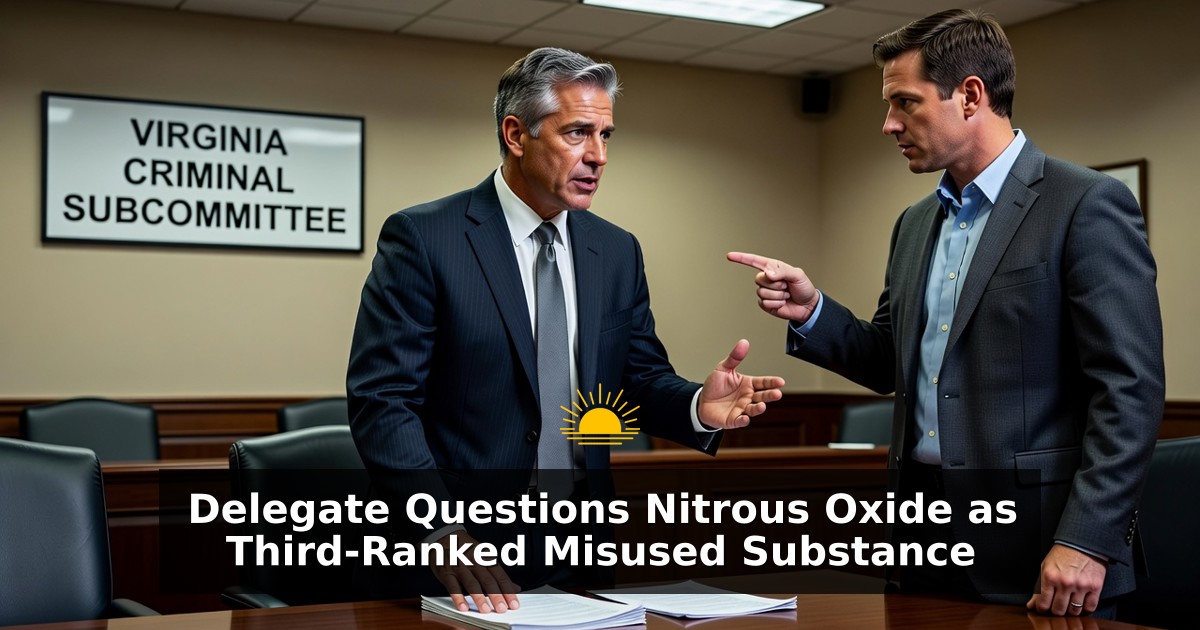
A Virginia Criminal Subcommittee hearing featured a direct exchange between Delegate Williams and the patron of legislation addressing nitrous oxide when the ranking of the substance among misused drugs came under scrutiny. Williams sought immediate clarification after hearing that nitrous oxide stood third in prevalence of misuse. The patron affirmed the order as marijuana first, cocaine second, and nitrous oxide third. The moment underscored growing legislative interest in a substance long familiar in medical and culinary settings yet increasingly linked to recreational abuse across the Commonwealth.
The clarification request captured attention because the ranking placed an industrial and medical gas ahead of many better-known street drugs in reported misuse. Williams asked the patron to repeat the sequence of one, two, and three so the record would be unmistakable. The response confirmed marijuana, followed by cocaine, then nitrous oxide. Observers at the subcommittee session noted that the exchange illustrated how quickly perceptions of substance threats can shift when fresh data enter the policy conversation.
Nitrous oxide, commonly called laughing gas, has legitimate uses in dentistry, surgery, and food service as a propellant for whipped cream. When inhaled outside controlled settings, however, it produces a brief euphoric high that has driven a rise in recreational use, particularly among younger adults. Empty canisters known as whippets are frequently recovered from parks, college campuses, and roadside areas in multiple Virginia localities. Public health officials have tracked emergency-room visits tied to the gas for several years, citing both acute oxygen deprivation and longer-term neurological harm.
Ranking Data and Legislative Context
Substance-misuse rankings presented during General Assembly subcommittee work typically draw from state health department surveys, hospital discharge data, and law-enforcement seizure reports. In the hearing, the bill patron relied on such compiled figures to argue that nitrous oxide now outpaces several controlled substances once viewed as higher priorities. Marijuana remains the most widely misused substance in Virginia according to the same data sets, with cocaine retaining a persistent second-place position in many urban and suburban jurisdictions. The elevation of nitrous oxide into third place therefore signals a measurable change in consumption patterns that lawmakers are only beginning to address through targeted bills.
Delegate Williams’s insistence on hearing the full ranking repeated served a procedural as well as substantive purpose. Subcommittee members often request restatement of key factual claims so that the legislative record clearly reflects the evidence base for any proposed restriction or regulatory change. By securing the patron’s confirmation on the record, Williams ensured that subsequent debate would rest on an unambiguous assertion about relative prevalence. The exchange remained focused on the data rather than on personal disagreement, consistent with the fact-finding role of criminal-law subcommittees.
Health consequences associated with repeated nitrous oxide inhalation include depletion of vitamin B12, which can produce irreversible nerve damage, muscle weakness, and cognitive impairment. Medical literature reviewed by Virginia health agencies also documents cases of asphyxiation when users inhale the gas in enclosed spaces or from masks that exclude oxygen. Fatalities, while less common than with opioids, have occurred in the state and are frequently classified as accidental. These clinical realities supply the public-health rationale that bill patrons cite when seeking new controls on retail sales or possession of high-volume canisters.
Retail Availability and Enforcement Challenges
Nitrous oxide remains widely available through convenience stores, smoke shops, and online retailers that market chargers for whipped-cream dispensers. Virginia law already restricts sales to minors in some contexts, yet enforcement gaps persist because the product is dual-use and packaging rarely carries prominent warnings about inhalant risks. Local governments in Northern Virginia, Hampton Roads, and the Richmond region have reported spikes in discarded canisters near schools and recreation centers, prompting ordinances that limit quantities sold to any single customer. State-level legislation under discussion in the Criminal Subcommittee would aim to create uniform standards rather than a patchwork of local rules.
Law-enforcement agencies face practical difficulties when responding to nitrous oxide incidents. Unlike marijuana or cocaine, the gas leaves the body rapidly and is not detected by standard roadside toxicology screens. Officers therefore rely on physical evidence such as canisters, balloons, or observed behavior to establish impairment or illegal distribution. Training bulletins issued by the Virginia Department of Criminal Justice Services now include modules on recognizing nitrous oxide intoxication, reflecting the substance’s climb in misuse rankings. The subcommittee exchange highlighted how such operational realities intersect with the statistical claims advanced by bill patrons.
Comparative data from neighboring states show similar upward trends in nitrous oxide calls to poison-control centers. Maryland and North Carolina have each considered tighter labeling requirements and age-verification mandates in recent sessions. Virginia’s approach, as framed in the hearing, appears focused on aligning criminal penalties and retail restrictions with the documented third-place ranking. Supporters argue that early legislative attention can prevent the substance from further displacing other drugs in youth experimentation patterns. Critics of expanded regulation typically emphasize the need to preserve legitimate commercial access for restaurants and medical providers.
Public Health Monitoring and Next Steps
Virginia’s Department of Health maintains ongoing surveillance of inhalant-related emergency visits through its syndromic surveillance system. Recent quarterly summaries have noted year-over-year increases in cases coded for nitrous oxide exposure, particularly in the 18-to-25 age cohort. These figures supply independent corroboration for the ranking cited by the bill patron and help explain why Criminal Subcommittee members treated the claim as worthy of precise restatement. Continued monitoring will allow legislators to evaluate whether any new statute produces measurable declines in misuse.
Educational campaigns form another component of the Commonwealth’s response. School-based prevention programs have begun incorporating information about the specific dangers of nitrous oxide alongside traditional lessons on marijuana and cocaine. Community coalitions in several cities distribute posters and social-media content warning that the gas is neither harmless nor legal to inhale for recreation. The subcommittee discussion reinforced the message that public awareness must keep pace with shifting substance rankings if prevention efforts are to remain effective.
As the bill moves through additional hearings, members are expected to examine fiscal impacts on retailers, potential sentencing guidelines, and coordination with existing controlled-substance schedules. The clear affirmation that nitrous oxide ranks third behind marijuana and cocaine provides a factual anchor for those deliberations. Delegate Williams’s pointed questions ensured that the ranking entered the legislative record without ambiguity, setting the stage for evidence-based debate on how Virginia should address a substance whose misuse has quietly become widespread.
Further testimony from toxicologists, retailers, and treatment providers is anticipated before any final recommendation leaves the subcommittee. The exchange already demonstrates that lawmakers are prepared to confront surprising prevalence data rather than rely on outdated assumptions about which substances dominate the misuse landscape. In doing so, the Criminal Subcommittee continues its role of matching criminal-law tools to contemporary public-health challenges across Virginia.
changing Cocaine delegate delegate Davis delegate Schmidt delegate Williams list Marijuana nitrous nitrous oxide oxide recognize thank you