Dental Hygiene Group Cites Pilot Studies in Testimony Against Scope Expansion Measure
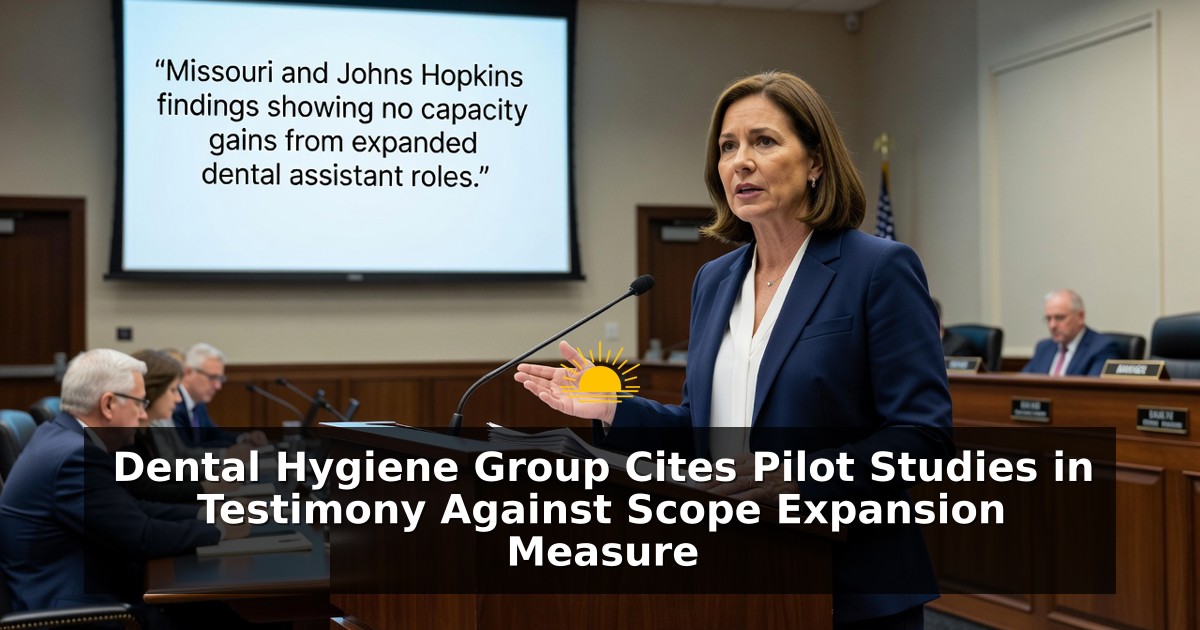
A representative speaking for the Virginia Dental Hygiene Association presented research findings during a meeting of the Health Professions Subcommittee to oppose legislation that would expand certain clinical duties within dental practices. Barrett Hartman delivered the remarks on behalf of the association and focused on data from earlier pilot efforts in other jurisdictions. He argued that those initiatives failed to deliver meaningful improvements in overall clinic capacity or better access for patients facing serious periodontal conditions. The testimony formed part of a broader discussion on workforce models intended to address oral health access challenges across the Commonwealth. Lawmakers heard the presentation as they weighed potential changes to how advanced procedures might be assigned in dental settings.
Hartman began by addressing a Missouri pilot project that had been referenced earlier in the proceedings. He read directly from a report issued by the Missouri Dental Association evaluating that effort. According to the document, the pilot project study did not demonstrate a significant increase in clinic capacity. It likewise showed no improved access for more serious periodontal patients who often require complex and time-intensive care. These results, Hartman indicated, undercut the central rationale offered for similar policy changes in Virginia. The association maintains that any reform must be measured against clear evidence of expanded patient throughput and better outcomes for those with advanced disease.
Missouri Pilot Project Results Under Scrutiny
The Missouri experience has drawn attention from dental professionals nationwide because it tested expanded roles in real clinical environments. Evaluators tracked whether allowing additional personnel to perform certain advanced tasks would free dentists for higher-level work and thereby raise the number of patients served. The final assessment concluded that clinic capacity remained essentially unchanged. Patients with more severe periodontal needs did not gain easier entry into treatment slots either. Hartman stressed that the very problems the Virginia proposal seeks to solve—limited access and constrained capacity—persisted under the Missouri model. He presented the report language as a cautionary data point rather than an abstract opinion.
Periodontal disease remains a leading cause of tooth loss and is linked to systemic health concerns including cardiovascular conditions and diabetes management difficulties. Patients in this category typically need thorough scaling, root planing, and ongoing maintenance that demand both skill and chair time. When pilot programs fail to open additional appointments for these individuals, the public-health justification for scope changes weakens. The Missouri Dental Association’s own summary made that shortfall explicit. Virginia lawmakers therefore received a direct quotation from the source document rather than a secondary interpretation. The association used the finding to question whether parallel language in the pending measure would produce different results inside the Commonwealth.
Johns Hopkins Evaluation of Practice Capacity
Hartman next turned to a separate investigation conducted by researchers affiliated with Johns Hopkins in partnership with the Indian Health Service. That study examined the effects of assigning advanced procedures to dental assistants in a comparable delivery system. Investigators observed that individual patients often received a greater number of services during their visits. At the same time, overall practice capacity declined once dental assistants assumed those advanced responsibilities. The reduction in total patients seen per day or per week offset any per-patient service gains. Hartman presented this outcome as evidence that task-shifting can produce unintended operational consequences even when it appears beneficial at the single-patient level.
Capacity in a dental practice is commonly measured by the volume of distinct patient encounters that can be completed within available operatories and staffing hours. When auxiliary providers take on complex procedures, the time required per encounter frequently rises. Scheduling density may fall, and the dentist’s ability to oversee multiple chairs can be constrained by the need for closer supervision. The Johns Hopkins findings documented precisely that pattern within Indian Health Service clinics. Although each treated patient might leave with more completed services, fewer patients overall progressed through the system. The Virginia Dental Hygiene Association highlighted this trade-off as a core reason for opposing the current bill.
Broader Context of Dental Workforce Debates
Oral health access disparities continue to affect rural and underserved communities throughout Virginia. Shortages of dentists, aging practitioner demographics, and uneven distribution of specialists contribute to longer wait times and higher rates of untreated disease. Policymakers periodically examine mid-level provider models and expanded-function auxiliaries as possible remedies. Proponents generally contend that carefully trained assistants or hygienists can safely perform additional procedures under prescribed conditions, thereby stretching existing resources. Opponents counter that empirical tests have not consistently validated capacity or access claims and may introduce quality or supervision risks. The subcommittee hearing provided a formal venue for both perspectives to be entered into the legislative record.
Professional associations representing hygienists, assistants, and dentists frequently submit data-driven testimony when scope-of-practice bills advance. The Virginia Dental Hygiene Association’s decision to foreground the Missouri and Johns Hopkins studies reflects a preference for outcome metrics over theoretical workforce projections. By quoting the Missouri Dental Association report verbatim and summarizing the Johns Hopkins capacity results, Hartman sought to ground the debate in published evaluations rather than anecdotal experience. The association’s position is that any statutory change must demonstrably enlarge the number of patients who can be treated, particularly those with advanced periodontal needs, before it receives support.
Legislative Consideration and Next Steps
Members of the Health Professions Subcommittee customarily review bills that affect licensing, supervision ratios, and allowable duties for health-care personnel. Testimony from stakeholder organizations forms a significant portion of the information base used to assess such measures. Hartman’s appearance added specific pilot-project and academic study references to that record. He closed by noting that additional witnesses were prepared to speak, underscoring coordinated interest among oral-health groups. The subcommittee will continue its deliberations according to the General Assembly calendar, weighing the cited research alongside other submitted evidence and fiscal impact statements.
Dental practice acts across the United States already vary widely in the procedures permitted to hygienists and assistants. Some states have authorized expanded functions after multi-year pilots; others have declined to do so after reviewing similar capacity data. Virginia’s current examination of the issue therefore fits within a longer national pattern of incremental, evidence-focused adjustment. The studies referenced in the hearing supply concrete benchmarks against which any new Virginia framework could later be judged. Whether the legislation advances, is amended, or is set aside will depend on how legislators balance access goals with the operational findings now on the record.
Public-health observers note that periodontal treatment capacity is only one dimension of oral-health equity. Preventive services, pediatric care, and emergency extraction availability also shape community outcomes. Still, the association’s testimony concentrated on the precise claims most often advanced for the pending bill—namely, that expanded assistant roles would raise clinic throughput and improve entry for complex cases. The Missouri report and the Johns Hopkins evaluation, as presented, indicate those claims did not materialize in the tested settings. That factual presentation remains the central contribution of the Virginia Dental Hygiene Association to the subcommittee’s consideration of the measure.
advanced procedures association Barrett capacity clinic capacity dental assistance health services Johns Hopkins study Madam Chair Missouri Dental Association Missouri Pilot Project patients periodontal patients practice capacity project services study Virginia Dental Hygiene Association